
Africa
At Addis Ababa’s gleaming terminal, two lines tell Africa’s story: one for Africans flying out (to Paris, Dubai, New York), another for foreigners flying in (mining deals, aid work, contracts). Rarely do you see Africans queueing to visit other African capitals as traders or tourists.
This isn’t about passports, it’s about economic absurdity. A Senegalese entrepreneur faces more hurdles selling to Nigeria than to France. Africa’s brightest measure success by how far they escape the continent. "Made in Africa" remains a novelty, not a norm.
Africa has the resources, demand, and demographic heft to thrive. What’s missing? The collective muscle memory to harness them.
The Cost of Fragmentation: Paying the Price of Smallness
The Addis airport lines aren’t just symbolic, they’re a receipt. A receipt for the fragmentation tax all Africans pay. Consider these contradictions:
- Trade → Ethiopia imports steel from China cheaper than from South Africa (Afreximbank 2023).
- Healthcare → Africa spends $2B/year training doctors who then staff European hospitals, while 1 in 3 clinics on the continent has no physician (WHO).
- Travel → Only 4 African nations offer visa-free entry to all Africans. For comparison, Americans visit 13–30 African countries visa-free.
- Infrastructure → Zambia’s copper exports still route through Dar es Salaam, not Namibia’s closer ports.
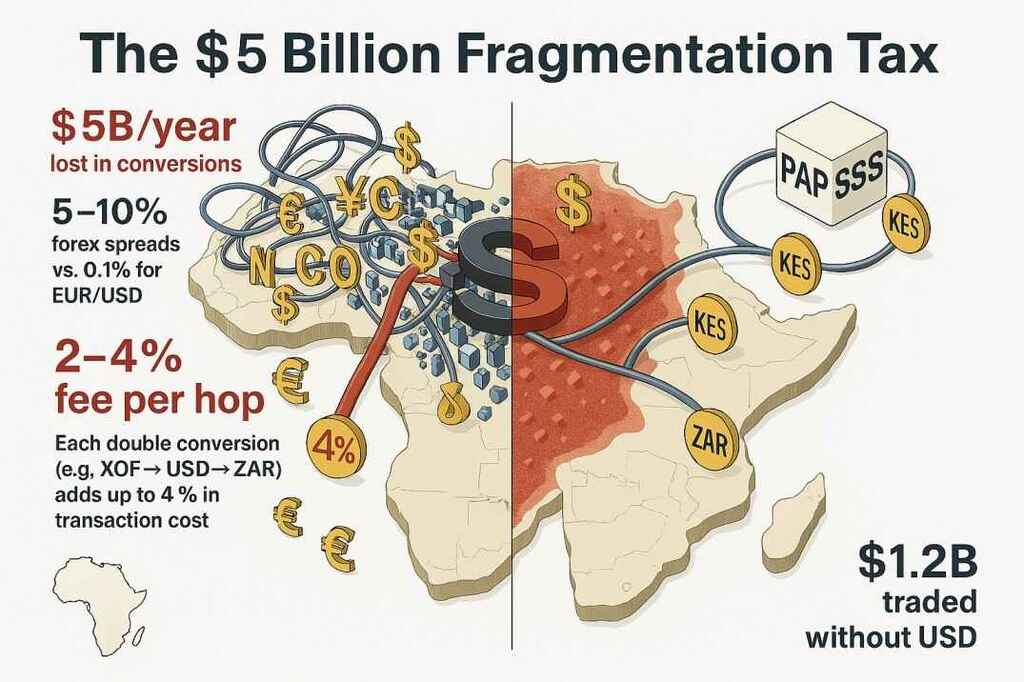
- Digital → Internet traffic between Lagos and Accra (450km) detours 7,000km through Europe (Afrinic). Forex → $5 billion/year is lost by 42 African nations in currency conversions (Afdb).
How Currency Fragmentation Strangles Forex Markets
Africa’s 40+ currencies, many illiquid, non-convertible, or artificially pegged, create a forex market nightmare:
1. Liquidity Deserts & Painful Spreads
Most African currencies trade in thin markets, with bid-ask spreads 5-10x wider than EUR/USD.
Most African currencies trade in thin markets, with bid-ask spreads 5-10x wider than EUR/USD.
Case Study: A Ghanaian importer buying Kenyan goods loses 7% upfront on shilling-cedi conversions (Ecobank).
2. Dollar Dependency = Free Money for Intermediaries
Intra-African trade often requires double conversions (e.g., XOF → USD → ZAR), adding 2-4% fees per transaction.
Parallel Markets: In Nigeria, the naira’s black-market rate trades 40% below official rates (IMF 2023).
3. Central Banks on Life Support
Low Reserves: 60% of African central banks hold <3 months of import cover, leaving currencies vulnerable to speculative attacks.
Case Study: Ghana’s cedi collapsed 50% in 2022 after reserves dried up.
4. No Hedging equals to Investor Flight
Only South Africa, Egypt, Kenya have liquid currency futures. Others face 8-12% hedging costs (vs. 1-3% in developed markets).
Result: Foreign investors demand higher returns to compensate for unhedgeable risk.
Colonial Logistics, Modern Consequences
Africa inherited borders that make zero logistical sense. The damage?
- Ports: 73-78% of port capacity is foreign-controlled (China owns 19-23%).
- Trucking: A Mombasa-Kampala haul spends 18 hours at borders, longer than the actual drive (TMEA).
- Airlines: African carriers fill 62% of seats on continental routes vs. 82% on Europe-Africa flights (IATA).
- Informal Trade: 38-42% of intra-African commerce happens off the books (UNCTAD).
The ultimate irony? When COVID hit, Africa created a mutual health passport system in 9 weeks.
Proof: Integration is possible when lives depend on it.
Where the Rubber Meets the Road: Solutions in Action
While AU summits gather dust, three movements are bypassing bureaucracy:
1. AfCFTA’s Quiet Revolution
The African Continental Free Trade Area is already cutting costs:
- Nigerian firms slashed parts imports from Kenya by 22%.
- Border clearance times fell from 5 days to 9 hours in pilot corridors (AfCFTA Q2 2024).
2. Fintech’s Forex Rebellion
- PAPSS: Cleared $1.2B in trade without touching the dollar.
- Chipper Cash: Handles 500,000 cross-border SMB transactions/month.
- Wave: Cuts XOF-zone remittance costs by 75%.
3. Infrastructure Mutiny
- Lori Systems: Uses AI to cut border delays in 11 countries.
- Africa Data Centres: Locally routes 38% of intra-African internet traffic.
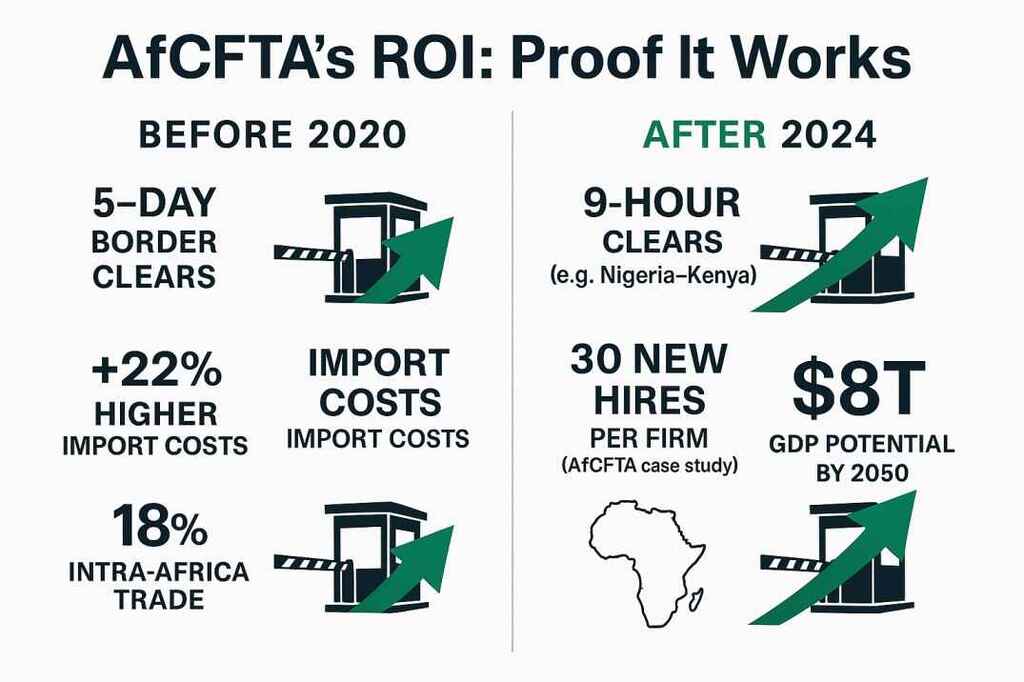
The $8 Trillion Stakes (By 2050)
Africa’s GDP could hit $16 trillion, but only if intra-African trade rises from 18% to 50%. The gap? $8 trillion in lost prosperity.
Who Must Act?
Governments:
- Ratify AfCFTA Phase II (47/54 nations are stalled).
- Roll out the African Passport by 2025.
- Deploy armed trade corridor escorts (not just peacekeepers).
Businesses:
- Dangote Cement added $1.3B revenue by prioritizing regional expansion.
- MTN’s $1B fiber network cut West African data costs by 60%.
Citizens:
- Demand visa openness (Rwanda’s policy created 150,000 jobs).
- FixTheCountry movements (like Ghana’s) forced port reforms.
Bottom Line: The Clock is Ticking
Kwame Nkrumah warned in 1963: "Unite or perish." Today, it’s unite or stagnate. The tools exist. The models work. The only question: Will leaders lead, or will they be outpaced by the entrepreneurs and engineers already building the future?
Final Answer: Africa’s economic fragmentation isn’t fate, it’s a series of solvable problems. The first step is admitting the receipt it has been handed is too damn high.