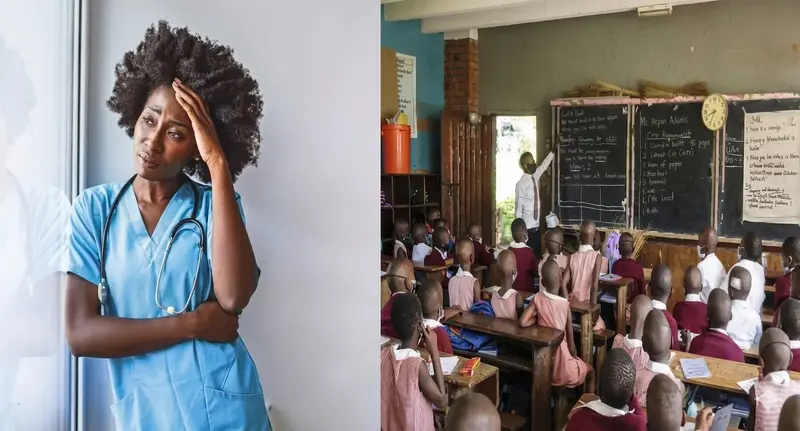
Nurses and teachers in Africa facing daily struggles - healthcare shortages and overcrowded classrooms highlight the pay gap and systemic underfunding. Image Credits: Kencrave
31 min read
Business
The Global Pay Gap: Why Nurses And Teachers In Africa Earn Less Than 20% Of Their Global Peers
African nurses and teachers earn less than 20% of what their peers in Europe and North America take home. A nurse in Kenya makes about $7,000 a year compared to $100,000 in Switzerland, a 14‑times difference. Kenyan teachers earn around $5,000 annually, while teachers in Luxembourg earn $126,000, a 10‑times gap.
These pay differences are the result of long‑standing undervaluing of care and teaching jobs, tight government budgets that favor debt payments over social services, weak unions, and the migration of skilled workers to richer countries.
Kenya’s nurse‑to‑population ratio is 22.7 per 10,000, below the World Health Organization’s recommended levels. Yet many trained nurses remain unemployed because of limited government funding.
Closing this gap calls for urgent reforms, stronger unions, and global action that recognizes the true economic importance of healthcare and education.
Comparison of salaries showing African professionals earn under 20% of global peers
TheUnseen Systems Behind a Country's Development
Nurses and teachers are the backbone of human development, yet they remain systematically underpaid, especially in Africa. Think about the nurse who works a double shift, managing a ward with limited supplies, or the teacher who spends their own money on classroom materials.
This isn't just a feel-good issue about fairness; it's an economic emergency with far-reaching consequences. When a country underpays its educators and healthcare workers, it's not just affecting their bank accounts.
It's impacting literacy rates, health outcomes, and the long-term productivity of an entire generation. This analysis breaks down the global salary comparisons in teaching and nursing professions, explore the reasons behind this massive disparity, and outline what must be done to create a more equitable system.
I. Global Salary Comparisons Across Continents
The State of Global Nurse Pay
Nursing is a demanding profession everywhere, but the financial reward varies wildly. Across Africa, nurses are among the lowest-paid health workers in the world. According to a 2025 WHO report, the African and South-East Asian regions have the lowest starting wages for nurses globally. In the WHO African Region, there are just 14 nurses for every 10,000 people, compared to 77 per 10,000 in Europe.
The salary figures across the continent, paint a stark picture. In Ethiopia, monthly nurse pay can be as low as $57. In Nigeria, entry-level nurses earn around $50 to $94 per month, while registered nurses make roughly $80 to $250 monthly.
Cameroon offers between $250 and $400 per month, while Ghana ranges from $300 to $500. In Zimbabwe, nurses earn around $250 per month. Even in South Africa, the continent's most industrialized nation, nurses earn approximately $1,000 to $2,500 per month.
In Kenya, for instance, nurses earn between KES 60,000 and 80,000 monthly, which translates to roughly $7,000 to $9,000 annually. Now, compare that to the global elite. In Switzerland, nurses can earn anywhere from $90,000 to $123,000 annually. The United States and Australia are similarly high, with salaries ranging from $83,000 to over $95,000.
Even within Europe, the gap is massive. A German nurse might earn $41,000 to $65,000, which is still several times more than their Kenyan counterpart. Asia shows a mixed picture: Japan offers $33,000 to $48,000, while Singapore is significantly more generous at $45,600 to $62,400. In South America, Chile leads with roughly $25,575, while Brazil's average hovers around $9,200. The insight here is stark: African nurses often earn less than 15% of what a European nurse makes, despite frequently handling heavier patient loads and operating with weaker medical infrastructure.
Global nurse salary comparison: Africa's $7,000 average sits 86% below the $47,000 global benchmark. Australia leads at $85,000, followed by North America ($83,000) and Europe ($65,000).
The Breakdown: Teacher Salaries Around the World
Teachers face a remarkably similar predicament. Across Africa, teacher pay varies widely by country, but many educators earn far less than their peers in other regions. According to the African Union, teacher salaries across the continent are often low and below the cost of living, with unqualified teachers earning between 40% and 60% of what qualified teachers make. In some countries, teaching has become a "profession of last resort" as low pay drives the best candidates away from the field.
A 2025 investigation into academic salaries across Africa found that Nigerian professors are among the continent's lowest-paid, earning an average of $366 per month (about $4,400 annually). By contrast, a South African professor takes home $4,789 monthly ($57,471 per year), more than 13 times higher.
Kenya pays professors around $4,000 monthly ($48,000 annually), while Uganda offers about $4,216 per month ($50,595 per year). Even countries with smaller economies, such as Eswatini ($41,389 annually) and Lesotho ($32,455), pay their university lecturers significantly better than Nigeria.
For primary and secondary school teachers, the picture is similarly stark. A study of teacher-pay across 15 African countries found that in seven nations, teachers' monthly earnings are lower than other formal sector workers with comparable education and experience.
However, the research noted that teachers in those countries report working fewer hours. When adjusted for hourly wages, only one country, Nigeria, shows teachers earning significantly less than other workers. The study also found that teachers are nearly twice as likely to hold a second job compared to other workers, and they are more likely to receive non-pecuniary benefits such as medical insurance or pensions.
In Kenya, for instance, a teacher's annual salary ranges from $3,000 to $8,000, while Nigerian teachers average between $5,000 and $14,000 annually. The story changes dramatically when we look to Europe. Luxembourg tops the OECD charts with starting salaries at $71,647, which can rise to $126,576. Germany is also a high performer, with teachers earning between $70,419 and $91,713.
a. North America: The U.S. offers a starting salary of $48,112, with an average of $74,495.
b. Asia: South Korea pays between $33,615 and $94,489, and Japan averages between $28,611 and $58,562.
c. Oceania: Australian teachers can earn between $47,991 and $75,486 annually.
d. South America: Chile pays up to $47,335, while Brazil averages around $20,261.
The implication is unavoidable: African teachers often earn less than 10% of Luxembourg's starting salaries. They are tasked with teaching overcrowded classrooms with outdated textbooks and limited resources, a burden that doesn't reflect in their pay.
The African Union notes that low salaries and poor conditions have contributed to a high level of brain drain and a general decline in the status of the teaching profession across the continent.
Data‑driven chart showing African teachers earn far below the global $52,000 average
II. Unpacking the Root Causes of the Pay Gap
The vast pay gap between African nurses and teachers and their global peers is not accidental. It is the result of deep-rooted historical, social, and economic forces that have systematically devalued these professions. Understanding these root causes is essential for designing effective solutions.
a) The Gender Value Gap
Historically, nursing and teaching have been seen as female professions. Societal norms have often undervalued "women's work," leading to the perception that these roles are less deserving of high compensation. Research confirms that careers dominated by women tend to pay less, not because women choose lower-paying careers, but because the careers women choose are systematically paid less. This gender bias is deeply embedded in labor markets and continues to shape wage-setting practices today.
b) Colonial Impacts and Post-Independence Underinvestment
The roots of Africa's underfunded health and education systems stretch back to the colonial era. Colonial administrations in Africa invested in education and health services primarily to serve their own economic interests.
Spending on social services for the local population was largely driven by the need to expand the trade-based colonial economy and create a workforce capable of supporting commercial activities. Education was designed for administrative purposes rather than broad-based empowerment, a legacy that continues to shape educational outcomes today.
After independence, many African governments made ambitious commitments to expand access to education and healthcare. Ghana, for example, enacted the first free compulsory universal primary education policy in sub-Saharan Africa and provided free healthcare to all citizens.
However, these programs were costly and often unsustainable. By the 1980s, economic decline, mismanagement, and pressure from the World Bank and International Monetary Fund forced many countries to adopt structural adjustment programs that cut social spending.
These reforms introduced cost-sharing measures, user fees, and reduced government investment in health and education. The result was a deepening of existing inequalities, declining enrollment rates, and a deterioration in the quality of public services. This legacy of underinvestment continues to constrain budgets, leaving governments with limited resources to pay competitive wages to nurses and teachers.
c) Crippling Budget Constraints
Many African governments face difficult choices today. Debt servicing and large-scale infrastructure projects often take priority over health and education. This diverts public funds away from the very systems that build human capital, resulting in low wages and understaffed public institutions. As of 2026, more than 25 African countries are currently in debt distress or at high risk, forcing governments to spend more on repaying loans than on critical investments in health and education.
d) Policy Gaps and Weak Unions
Trade unions in some regions lack the bargaining power to effectively negotiate wage increases. Without strong collective action, governments and private healthcare providers have little incentive to raise pay. This leaves nurses and teachers vulnerable to stagnant wages and poor working conditions.
e) The "Brain Drain" Paradox
The low pay in Africa creates a powerful push factor. Skilled nurses and teachers, frustrated by poor compensation and lack of advancement, often migrate to wealthier countries for better salaries and working conditions. The WHO notes that nearly 46% of health workers in Africa intend to migrate abroad. The Migration Policy Institute reports that approximately 70% of Ugandan nurses aspire to work overseas.
This migration, known as "brain drain," deprives Africa of its best talent and worsens severe staffing shortages. Nigeria lost more than 5,600 doctors to the UK in less than a decade, while Ghana saw more than 6,000 leave in just two years. Kenya has more than 4,000 nurses abroad, while its nurse-to-patient ratio remains only a third of the WHO minimum. The African Union Development Agency estimates that Africa loses nearly $2 billion annually to brain drain.
How underfunding in health and education fuels low pay, migration, shortages, and economic decline.
The Investment Gap
A comparison of education and health spending across global and African nations showing 2026–2027 investment gap projections.
Key Insights from the Investment Gap
The data reveals several critical insights that explain the pay gap for nurses and teachers in Africa:
1. The Education Spending Gap
Public education expenditure patterns reveal severe regional variations heading into the 2026/2027 projection cycle. While high-income global nations comfortably invest significant resources—led by countries like Norway at 6.1% and the United States at 5.4% of GDP. The average expenditure across Sub-Saharan Africa remains depressed, ranging between just 2.9% and 3.7% of GDP.
This leaves the region lagging far behind the 5.0% OECD average. Regionally, the structural imbalance remains stark: even though Sub-Saharan Africa hosts a massive and growing share of the world's school-age population, its absolute share of global education resources has failed to close the historical gap with Western nations, demonstrating a persistent stagnation in global educational equity.
2. The Massive Health Spending Gap
The global divide in health spending is even wider and more critical. According to 2027 projections, average total health expenditure per capita in Sub-Saharan Africa remains dangerously low at just $98, compared to staggering investments in Western nations such as France ($7,400), Norway ($8,900), and the United States ($14,500).
This represents a huge spending gap where top global nations spend over a hundred times more per individual than the African regional average. Most strikingly, while Sub-Saharan Africa bears a crushing 24% of the global disease burden (measured in DALYs), it accounts for a mere 1.2% of global health expenditure, highlighting a profound and deadly asymmetry in global health finance.
3. Public Investment in Human Capital
At the global level, public human capital expenditure continues to show stark regional polarization in the 2026/2027 period. Public human capital investment for education struggles at a range of 2.9% to 3.7% of GDP across Sub-Saharan Africa. This heavily contrasts with advanced economies where education spending routinely matches or exceeds the 5.0% OECD benchmark. When combined with health spending, the total domestic resource allocation in wealthy nations remains multi-fold higher.
This divide confirms that matching the high per-capita human capital resources currently enjoyed in Europe and North America on a global scale would require an unprecedented rebalancing of world macroeconomic wealth.
4. Africa's Health Workforce Crisis
African health systems are severely compromised by deep financial deficits that fuel an ongoing workforce crisis. In several countries, public health allocations have declined. 2027 projections show that total health spending per capita is less than $9 in Kenya and drops below a critical $7 in Nigeria. This underfunding directly undermines the primary health care infrastructure, translating to low wages and substandard working conditions.
As a result, domestic healthcare systems cannot sustain essential personnel numbers, driving a massive brain drain where a high percentage of medical workers intend to migrate abroad, worsening the severe shortage of nurses and physicians across the continent.
5. Education Spending as Share of GDP
While some African nations allocate significant relative shares of their wealth to public education, others lag critically behind. Projections for 2026/2027 show Botswana leading the group at an impressive 8.3% of GDP, followed closely by South Africa at 6.9% and Kenya at 4.1%, all outperforming or nearing global baselines.
Conversely, nations like Ghana (3.1%), Ethiopia (2.1%), and especially Nigeria, at a near-negligible 0.5% of GDP show severe underinvestment. However, due to smaller GDP denominators and immense school-age youth populations, even the highest-spending African nations still end up with tiny absolute dollar amounts per student when compared to wealthy nations, leaving a massive gap in how much money is actually spent on each child
Implications for the Pay Gap
1. Underfunding Drives Low Wages
The massive gap in public investment directly translates to low wages for nurses and teachers. When governments spend only $8 per person on healthcare, there is little room to pay nurses competitive salaries. Similarly, when education spending per student is €220 compared to €9,025, teacher salaries inevitably suffer.
This is not a matter of African governments being "unwilling" to pay, but a structural reality of vastly unequal fiscal capacity. The World Inequality Lab's research shows that the productivity gap between regions is so severe that achieving human capital convergence would require massive global redistribution.
2. The Brain Drain Is a Symptom, Not a Cause
The brain drain of skilled nurses and teachers is often framed as a problem of "poor choices" or "lack of patriotism." But the data shows it is a rational response to extreme inequality in public investment. When a Kenyan nurse can earn 14 times more in Switzerland, migration is an economic necessity, not a moral failing. Solving the brain drain requires solving the investment gap first.
3. The Colonial Legacy Influence
The current investment gap is not an accident of history; it is the continuation of colonial patterns of underinvestment. Public education and health expenditure were almost non-existent in Africa during the colonial period, and post-independence gains have been limited by debt burdens and structural adjustment programs.
The World Inequality Lab notes that the education gap between the world's poorest and richest regions increased enormously over 1800-1950, and since 1950 it has stabilized at a very high inequality level with little change over time.
4. Global Action for Closing the Investment Gap
Closing the pay gap requires closing the investment gap. The cost of providing all children with the same education and health expenditure as Europe/North America would be 32% of world GDP, a staggering figure that highlights the scale of global inequality.
But as the World Inequality Lab's optimistic scenario shows, achieving this convergence would benefit everyone, with global average productivity rising from 16€/hour to 100€/hour and all regions, including the United States, being better off. This is not charity; it is shared prosperity.
III. A Closer Look at Kenya: A Case Study in Underfunding
Kenya offers a clear snapshot of how these global dynamics play out on a national level. The country's health and education systems face a constant struggle to retain qualified personnel.
Nurse and teacher pay gap vs global benchmarks. Highlights 14x and 10x salary disparities and below‑standard nurse ratio.
In the health sector, Kenya's nurse-to-population ratio is 22.7 per 10,000, which is below the WHO's recommended minimum of 25. This shortage is compounded by a puzzling paradox: many trained nurses remain unemployed because the government fails to absorb them into the public system due to budget constraints.
The situation for teachers is equally dire. Kenya introduced free primary education, which increased school enrollment. However, the government did not scale up the budget for teachers to match the surge in students.
Entry-level teachers earn only KES 28,600 to 37,100 monthly, a figure that is far below what OECD peers earn. This low pay demoralizes teachers and makes it difficult to attract the best candidates to the profession.
IV. Comparative Insights: Africa vs. The Rest of the World
Africa vs. Europe: A Kenyan nurse earning roughly $7,000 annually compared to a Swiss nurse earning around $100,000 represents a 14x gap. In Zimbabwe, where nurses earn about $250 per month, the exodus is already severe, with over 3,600 Zimbabwean nurses now working in the UK alone.
The WHO confirms the European and Eastern Mediterranean regions report the highest median nursing wages, while the African and South-East Asian regions report the lowest.
Africa vs. North America: A teacher in Nigeria earning roughly $10,000 annually is earning about 7x less than their American counterpart, who averages around $74,000. Nigerian university professors earn just $366 monthly ($4,400 annually), compared to South African professors who earn $4,789 monthly ($57,471 annually), more than 13 times higher.
The gender bias embedded in these disparities is clear: professions dominated by women, such as teaching and nursing, are systematically undervalued, with education professionals earning about 25% less than colleagues with the same qualifications in other fields.
Africa vs. Asia: Singapore's nurses earn about $60,000 annually, nearly 9x Kenya's average. The disparity is even more pronounced in South Asia, where nurses receive the lowest average salaries in the region, up to 30 times less than in developed nations, a pattern mirroring Africa's experience.
Africa vs. Oceania: Australian teachers earn around $75,000, nearly 10x Kenya's entry-level pay. Australia's education sector benefits from stable public investment and strong union bargaining power, conditions largely absent across much of Africa.
Africa vs. South America: Chilean teachers earn around $25,000, still 3x higher than Kenyan teachers. Even within Africa, the gaps are vast: Nigerian professors earn 13 times less than their South African counterparts, highlighting that low pay is not uniform across the continent.
The comparison is clear: African nurses and teachers are not just underpaid in absolute terms, but they are systematically undervalued relative to their peers everywhere else. This is as a result of historical underinvestment, weak labour protections, and global systems that perpetuate inequality. Until these underlying causes are addressed, the cycle of low pay, brain drain, and crumbling public services will continue to hold Africa back.
Key Takeaway: African nurses and teachers are among the lowest-paid globally, earning a fraction of what their peers in other regions take home.
Implications: This wage gap is not a minor inconvenience but a structural crisis with devastating consequences. The World Health Organization confirms that the African region has just 14 nurses per 10,000 people compared to 77 in Europe. By 2030, nearly 70% of the global nursing shortage will be concentrated in Africa. Low pay is the primary driver as the African and South-East Asian regions report the lowest median entry-level wages for nurses worldwide.
For teachers, UNESCO has warned that the profession is increasingly viewed as a "profession of last resort" in many African countries due to poor working conditions and insufficient pay, with many educators earning as little as $100 per month. These conditions fuel brain drain, as 46% of health workers in Africa intend to migrate abroad, leaving behind understaffed hospitals and overcrowded classrooms.
V. The Global Pay Gap: Economic and Social Consequences of Underpaying Nurses and Teachers
The low wages paid to nurses and teachers across Africa are not just a matter of individual hardship; they have profound and devastating consequences that ripple through entire societies. When governments fail to invest adequately in their health and education workforces, the entire system begins to crumble, affecting everyone from patients and students to the broader economy. These consequences are playing out in real time across the continent.
How Budget Cuts Threaten Health and Education
The human cost of public sector cuts has been laid bare in a comprehensive 2025 ActionAid report, which surveyed over 600 healthcare workers and teachers across six African countries. The findings are staggering: 97% of healthcare workers said their wages are no longer enough to cover basic needs like food and rent.
In Ghana, newly posted nurses and midwives have worked for over nine months without pay, forcing them to survive on loans and family support. The emotional weight is unbearable in that families who once celebrated their graduation now whisper in worry, asking when things will change. Younger siblings wait for school fees that never come, while parents who sacrificed everything face the shame of debt collectors.
Yet these health workers still show up at hospitals and clinics, expected to smile, comfort patients, and make critical decisions that could mean the difference between life and death. The system is pushing them to the breaking point, and with a minute of distraction, a single miscalculation, lives could be lost.
In Kenya, healthcare workers report burnout levels nearing 100% due to overwhelming workloads. In Ghana, 90% of health professionals reported severe stress due to financial strain and excessive workloads. This is not a sustainable situation; it is a life-or-death crisis.
How Underfunding and Overcrowding Are Breaking Schools in Africa
The education sector is equally devastated. Teachers across Africa report being overwhelmed by overcrowded classrooms, with some forced to manage over 200 students without books or supplies. A staggering 87% of teachers lack basic classroom materials, and 73% report paying for equipment out of their own pockets. The situation is so dire that many teachers now describe their profession as "the least valued" and say they feel "stressed and hopeless."
Budget cuts have resulted in failing public education systems crippled by rising costs, a dire shortage of learning materials, and overcrowded classrooms. Four of the six countries covered by the ActionAid research are spending less than the recommended one-fifth of their national budget on education.
Teachers' real incomes have fallen by between 10% and 50% over the past five years, leaving them struggling to put enough food on the table. The consequences for children are devastating like say, crowded classrooms with inadequate teaching and learning materials make delivering quality education nearly impossible, and monitoring individual student performance has become a daunting task.
How Low Pay and Cuts Hit Women Hardest in Health and Education
Women, who make up at least 70% of frontline public sector workers, are disproportionately affected by these cuts. As primary caregivers and healthcare providers, they face the double burden of struggling to provide for their own families while caring for patients and students.
In Kenya, a healthcare worker reported witnessing four women giving birth at home in a single month due to unaffordable hospital fees. Women and girls are forced to seek vaccines and immunization in private hospitals when they are not available in public ones, and local health services are limited in catering for pregnant and lactating women.
VI. Why Africa's Best and Brightest Are Leaving
The most devastating consequence of the pay gap is the mass emigration of skilled professionals seeking better opportunities abroad. This is not an abstract phenomenon; it is a daily reality that is hollowing out Africa's health and education systems.
The scale of the drain is staggering: Nigeria has lost more than 5,600 doctors to the UK in less than a decade, Ghana has seen more than 6,000 leave in just two years, Kenya has more than 4,000 nurses abroad while its nurse-to-patient ratio remains only a third of the WHO minimum, and Zimbabwe lost 4,000 nurses between 2021 and 2023, leaving only 1,724 doctors on the public payroll for 16 million people.
Why African Nurses and Teachers Migrate: Low Pay, Poor Conditions, and Better Opportunities Abroad
The push factors driving this exodus are clear and well-documented. The primary driver is inadequate remuneration where 97% of health workers say their wages no longer cover basic needs. But beyond pay, professionals cite poor working conditions, lack of career development opportunities, and political instability as major motivating factors.
A cross-sectional study among Nigerian nurses found that 95.2% expressed intention to migrate, with 63.6% already having initiated the process. Another study of 2,152 medical and nursing students found that 72.9% intend to practice abroad, with 32.7% having no intention of ever returning to Nigeria.
The reality is that for many African professionals, leaving is not merely about money but about the pursuit of dignity, safety, and hope. Young professionals describe their home countries as places where talent is stifled and dreams are deferred, whereas other countries offer a clearer pathway to personal growth and professional fulfilment.
Top Destinations Driving Africa’s Brain Drain
The destination choices of African professionals reveal clear patterns driven by historical colonial ties, language, and active recruitment by wealthy nations. For nurses, the United Kingdom has been a primary destination. London and Nairobi signed a managed recruitment agreement in 2021, and by April 2024, Kenya's Ministry of Health reported 280 nurses deployed to the UK, with another 200 awaiting placement. Nigerian nurse registrations with the UK's Nursing and Midwifery Council grew from 808 in 2021 to 2,779 in 2024, a 343.9% increase.
For medical students, the top three emigration destinations are the United States (28.5%), the United Kingdom (24.6%), and Canada (23.1%). These preferences are driven by perceptions of better training quality, access to advanced equipment, and improved career prospects. Over two-thirds of Nigerian medical students report intentions to emigrate.
The Economic Loss of Africa’s Skilled Workforce
The brain drain represents a massive fiscal transfer from poor treasuries to wealthy ones. It is extraction, not voluntary exchange; just as colonial economies transferred Africa's raw materials abroad, today's global North extracts human capital.
A 2006 World Health Organization study estimated that the total cost of educating a single medical doctor from primary school to university in Kenya is $65,997; for every doctor who emigrates, the country loses about $517,931 in returns from investment. The total cost of educating one nurse from primary school to college is $43,180; for every nurse that emigrates, Kenya loses about $338,868.
The African Union Development Agency estimates that Africa loses nearly $2 billion annually to brain drain. Nine African countries, including Nigeria, have lost more than $2 billion since 2010 from training doctors who migrated abroad.
The deeper cost is institutional. When a senior nurse leaves a provincial hospital, mentorship disappears. When a lecturer departs, courses collapse. When regulators or planners emigrate, bureaucratic memory is lost. Remittances sent home may sustain households, but they do not rebuild the institutional ecosystems hollowed out by professional flight.
As Ghana's Korle Bu Teaching Hospital, which lost nearly 300 specialised health professionals between January and June 2025, has warned: "If this continues unchecked, the question will not be whether we have hospitals, but whether we have doctors and nurses left to run them."
The irony is that African states, built training pipelines with heavy subsidies to produce these professionals for national development. Kenya underwrote tuition and living costs for public university students well into the structural-adjustment era.
Makerere in Uganda offered free housing and meals, sometimes even stipends. Ghana ran generous scholarship schemes for medical students tied to public service. Today, the pipeline still produces, but the first job is increasingly offshore. The result is devastating: origin states finance formation, destination states harvest returns. Unless the fiscal transfer is priced and reinvested at the source, this devastation holds.
VII. Strategic Recommendations: Revaluing Care and Education
Policy Reforms: Governments must prioritize funding for health and education.
Union Empowerment: Supporting the capacity of unions to negotiate for fair wages and better working conditions is crucial.
Global Advocacy: The world needs to stop looking at spending on childcare, health, and education in Africa as a "charity expense" and start viewing it as a powerful economic engine.
Until these changes take root, the cycle of underfunding, brain drain, and low morale will continue to undermine Africa's human development.
African nurses and teachers earn under 20% of global peers
Policy Recommendations to Stakeholders
The analysis reveals that Africa's pay gap for nurses and teachers is not inevitable; it is the result of policy choices that can be reversed. Drawing on recommendations from the African Union, World Health Organization, Education International Africa, and other authoritative bodies, the following actions are essential for closing the gap and building resilient health and education systems.
i.For African Governments and the African Union
Invest at least 20% of national budgets in education and 15% in health: Education International Africa has urged African governments to meet or exceed the global benchmark of 6% of GDP or 20% of national budgets allocated to education.
For health, the WHO estimates Africa needs an additional 6.1 million health workers by 2030, requiring urgent investment in their education, employment, and retention. This means moving beyond rhetoric and making concrete budget commitments that prioritize human capital over debt servicing.
Adopt a minimum first degree as the qualification for teachers and ensure competitive salaries: Education International Africa has called on AU Member States to raise professional teaching standards, following the examples of South Africa and Ghana. Currently, only about 60% of teachers in Sub-Saharan Africa are trained to national standards.
Governments must also implement minimum living-wage salaries for teachers i.e., in Sierra Leone, the cost of a basic food basket far exceeds what most teachers take home. As Dr. Dennis Sinyolo of EI Africa stated, "Improving the professional status, salaries and working conditions of teachers restores their dignity".
Strengthen governance and combat corruption: Weak institutional coordination, corruption, and illicit financial flows drain resources that could fund better pay. Strengthening financial oversight, making procurement transparent, and implementing independent monitoring mechanisms are essential to ensure that public funds reach frontline workers. The WHO's Africa Health Workforce Investment Charter emphasizes "enabling government leadership and stewardship" as a core principle for sustainable workforce investment.
ii.For Multilateral Development Banks (MDBs) and UN Agencies
Lift conditions that cap public sector wage bills: The International Monetary Fund has long recommended that governments keep their wage bills below 6% of GDP. But in countries like Sierra Leone, where teachers and health workers make up over half of government employees, this cap directly prevents the hiring of needed professionals.
The ActionAid study found that while the government increased teacher and health worker recruitment, the IMF's wage bill target has created pressure to limit hiring despite critical shortages. Development partners must remove conditions that undermine investment in human capital.
Simplify access to climate and development funds: Complex procedures and heavy paperwork prevent vulnerable communities from accessing available financing. The Pan-African Parliament has called for the establishment of the African Education, Science, and Technology Innovation Fund as a blended financing mechanism to support these initiatives. MDBs and UN agencies must streamline access, invest in technical capacity building at the local level, and ensure that funding reaches the communities that need it most.
Strengthen social dialogue and union participation in policymaking: Education International Africa has insisted that "nothing for us without us" and that teachers' unions must be fully involved in decisions affecting teaching and learning.
The proposal for an annual African Summit on the Teaching Profession, where education unions and Ministers of Education co-design policy, is a concrete step toward institutionalizing this dialogue. Civil society must continue to hold governments accountable for budget commitments and wage agreements.
Provide direct support to frontline workers and community-based initiatives: NGOs and civil society organizations can help bridge gaps by providing targeted support to overwhelmed teachers and healthcare workers like say provide classroom materials for teachers, mental health support for healthcare workers, and advocacy for their rights. Small, flexible grants to community-based organizations have demonstrated outsized impact, particularly in reaching women-led initiatives and rural communities.
iv.For the Private Sector and Investors
Adopt ethical recruitment practices: The WHO Global Code of Practice on the International Recruitment of Health Personnel promotes ethical and equitable recruitment through government-to-government bilateral agreements that aim to yield mutual benefits.
Private recruitment agencies and hospitals must commit to these standards, ensuring that recruitment from African countries does not worsen staffing crises. As the AHOP policy brief notes, collaborative strategies such as bilateral agreements can help manage brain drain while respecting the rights of migrating professionals.
Invest in training and retention programs: The private sector can partner with governments to fund training programs, provide scholarships, and support retention initiatives. In Senegal, the establishment of seven regional training centres in remote areas has successfully encouraged trained personnel to remain in their regions of origin. Similar models can be scaled with private sector support across the continent.
The Real Impact of Low Pay on Health and Education
Africa's pay gap for nurses and teachers is not a problem that will solve itself. It requires a coordinated, urgent response from every stakeholder: governments that prioritize human capital in their budgets, international institutions that remove harmful conditions, unions that advocate for workers' rights, and a private sector that invests ethically.
The solutions are grant-based finance, debt relief, local capacity building, and good governance. What is needed is the political will to turn promises into action. As WHO has warned the gap between what Africa health systems need and the workers available will only widen. The future of the continent, and of the planet, depends on it.
Key Takeaways
1. 10x to 14x Gap: African nurses and teachers earn less than 20% of their counterparts in Europe and North America, with a nurse in Kenya making roughly 14 times less than one in Switzerland.
2. Historical Devaluation: Both professions are undervalued due to gendered perceptions that equate women's work with lower economic worth.
3. Broader Economic Impact: Low pay fuels "brain drain," where skilled professionals migrate to wealthier nations, accelerating staff shortages and weakening Africa's health and education systems.
4. Kenya's Struggles: Even with critical shortages (nurse-to-population ratio below WHO recommendations), Kenya struggles to absorb graduates due to budget constraints.
5. Systemic Solutions: Closing the gap requires a mix of policy reform, union empowerment, and global advocacy to revalue care and education sectors.
Frequently Asked Questions
1.Why do nurses and teachers in Africa earn less than other regions?
The disparity is driven by historical undervaluation, budget constraints, weak unions, and brain drain.
2. What is the salary gap between African teachers and those in Europe?
African teachers often earn less than 10% of their European peers in top-paying countries like Luxembourg.
3. How does the 'brain drain' impact African healthcare?
It worsens shortages, leading to higher patient-to-staff ratios and lower quality of care.
4. Is the pay gap in Africa purely an economic issue?
No, it’s also rooted in social and gendered perceptions of “women’s work.”
5. What is the nurse-to-population ratio in Kenya compared to WHO guidelines?
Kenya’s ratio is 22.7 per 10,000, below the WHO minimum of 25.