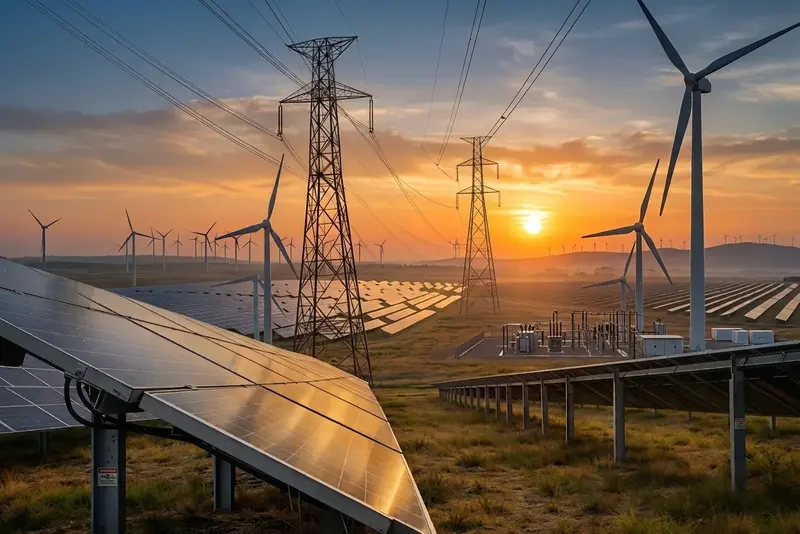
Renewable energy landscape with solar panels, wind turbines, and power lines at sunrise, sustainable electricity generation and clean energy infrastructure. Image Credits: Kencrave
27 min read
Business
Africa's Energy Crisis: Causes, Costs & Solutions For Reliable Electricity
Africa holds roughly 60% of the world's best solar resources yet about 600 million people remain without electricity. Explore the continent's energy crisis that is rising costs, unreliable grids, and the reforms that could power a brighter future.
Executive Overview
Africa holds 60% of the world's best solar resources, yet 600 million people remain without electricity, a challenge that defines the continent's energy crisis. In 2026, households and businesses in major economies like Kenya and Nigeria face rising electricity bills alongside increasingly unreliable power, creating a double burden that stifles economic growth, undermines digital transformation, and deepens inequality.
Key Findings
The Access Gap: Africa accounts for over 80% of the global energy-access deficit, with electrification rates below 20% in countries like South Sudan and Chad.
The Cost Paradox: Kenya's 90% renewable grid delivers tariffs of about 40% above the continental average due to expensive contracts and transmission losses of around 21%.
Economic Drain: Unreliable power costs Nigeria $29 billion annually (5-7% of GDP), with businesses spending $20-22 billion yearly on self-generation.
Recovery is Possible: South Africa reduced blackouts from 300+ days in 2023 to 8 consecutive months of stable power through policy reform and private investment.
Strategic Recommendations
Policy Reform: Transition from monopoly models to competitive markets as Kenya's 2026 Energy Regulations now mandate.
Renewable Investment: Leverage Africa's geothermal, solar, and wind potential to stabilize costs.
Integrated Planning: Align digital infrastructure growth with energy capacity expansion.
Regional Integration: Build cross-border transmission networks to enable power trading.
The Power Challenge In Africa Despite Vast Sources of Renewable Energy
Operating a business in Sub-Saharan Africa means navigating around economic survival to a grid that collapses without warning at peak operational hours, all while the monthly bill aggressively climbs. This is the 'Power Paradox' of Africa: a continent home to the world’s richest renewable energy resources remains defined by localized darkness.
The continent is home to some of the world's richest renewable energy resources, enough solar energy to power the planet several times over, vast geothermal reserves, and powerful hydroelectric potential. Yet, around 600 million Africans still live without any access to electricity. This is not merely an infrastructure problem; it is a fundamental barrier to economic opportunity, social development, and basic human dignity.
African countries spend approximately 5% to 6% of their GDP on human capital, a fraction of the 11% to 14% spent in Europe and North America. This underinvestment is strikingly visible in the energy sector. For example, Kenya, with a population of over 50 million people, has one major electricity distribution company (KPLC).
When this single utility fails to deliver reliable power, the consequences are felt across the entire economy. Businesses lose revenue, remote workers lose income, hospitals cannot operate life-saving equipment, and children cannot study at night. The energy crisis is not just about blackouts; it is about a continent being held back.
In many African countries, electricity bills are rising even as the power supply becomes less reliable. This is attributed to some factors: aging infrastructure that requires more frequent and expensive repairs, the high cost of fuel used to run backup generators when the grid fails, and tariff structures that struggle to balance consumer protection with the need to fund network upgrades. The result is a system where households and businesses pay more for electricity while receiving less reliable service.
Africa's Energy Outlook 2026: Progress, Gaps, and Rising Costs
The Scale of the Problem: Who Lacks Access?
The data clearly paints a picture of energy inequality across the African continent. North African nations like Egypt and Morocco have achieved near-universal electrification, with rates exceeding 99%. However, the scenario in Sub-Saharan Africa is dramatically different. In countries like South Sudan and Chad, access rates remain below 20% of the population. Kenya has made significant progress, with over 75% of the population now having access to electricity, driven by its ambitious Last Mile Connectivity Project. But this progress is fragile, and high costs, infrastructure weaknesses, and a rapidly growing population keep the dream of universal, reliable power out of reach for many.
The situation is aggravated by a rapidly growing population and the new demands of the digital economy. Africa currently accounts for over 80% of the global energy-access deficit. The continent's data centre market, a key driver of the digital economy, was worth $3.5 billion in 2024 and is expected to reach $6.8 billion by 2030. This demand is outpacing the continent's ability to supply reliable power.
The African Union notes that one of the biggest weaknesses is the continent's transmission infrastructure and its ability to integrate energy systems. To close the infrastructure financing gap, estimated at between $90 billion and $100 billion annually, partnerships with international investors remain critical.
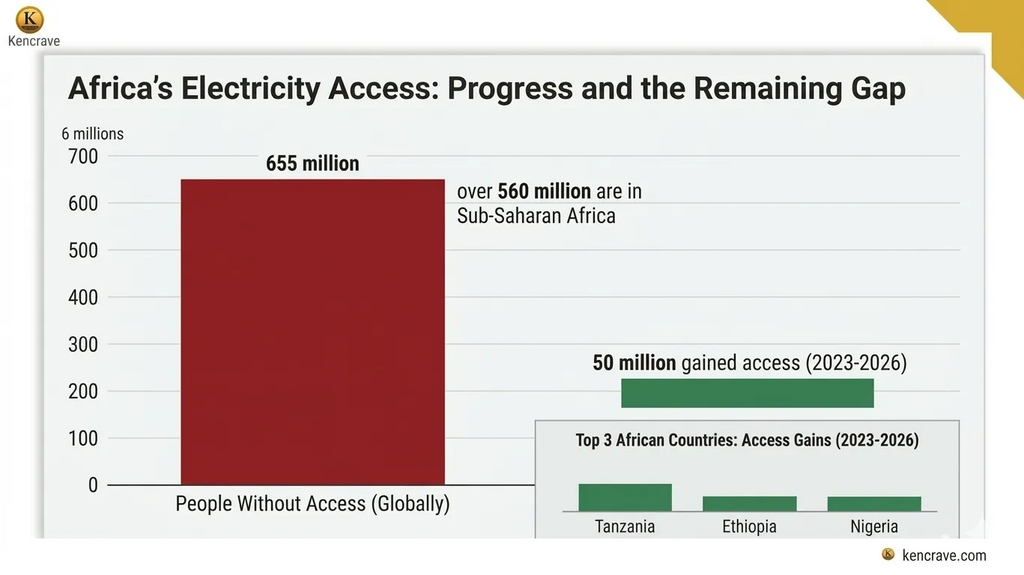
655 million people globally lack electricity access, with over 560 million in Sub-Saharan Africa, while 50 million gained access between 2023-2026 under the Mission 300 initiative.
A Case Study of Kenya: A High-Price, Green-Energy Challenge
Kenya is a nation with one of the greenest power grids on the continent, with nearly 90% of its installed electricity capacity coming from renewable sources like geothermal, hydro, wind, and solar. Yet, despite this abundance, Kenyan households and businesses pay some of the highest electricity tariffs in Africa, roughly 40% above the continental average (Global Oil Prices, 2025). The disconnect between green energy and affordable power is deeply frustrating for consumers.
The high cost of electricity is not due to a lack of generation capacity but is rooted in the sector's structure. Long-term contracts, many with clauses like "take-or-pay," have locked the state utility into costs far higher than those from state-owned generators. The issue of Independent Power Producers has been flagged in numerous reports, with critics noting that many operate with a lack of transparency about their ownership, and their contracts are very expensive to the consumer.
The burden of this expensive energy is passed directly to households and businesses. The cost is further inflated by high transmission and distribution losses, which are around 21%, well above the regulator's 17.5% target. The Kenya Association of Manufacturers argues that the utility's commercial losses should not be passed on to consumers and that the fuel charge should remain a clean pass-through cost.
This combination of expensive power purchase agreements and operational inefficiencies results in a system where one of the greenest power grids in the world delivers some of the most expensive and least reliable power for the average citizen.
Paying More for Less: The Double Burden of Unreliable Power
The irony of paying more for less reliable power is perhaps the most frustrating aspect of Africa's energy crisis. In Kenya, the government froze a planned electricity tariff hike in June 2026 that would have raised bills for households and businesses. The decision came after the distribution company (KPLC) submitted an application for new retail electricity prices that were expected to guide bills from July 1, 2026, through June 2029. The proposed changes included shifting the lifeline consumer bracket from 100 kilowatt-hours per month to just 30 kWh, effectively pushing most households into a higher-cost tariff band.
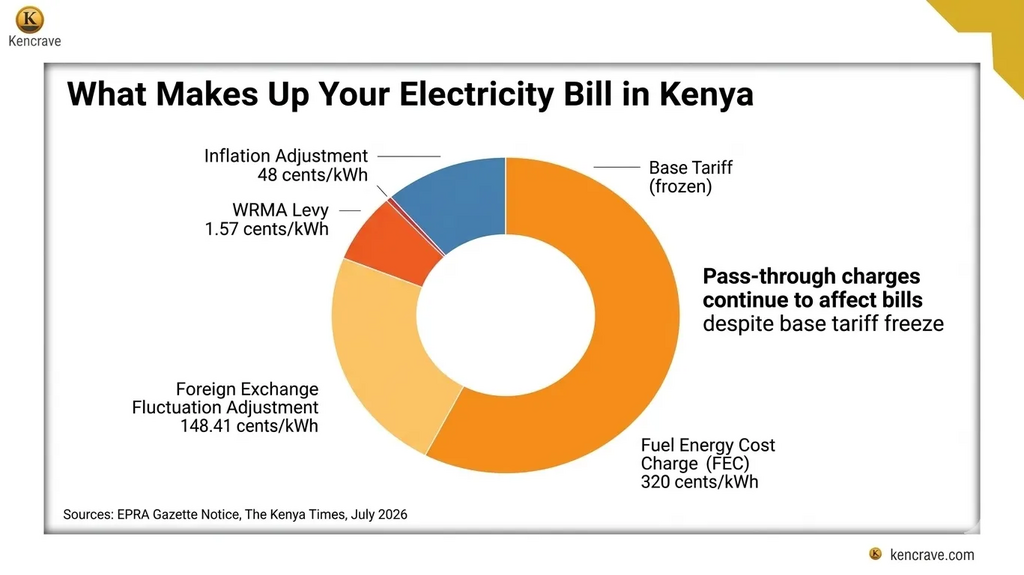
Under the withdrawn application, lifeline consumers would have paid KSh 14 per kWh, up from the current KSh 12.23, while ordinary domestic consumers would have faced a rate of KSh 21.68 per kWh, compared to the current KSh 16.45. The freeze means consumers will not face an immediate increase in the base tariff, but monthly pass-through costs, including the Fuel Energy Cost Charge, Foreign Exchange Fluctuation Adjustment, and VAT, continue to affect bills.
Breaking down Kenya electricity bill components. Fuel Energy Cost (320 cents/kWh), Forex Adjustment (148 cents/kWh), and Inflation Adjustment (48 cents/kWh) continue to drive bills higher despite the base tariff freeze.
This pattern is not unique to Kenya with similar cases reported in other African countries.
Nigeria's Energy Crisis: Subsidies, Blackouts, and the $29 Billion Loss
In Nigeria, rising electricity tariffs lead to households and businesses paying significantly higher bills without any meaningful improvement in power supply. Band A customers, who are classified as receiving a minimum of 20 hours of electricity daily and charged the highest tariff rates, report receiving barely 10 to 12 hours of electricity some days, yet their bills keep increasing. Businesses report paying huge electricity bills and still spending heavily on fuel because supply remains unstable.
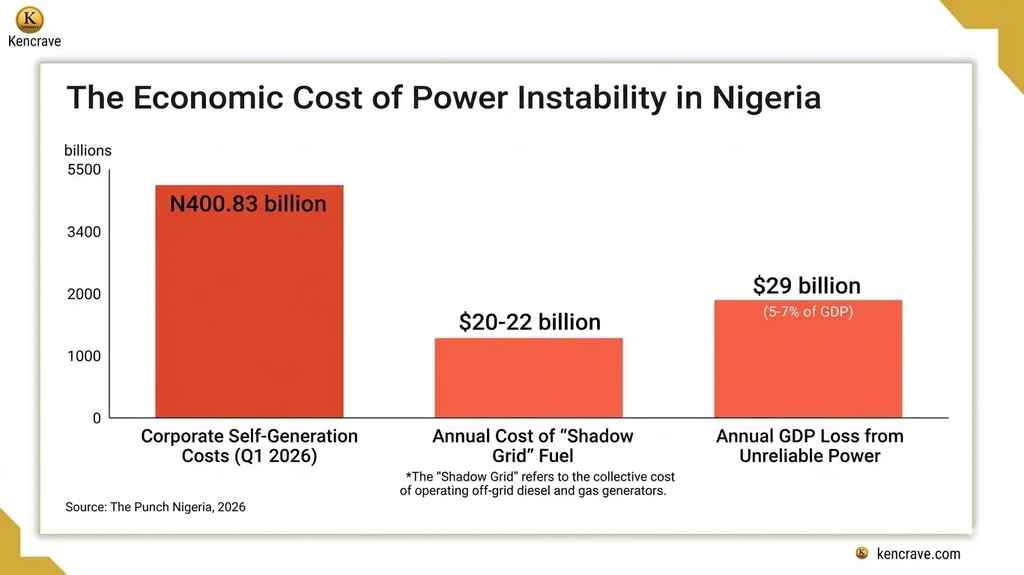
The numbers are staggering. In just the first quarter of 2026, 24 companies listed on the Nigerian Stock Exchange spent N400.83 billion on diesel, gas and other alternative energy sources to keep their businesses running. That represents a 3.66% increase over the same period in 2025, while companies that separately disclosed electricity expenses reported an even more shocking 81.5% increase in power costs following higher tariffs and worsening supply constraints. According to the World Bank, unreliable electricity costs Nigeria about $29 billion annually, equivalent to roughly 5-7% of GDP.
The Price Divide: Africa's Most and Least Expensive Electricity Markets
One of the most striking features of Africa's energy landscape is the sheer disparity in electricity costs across the continent. In some countries, power is remarkably affordable, while in others, it represents a heavy expense for households and businesses alike. Understanding this contrast is essential for a clear view of the broader energy crisis and the policy choices that shape it.
The 10 Most Affordable Electricity Markets in Africa
According to data from Global Petrol Prices for the first quarter of 2026, several African nations offer electricity at rates significantly below the global average of $0.176 per kilowatt-hour (kWh). These low tariffs are often the result of abundant hydropower resources, significant public investment, and deliberate government policies aimed at keeping electricity accessible.
a) Ethiopia consistently ranks as the continent's cheapest electricity market. With vast hydropower potential, including the Grand Ethiopian Renaissance Dam, residential tariffs average just $0.006 per kWh, while commercial users pay approximately $0.014-$0.018 per kWh. This abundance of cheap hydropower supports the country's ambitions to become a regional electricity exporter. However, low tariffs can also strain the financial sustainability of power utilities if revenues do not fully cover supply costs.
b) Egypt is another market with highly affordable electricity, benefiting from heavy investments in generation and distribution infrastructure. Residential tariffs average $0.021 per kWh, while commercial users pay around $0.038-$0.039 per kWh. The country's industrial policy leverages these low tariffs to maintain competitiveness in manufacturing and export markets.
c) Zambia relies heavily on cheap hydropower, with residential tariffs at $0.023-$0.024 per kWh and commercial rates around $0.040-$0.048 per kWh. However, the country's heavy dependence on hydropower also makes it vulnerable to drought and climate variability, exposing a key weakness of this model.
d) Angola and Nigeria also feature among the continent's cheapest markets. Angola's residential tariffs are approximately $0.016-$0.030 per kWh, while Nigeria's residential rate sits at roughly $0.036-$0.037 per kWh. Nigeria's low tariffs are sustained by substantial government subsidies, but this approach imposes a significant burden on public finances and discourages private investment in the power sector.
e) Algeria($0.042/kWh residential), Sudan ($0.044/kWh), Tunisia ($0.068/kWh), Democratic Republic of Congo ($0.072/kWh), and Cameroon ($0.088/kWh) round out the top ten most affordable markets. It is important to note that a low tariff does not automatically guarantee universal access, optimal service quality, or sustainable production, but it is primarily an indicator of cost for the end user, which may not reflect massive subsidies or the true cost of generation.
The 10 Most Expensive Electricity Markets in Africa
Other African countries face the highest electricity costs, with significant consequences for household budgets and business competitiveness. Unlike the affordable markets, which often rely on hydropower, the most expensive markets are typically characterized by reliance on imported fossil fuels, small grid size, or inefficient tariff structures.
a) Cabo Verde records the highest household electricity prices in Africa, with tariffs reaching approximately $0.32-$0.35 per kWh as of 2024. This reflects the country's heavy reliance on imported fossil fuels and the high cost of generating electricity on small island grids.
b) Kenya has the highest power costs among major African economies and neighboring countries. Kenyan households pay an average of $0.256 per kWh, while industrial tariffs range between $0.18 and $0.23 per kWh. The high cost is driven by expensive power purchase agreements with private producers, a complex tariff structure that includes multiple taxes and surcharges, and transmission and distribution losses that are above regulatory targets. This has made Kenyan manufacturers less competitive regionally and has contributed to the country's premature de-industrialization.
c) Other countries with significantly high electricity prices include Sierra Leone ($0.253/kWh), Mali ($0.223/kWh), Burkina Faso ($0.21/kWh), Gabon ($0.21/kWh), Togo ($0.197/kWh), Rwanda ($0.193/kWh), and South Africa ($0.191/kWh).
d) Uganda presents a unique mix. While the country offers some of the lowest industrial tariffs in the region, $0.055 per kWh, its residential tariffs are among the highest at approximately $0.206 per kWh. This deliberate cross-subsidy is a government policy designed to promote industrialization by keeping power costs low for manufacturers. However, it places a heavy burden on households and raises questions about the equity of such tariff structures.
Why Prices Vary: 4 Key Drivers of Africa's Energy Divide
The wide gap between Africa's cheapest and most expensive electricity markets reflects several underlying factors:
Generation Mix: Countries like Ethiopia, Zambia, and the Democratic Republic of Congo that rely heavily on large-scale hydropower benefit from lower generation costs. In contrast, nations that depend on imported fossil fuels or costly thermal generation, such as Cabo Verde and many West African countries, face higher tariffs.
Subsidy Policies: Governments in countries like Egypt and Nigeria keep tariffs artificially low through heavy subsidies. While this makes electricity affordable for consumers, it imposes a significant fiscal burden and often leaves power utilities financially unsustainable, discouraging investment in infrastructure maintenance and expansion.
Market Size and Infrastructure: Smaller markets and those with inefficient or ageing grids, such as some West African nations, often face higher costs due to limited economies of scale and high transmission losses.
Regulatory Frameworks: Countries like Kenya and Uganda maintain cost-reflective tariffs and more advanced regulatory frameworks, which can lead to higher consumer prices but are often associated with better financial sustainability for utilities. This highlights the trade-off between affordability and long-term viability.
The Human and Economic Cost of Power Instability
a) The Price of Power Blackouts for Business
For businesses, power instability is a silent and ‘devastating tax’ on operations. In Kenya, the Kenya Association of Manufacturers has consistently highlighted that regular power fluctuations and outages lead to damage to both products and machinery. The rising power costs subsequently increase production costs.
This erodes the competitiveness of local manufacturers, making it difficult for them to compete with regional rivals. According to Kenya National Bureau of Statistics, Manufacturing currently contributed around 7% to Kenya's GDP, far below the Vision 2030 target of 20%, a gap partly attributed to energy costs and reliability. Over time, Kenya’s manufacturing has been on a decline since from the highs of 11.5% in 2009 to around 7% in 2025.
In Nigeria, for manufacturers, energy now accounts for as much as 30 to 35% of production costs, compared with less than half that level in countries with stable electricity systems. Frequent outages damage expensive industrial equipment, disrupt production schedules, and reduce capacity utilization. Small and medium-sized enterprises, lacking the financial muscle to invest in sophisticated backup systems, suffer even more devastating consequences. Many simply shut down.
Column chart showing the cost of power instability in Nigeria: corporate self‑generation costs reached ₦400.83 billion in Q1 2026, while the annual cost of the country’s unreliable power supply is estimated at $29 billion (5-7 % of GDP).
The reliance on expensive, unreliable power effectively taxes the entire economy, stifling job creation, investment, and the growth of a stable, prosperous economy. According to estimates, operating the "shadow grid" of self-generated capacity in Nigeria consumes between $20 billion and $22 billion every year in fuel alone.
This is economic irrationality, where every naira burnt in generators is capital diverted from expanding factories, hiring workers, investing in technology, or lowering prices for consumers.
b) Households in Crisis: Rationing Power to Survive Rising Bills
The digital economy, which offers opportunities for remote work and global integration, is built on a foundation of reliable connectivity. A reliable power supply is the bedrock of that foundation. A World Bank study found that businesses in Africa lose an average of 5% of their annual sales due to power outages. Frequent power blackouts create a sense of instability that undermines the potential of remote work, hitting households and the most vulnerable the hardest.
In Nigeria, for low-income households, rising electricity costs are becoming another source of economic hardship at a time when inflation continues to strain household budgets. Many families are now rationing electricity usage in an attempt to cope with escalating living costs. Paying more for unreliable electricity is no longer a policy debate; it is a burden they can scarcely afford.
A Comparative Perspective: South Africa's Recovery
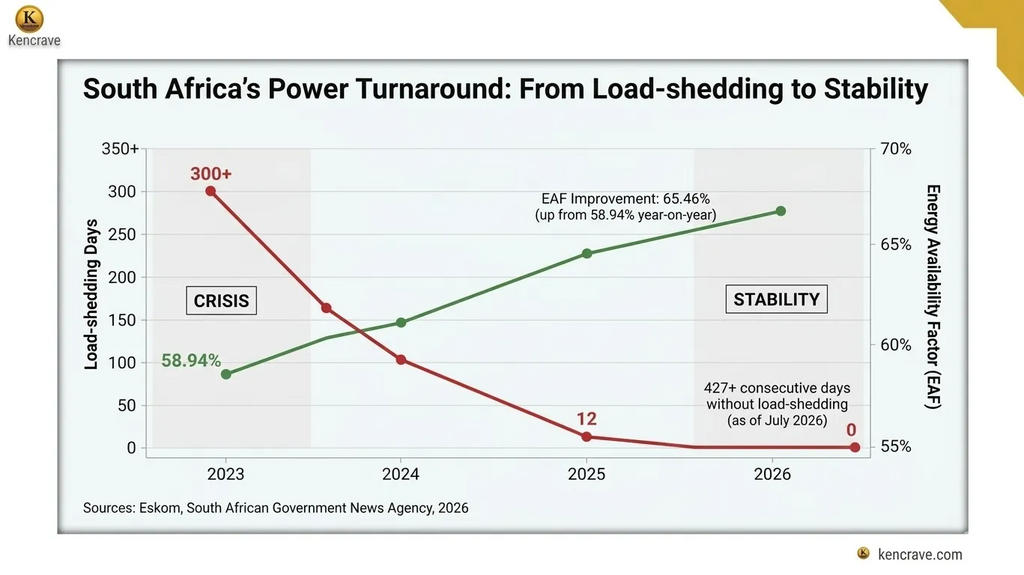
South Africa provides a useful benchmark on electricity recovery. The country has long suffered from one of the world's worst electricity crises, with 2023 seeing the most severe load-shedding, featuring over 300 days of blackouts and daily outages of 8-12 hours under Level 6 load-shedding. The economic damage was immense, with electricity shortages costing the economy an estimated 1.5 percentage points of GDP in 2023.
However, South Africa's experience also shows that recovery is possible. Through a combination of the Energy Action Plan launched in 2022, the Generation Recovery Plan initiated in 2023, and significant private sector investment in renewable energy, the country has made remarkable progress. By 2025, blackouts had fallen to just 12 days in the first eight months, and by early 2026, Eskom had gone eight consecutive months without load-shedding.
This turnaround offers a powerful lesson: sustained political commitment, policy reform, and private investment can address even the deepest energy crises. South Africa's experience also shows that reforming the utility's operational performance and attracting private investment in generation are critical to restoring reliability.
South Africa's energy turnaround from over 300 days of load-shedding in 2023 to over 427 consecutive days without load-shedding by July 2026, with Energy Availability Factor improving to 65.46%.
Global Power Prices: How Africa Compares to the World's Biggest Economies
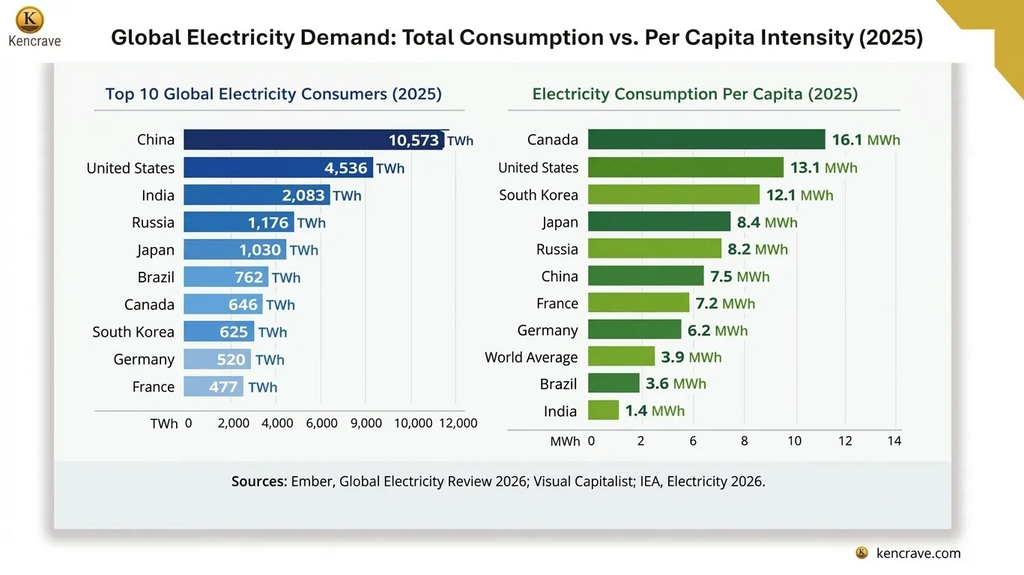
The world's largest economies are also its biggest electricity consumers. According to Ember's Global Electricity Review 2026, a handful of countries account for a significant share of global electricity demand. China leads by a vast margin, using 10,573 terawatt-hours (TWh) in 2025, roughly one-third of the world's total electricity consumption. This represents a dramatic rise from less than 10% in the early 2000s, driven by rapid industrialization, urbanization, and the expansion of manufacturing sectors.
The United States ranks second with 4,536 TWh, followed by India (2,083 TWh), Russia (1,176 TWh), and Japan (1,030 TWh). Rounding out the top ten are Brazil, Canada, South Korea, Germany, and France. Many of these countries are also among the world's largest economies, reflecting the link between economic activity and power demand.
Per Capita Power: Why Canada Uses 10x More Electricity Than India
While China dominates in total consumption, its per capita usage tells a different story. At 7.5 megawatt-hours (MWh) per person, China sits well below Canada (16.1 MWh) and the United States (13.1 MWh). Canada's high per capita consumption is driven by cold winters, large homes, and energy-intensive industries such as mining and oil production. India, despite being the third-largest consumer overall, uses just 1.4 MWh per capita, far below the global average of 3.9 MWh. This highlights the gap between industrial-scale demand and household consumption levels.
The Cost of Electricity in Major Economies
Electricity prices vary significantly across these major economies. Wholesale electricity prices in the European Union averaged roughly USD 95/MWh in 2025, about twice the level in the United States and significantly above prices in China. This price gap puts pressure on energy-intensive industries in Europe. For households, the pattern is similar: residential electricity is generally more expensive in Europe than in the United States or China.
Factors such as taxes, network charges, and generation mix all contribute to these differences. Countries like Germany and Italy rank among the most expensive markets globally, while major economies like the US and China enjoy comparatively lower tariffs.
Total electricity consumption and per capita usage across the world's top 10 power consumers in 2025, with China leading in total demand and Canada leading per person.
The World's Most Expensive Electricity Markets
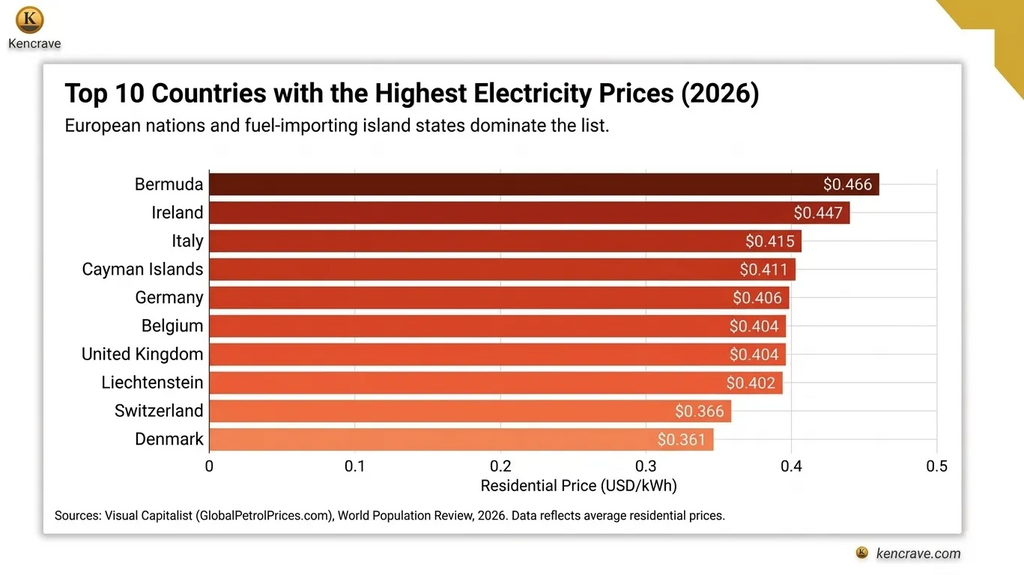
The cost of electricity varies widely around the world, with European nations and fuel-importing island states dominating the list of the most expensive markets. According to data compiled by Visual Capitalist, Bermuda has the highest residential electricity prices in the worldat an average of $0.466 per kilowatt-hour (kWh). Ireland follows closely at$0.447/kWh, with Italy at $0.415/kWh.
A key feature of these rankings is the dominance of European countries: eight of the ten most expensive electricity markets are in Europe. Factors such as high taxes, environmental levies, renewable energy surcharges, and grid maintenance costs all contribute to these high prices. In countries like Denmark and Germany, about half of the electricity price is attributed to taxes and surcharges.
Island nations also feature prominently due to their reliance on imported fuels and limited economies of scale. Bermuda, for example, lacks space for large-scale renewable projects and depends almost exclusively on imported fuel oil. Similarly, the Cayman Islands, the Bahamas, Barbados, and Cabo Verde face high costs due to transport logistics and smaller customer base.
Top 10 Countries with the Highest Electricity Prices (Residential)
Bermuda's exceptionally high prices are driven by its isolation and size. As a tiny island nation with a land area of roughly 53.2 km², it lacks the space for large-scale power plants, such as solar arrays or wind farms, and has no rivers for hydroelectric power. As a result, it relies almost exclusively on imported and expensive fuel oil to generate electricity.
Top 10 countries with the highest residential electricity prices in 2026. Bermuda leads at $0.466 per kWh, followed by Ireland, Italy, Germany, and the UK, with European nations dominating the ranking.
Key Drivers for Top 10 Countries with the Highest Electricity Prices (Residential)
Bermuda: Relies on imported fuel oil; lacks space for large-scale renewables.
Ireland: High taxes and distribution costs.
Italy: Heavy reliance on natural gas; price volatility.
Cayman Islands: Diesel dependence; small island grid.
Germany: An estimated 50% of price from taxes; nuclear phase-out.
Belgium: Geographically reliant on neighbours; high taxes.
United Kingdom: Island location; reliance on fossil fuels.
Liechtenstein: High taxes and distribution costs.
Switzerland: High taxes and regulatory costs.
Denmark: An estimated 50% of price from taxes.
Towards a Brighter Future: Strategies for Energy Resilience
1. Policy and Governance: Reforming the Sector
The primary challenge in many African nations is not a lack of resources but a failure of policy and governance. The high cost of electricity in countries such as Kenya, despite its green grid, is a direct result of expensive contracts with private producers and the poor structuring of the sector. Parliament has begun to respond with reforms such as a new moratorium on power deals with strict conditions like capped tariffs and competitive auctions. The Kenya Association of Manufacturers has also called for decisive government action, including reducing power tariffs, opening the electricity market beyond the monopoly, and implementing tax reforms.
In Kenya, the recent enactment of the Energy (Electricity Market, Bulk Supply and Open Access) Regulations, 2026, marks a structural shift in the power sector. The regulations dismantle the legacy single-buyer model and establish a competitive, transparent, and multi-supplier electricity market.
This is expected to catalyze private capital, enhance grid reliability, and deepen regional energy integration. Market-driven pricing discovery, operational accountability for transmission losses, and granular tariff unbundling are designed to drive downward pressure on power tariffs over the medium-to-long term.
2. Investment and Technology: The Green Energy Leap
Africa's future lies in leveraging its abundant renewable resources. Countries like Kenya, with its vast geothermal reserves exceeding 10,000 MW, are well-positioned to lead the charge. The transition is already underway, with developers turning to renewables and hybrid solutions for data centres: geothermal-powered cloud campuses in Kenya, solar farms for South African data centres, and solar-plus-storage PPAs emerging in Nigeria as cheaper, long-term options.
Kenya is actively seeking to attract Chinese investment in the local manufacturing of clean energy equipment to accelerate its transition. These investments in renewable energy are not just environmental choices but also strategic hedges against the kind of oil price shocks that have historically destabilized African economies.
3. Integrated Planning: Coordinating Energy and Digital Infrastructure
The digital and energy sectors must be planned together to avoid future crises. McKinsey predicts that Africa's data centre demand will grow from its current 0.4GW to 2.2GW by 2030, requiring an investment of $10 to $20 billion. Currently, the total capacity of data centres in South Africa, Kenya, Nigeria, and Egypt is only about 250 MW.
Governments can integrate AI and data centre demand into national power planning to avoid the mistakes of countries like Ireland, where digital infrastructure has strained the grid. The African Union is also prioritizing investments in integrating energy systems, building the transmission infrastructure needed to efficiently distribute power.
4. Regional Integration: Powering Trade and Resilience
The African Union's Agenda 2063 aims for a fully integrated continent. A key part of that vision is regional energy integration, as seen in initiatives like the West African Power Pool. The African Union is also prioritizing investments in integrating energy systems and building the transmission infrastructure needed to efficiently distribute power. Infrastructure is no longer just developmental but a "tool of economic power."
Aligning transport and energy systems into a unified economic platform capable of driving industrialization is essential.
5 Critical Takeaways: What Africa's Energy Crisis Means
The Energy-Access Gap: Africa accounts for over 80% of the global energy-access deficit, with 600 million people lacking electricity, despite possessing immense renewable energy potential.
Rising Costs, Unreliable Supply: In many countries, households and businesses face rising electricity bills alongside frequent outages, creating a double burden for consumers.
The Cost of Alternative Power: The "shadow grid" of self-generated capacity represents a massive economic drain, consuming billions of dollars annually in fuel costs.
Structural Reform is Key: Regulatory reforms, such as Kenya's new open-access regulations, are critical to attracting investment and reducing costs.
Recovery is Possible: South Africa's successful turnaround from over 300 days of blackouts to eight months of stable power shows that the crisis can be overcome with sustained commitment and reform.
Top 5 Questions About Africa's Energy Crisis, Answered
1. Why do African countries with abundant renewable energy still have frequent power outages?
The issue is rarely a lack of generation capacity but a combination of factors: aging and inadequate transmission and distribution infrastructure, a history of underinvestment in grid maintenance, and, in some cases, financially strained utilities. This creates a system where power is generated but cannot be reliably delivered to consumers.
2. Why are electricity bills rising if the power supply is unreliable?
Bills can rise due to several factors: the high cost of expensive contracts with private power producers, the need for costly repairs and upgrades to an aging infrastructure, and fuel cost charges passed on to consumers. In many cases, consumers are effectively paying twice; once for unreliable grid power and again for backup generators.
3. How does Africa's energy crisis affect businesses?
The crisis acts as a significant economic drag. Businesses, especially manufacturers, suffer from frequent power fluctuations and outages that damage equipment, increase costs, and make them less competitive regionally and globally. For many, energy now accounts for 30-35% of production costs, compared to less than half that in countries with stable power.
4. Is Africa's digital future at risk because of the energy crisis?
Yes, the growth of the digital economy, especially energy-hungry data centres, is at risk if it is not planned alongside power infrastructure. Demand is expected to grow significantly, requiring massive investment and stable grids.
5. What are the most promising solutions for Africa's energy problems?
The solutions are varied: reforming policy and governance to create transparent, competitive energy markets; strategically investing in renewable energy (solar, wind, geothermal) and modernizing transmission grids; and integrating energy planning with digital and industrial strategies on a continental scale. Sources
This strategic analysis adopted data from publicly available reports from multilateral institutions, government agencies, and recognized industry research platforms.