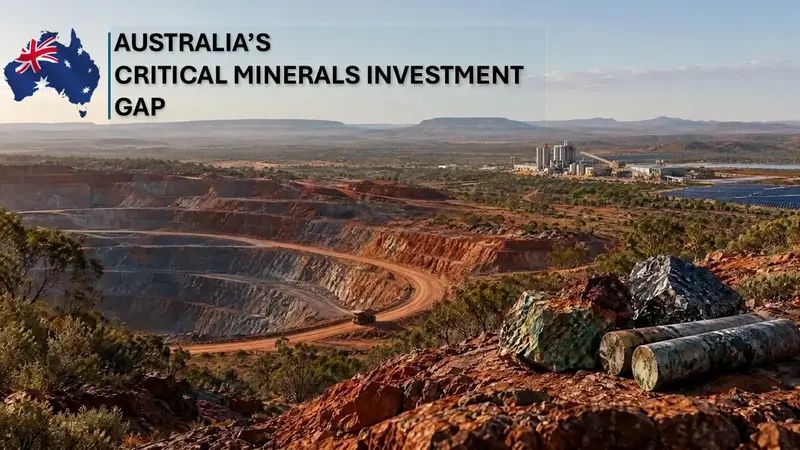
Image of investment in Australia’s critical minerals sector, showing an outback mine and mineral samples linked to a modern processing facility and solar array. Image Credits: Kencrave
22 min read
Business
Only 6 Of 907 Projects Reach Fid: Australia's Critical Minerals Investment Gap
Australia has committed A$28B to critical minerals processing but only 6 of 907 projects have reached Final Investment Decision. We rate the investment case, the US$4–5/kg cost gap, and the three projects that matter.
Executive Summary
Australia is the world's largest producer of lithium and the third-largest producer of rare earths, but it still exports most of those minerals to China for processing and captures only a small share of the value. Since 2022, governments have committed A$28 billion to support domestic processing, yet only six of 907 projects have reached Final Investment Decision (FID) and Australia's processing costs remain about US$4-5/kg higher than China's.
This report examines whether that support can build a viable processing industry and what investors should demand before committing capital. The conclusion is clear: the opportunity is real, but it remains early-stage and heavily dependent on government policy.
Key Takeaways / Findings
Australia's strength is mining, not processing. Australia produces 31.7% of the world's lithium and 7.4% of its rare earths, but around 94% of spodumene is exported to China for refining, and Australia has no operating graphite mines.
Government support is significant, but much of it has yet to translate into operating projects. Direct funding, a A$7 billion production tax incentive from July 2027, and partnerships with allied countries are in place. However, about 74% of projects are still at the exploration stage, and only eight are processing facilities.
Three projects will determine whether the model works. Arafura's Nolans project, Iluka's Eneabba refinery, and Alpha HPA have the ingredients most projects lack: secure feedstock, committed customers, and government-backed financing. Their success or failure will be the clearest test of Australia's processing strategy.
Four major risks remain unresolved. Australia's cost disadvantage of US$4-5/kg, a weak record of project execution, policy support that arrives late, and exposure to both Chinese and Western markets all continue to weigh on the sector.
The sector is best suited to long-term investors. Returns depend more on sustained government support and successful project delivery than on near-term catalysts.
Other Recommended Critical Minerals Reports and Strategic Analysis:
The sections that follow assess Australia's position across key critical minerals, track where public funding is being deployed, test the sector's main risks, and provide a five-part framework for evaluating individual projects.
The Value-Capture Gap: Why Australia's Mining Strength Is Not Enough
According to the Reserve Bank of Australia, Australia is the world’s largest lithium producer in 2025 and a significant supplier of rare earths. However, it captures only a fraction of the value from these resources. The country exports raw ore and imports processed materials, often from the same minerals it mined.
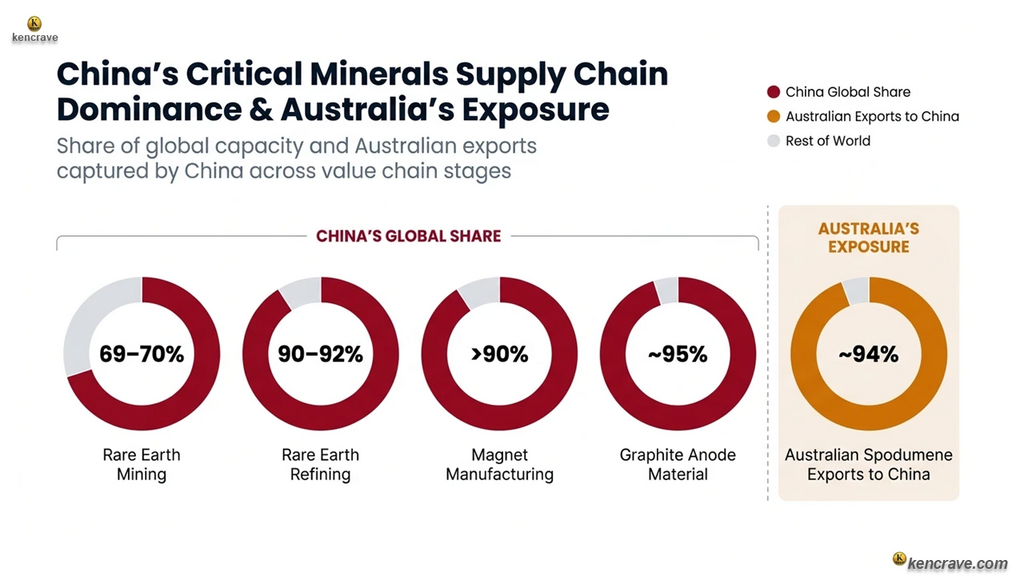
China now controls the majority of global refining capacity for critical minerals. China controls roughly 69%-70% of rare earth mining, 90%-to 92% of rare earth refining, and more than 90% of magnet manufacturing. This concentration has led to Australia’s allies to seek alternative supply sources, creating an opening that Australia is now moving to fill through new partnerships and processing investment.
China critical minerals supply chain dominance infographic showing global market share in rare earth mining (69-70%), refining (90-92%), magnet manufacturing (more than 90%), graphite anode materials (95%), and Australia's spodumene export exposure.
For investors, the central question is whether Australia can move up the lithium value chain, or whether high costs and lengthy project timelines will keep it a supplier of raw ore rather than finished materials.
Australia's Position in Global Critical Minerals
Australia's strength lies in extraction, not processing of critical minerals.
Lithium
Australia is the world's largest lithium producer, accounting for 31.7% of global production in 2025 (USGS data). However, Australia exports the vast majority of its lithium concentrate (spodumene) to China for refining.
Citing Australian Bureau of Statistics data (ABS), Argus Media reported that almost 94% of Australian spodumene exports went to China in 2025. The Western Australian Government reports that China accounted for 97% of the state's lithium exports in 2023-24. These figures show how dependent Australia is on a single buyer for its raw lithium.
Rare earths
Australia is the world's third largest, rare earths producer, accounting for 7.4% of global output in 2025, behind only China (69.2%) and the United States (13.1%). While Australia’s Lynas Rare Earths is among the few non-Chinese producers of separated rare earth oxides, it operates on a much smaller scale than China’s dominant and well-established producers.
Graphite
According to Australia’s National Science Agency, CSIRO, Australia holds around 4% of the world's natural graphite resources, ranking eighth globally. It has no operating graphite mines. China, on the other hand, controls roughly 95% of global anode material production.
The pattern is consistent with Australia focusing on mining, China refining, and the value flows to the midstream.
Where Government Money Is Going: Investment into Critical Minerals
The gap between mining and refining of critical minerals by Australia has prompted a large-scale government response. Australia’s Resources Minister, Madeleine King notes that Australian government has committed approximately A$28 billion in financial support for the critical minerals sector since May 2022. Nevertheless, she warned that the country may need to back the industry for decades. The policy architecture rests on three main pillars that is direct financing, tax incentives, and international partnerships for critical minerals.
Direct Financing: A Multi-Channel System
Public financing for Australia’s critical minerals projects does not come from a single source but from various public entities.
The Critical Minerals Facility (CMF) is run through Export Finance Australia (EFA). It started in 2021 with A$2 billion, doubled in 2023, and now manages up to A$5 billion as of February 2026.
Following the launch of the federal government's Critical Minerals Strategy 2023–2030, Federal Resources and Northern Australia Minister Madeleine King and Finance Minister Katy Gallagher formally updated the investment mandate of the Northern Australia Infrastructure Facility (NAIF).
This update required the agency to carve out exactly A$500 million specifically to support critical minerals projects As of November 2025, its portfolio was 32 projects, with about A$4.3 billion in approved loans for projects which are forecast to generate more than $33 billion in public benefit and support thousands of jobs across the north.
The Critical Minerals Strategic Reserve (CMSR) was established in 2025 and is administered through Export Finance Australia (EFA). It provides supply-side investment facilitation to de-risk critical minerals projects where private finance is constrained, using tools such as offtake agreements, financial support, and selective stockpiling.
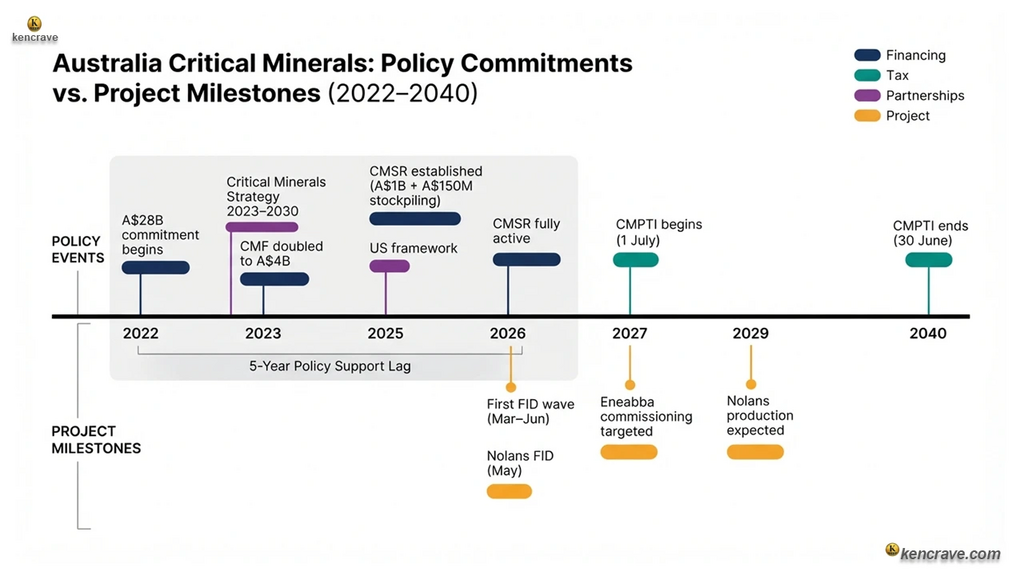
The CMSR has A$1 billion available for transactions through the expanded A$5 billion Critical Minerals Facility, plus A$150 million for stockpiling. It targets minerals such as rare earth elements, gallium, and antimony. The operations commenced in the second half of 2026.
In late October 2026, Resources Minister Madeleine King integrated the fully active CMSR framework as a core structural pillar of Australia's newly refreshed Critical Minerals Strategy indicating that the foundational reserve systems are now securely established
Tax Incentives: The Production Tax Incentive
The Critical Minerals Production Tax Incentive (CMPTI) will provide a refundable tax offset of 10%on eligible costs associated with producing critical minerals and rare earths. The incentive is valued at A$7 billion over the decade. It will be available for up to 10 years per project, covering production between 1 July 2027 and 30 June 2040.
International Partnerships
Australia signed critical minerals cooperation agreements with the United States, Japan, South Korea, India, France, Germany, and Britain. The October 2025 framework with the United States is the most significant, committing both countries to provide at least US$1 billion each toward a US$8.5 billion pipeline of priority critical mineral projects.
The framework includes mechanisms for joint project selection, offtake arrangements, price floors, and coordinated financing support. It also establishes a US-Australia Critical Minerals Supply Security Response Group to identify priority minerals and supply vulnerabilities.
Australia is a founding partner of the Quad Critical Minerals Initiative, which was launched at the Quad Foreign Ministers' Meeting in New Delhi on 26 May 2026. It seeks to mobilize up to $20 billion in government and private sector support with a focus on projects that can address critical minerals supply chain gaps.
The government's Critical Minerals Prospectus profiles 49 mining projects and 29 midstream processing projects seeking investment from around the world. This would create jobs and new supply chains of critical minerals with partner nations.
Which Australian Projects Have Real Backing?
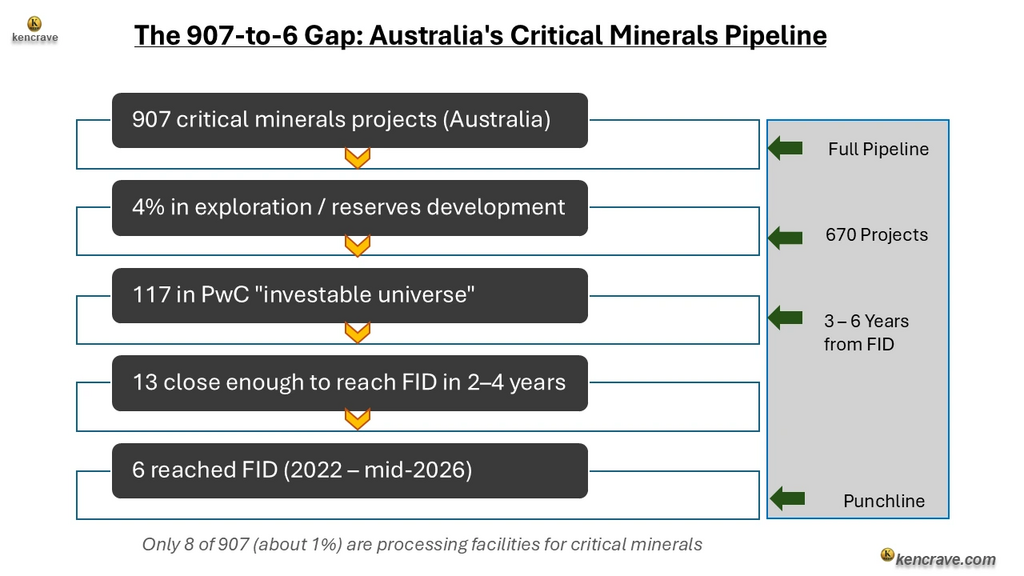
Australia's critical minerals pipeline is large on paper but thin on execution. A PwC's analysis report identified 907 critical minerals projects across Australia, yet only 6 reached Final Investment Decision between 2022 and mid-2026. About 74% remain in exploration or reserves development, and only 8 processing facility projects exist in the pipeline.
Australia critical minerals project pipeline infographic showing the 907-to-6 gap, where hundreds of exploration projects narrow to only six reaching Final Investment Decision (FID), highlighting rare earths and critical minerals development challenges.
The projects with real backing share three traits: secured feedstock, binding offtake, and government financing that reduces capital risk. Three critical minerals projects stand out in Australia:
Nolans project reached the Final Investment Decision in May 2026. Nolans’ cost was reported at about A$1.6 billion. Arafura had received about A$840 million in government loans, and A$200 million through the NRF. The government committed to buying 500 tonnes of rare earths from the project via its Critical Minerals Strategic Reserve.
The Nolans debt package comprises senior facilities from Export Finance Australia (under the CMF), the NAIF, Export Development Canada and the Export-Import Bank of Korea, with export-credit guarantees supporting commercial lenders including (Kreditanstalt für Wiederaufbau) KfW IPEX-Bank, Commonwealth Bank and ING. In April 2026, Arafura executed binding equity subscriptions with KfW, for the German Raw Materials Fund of about A$84 million, and with Export Finance Australia of US$100 million.
Once commissioned, Eneabba will be Australia’s first fully integrated rare earths refinery, and one of few facilities globally able to produce both light and heavy separated rare earth oxides. Construction is funded by a A$1.65 billion non-recourse loan from the Australian government, provided through the Critical Minerals Facility administered by Export Finance Australia.
In June 2026 Iluka secured its first binding take-or-pay offtake agreement for the supply of magnet rare earth oxides to an unnamed global automotive company. The agreement starts in 2028 for an initial four-year term. It covers about 10% of Iluka’s planned production over that period. It carries minimum revenue of US$155 million. The refinery will initially run on Iluka’s Eneabba stockpile of rare earth concentrate.
In July 2026, Iluka also signed an agreement with VHM Limited for the long-term supply of all planned rare earth concentrate production from the Goshen deposit. As of mid-2026 construction was more than 50% complete, with commissioning targeted for mid-2027.
Alpha HPA — HPA First Project (Queensland)
Alpha HPA’s Stage Two HPA First Project is financed by A$400 million in debt from EFA and the NAIF, committed 50:50 and made up of a A$320 million construction facility and an A$80 million cost overrun facility. EFA’s share was primarily funded through the CMF.
In early 2026, the National Reconstruction Fund Corporation committed A$75 million in equity as the cornerstone of a A$225 million funding round. This drew a further A$150 million from institutional investors including existing shareholders Orica and Australian Super.
Alpha HPA’s CFO, Craig Jones, said that without the government loan funding the project would not have moved into construction in a timely manner. Export Finance Australia notes that the joint backing of NAIF and EFA gave investors the confidence they needed, allowing Alpha HPA to tap public equity markets once the loan approval was announced (Export Finance Australia).
Australia critical minerals policy timeline (2022–2040) highlighting government funding, strategic initiatives, investment frameworks, and major project milestones across the rare earths sector.
What Are The Risks Facing Australia's Processing Ambitions?
The policy architecture is substantial, but it does not remove the structural barriers. Four risks emerge from Australia’s processing of critical minerals:
The cost gap is structural, not only cyclical
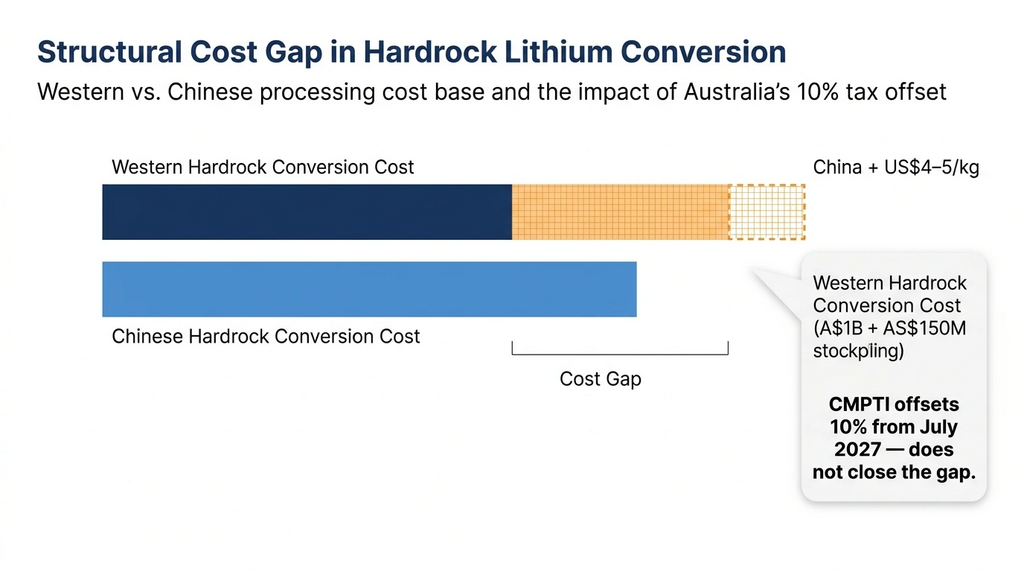
Western lithium refiners still struggle to compete, even with rising prices. When Albemarle shut down its last operating line at Kemerton in February 2026, its CEO noted that higher prices alone could not fix the high costs of Western processing. Mining Monthly reported a price gap of US$4–US$5 a kilogram between Chinese and Western refiners. About 250 jobs were lost plus dozens of contractors were affected. The company cited structural challenges and higher operating costs compared with plants in China.
Structural cost gap in hard rock lithium conversion comparing Western and Chinese processing costs, showing China's lower lithium refining costs and the limited impact of Australia's 10% Critical Minerals Production Tax Incentive (CMPTI).
Pipeline execution remains weak
PWC noted that only 13 of 907 projects are close enough to FID to get there within two to four years. Nearly 90% of the 117 projects in PwC’s investable universe are three to six years from a final investment decision, with complex builds taking up to ten years.
Across the entire 907-project pool, only eight of them, which represents about 1% are processing facilities. Most of the A$28 billion committed since 2022 remains prospective, conditional, or tied to tax incentives that only pay out once production begins. Even so, five final investment decisions between March and June 2026 finally broke a nearly four-year drought.
Policy support arrives late
Australia’s support faces near-term limits: the Production Tax Incentive only applies from 1 July 2027, and A$1 billion of the A$1.2 billion Strategic Reserve comes straight out of the existing CMF. In comparison, Washington launched Project Vault with US$12 billion in fresh backing, mostly via an Export-Import Bank loan
Geopolitical risk is two-sided
Australia's strategy relies on allied demand for non-China supply, but China's expanding export controls on rare earths, processing chemicals and equipment. In May 2026, the Treasurer ordered six China-linked investors to sell their Northern Minerals stakes. One analysis argues that blocking Chinese investment won't automatically create Australian industrial capability but risks unsettling other foreign investors. Additionally, Lynas still depends heavily on Chinese equipment and chemical inputs.
China's response to the Northern Minerals divestment order has been twofold. China's Foreign Ministry formally protested, urging Australia to provide a fair, transparent and non-discriminatory investment environment.
Beyond the official statement, Chinese commentators and some Australian analysts have warned that the order could provoke retaliation, pointing to China's previous use of rare earth export controls as a countermeasure. No specific retaliatory action has yet been announced.
Environmental and radiological permitting adds years to project timelines
Rare earth ores contain natural uranium and thorium that build up in processing waste. At the Yangibana project in Western Australia, processing residue reaches about 5,000 ppm thorium. Although expected worker radiation levels (1.8 mSv/y) were far below the 20 mSv/y safety limit, the project still waited two and a half years for environmental clearance—from January 2017 to mid-2019. Disputes over waste can also drag on after a plant opens.
Malaysia required Lynas to remove roughly 450,000 tonnes of radioactive residue to renew its Kuantan operating licence. However, Western Australia refused to accept the waste. This indicates that permitting is not a formality but a multi-year process that can delay production first.
The skills gap limits how fast refineries can be staffed in Australia
Australia’s talent pipeline is severely constrained. Only two universities (Curtin University and Murdoch University) still offer metallurgy, producing just a few dozen graduates a year, while mining engineering produces roughly 100 annually—a fraction of China’s 3,000.
Even if enrolments surged today, a four-year degree plus on-the-job training means new domestic engineers would not be fully productive until the early-to-mid 2030s. Skilled migration and retraining can help bridge the gap, but not fast enough to match a rapid refinery build-out.
How to Judge the Opportunity: Five Tests for Australian Critical Minerals Processing Investments
The policy architecture is substantial, but it does not guarantee returns. For investors evaluating critical minerals processing opportunities in Australia, the following five criteria, separate projects with a credible path to production from those that stall or remain on paper:
1. Secured Feedstock Projects with access to existing stockpiles or binding supply agreements reduce input risk. Eneabba benefits from Iluka's monazite stockpile accumulated over decades. This is supplemented by an 18-year supply agreement with VHM Limited for concentrate from the Goschen project. Arafura's Nolans is an integrated ore-to-oxide project, with mine and processing under one entity.
2. Binding Offtake A signed contract with a credible end-user converts a project from a forecast into a commercial proposition case. Arafura's offtake agreements cover 88.3% of nameplate capacity, with counterparties including Hyundai & Kia (33.8%), Traxys North America (19.1%), Siemens Gamesa RE (11.7%), and Traxys Europe (6.8%).
3.Government support varies widely in quality Non-recourse loans built around project economics show that state lenders have done real due diligence without putting the parent company's balance sheet at risk. Eneabba’s A$1.65 billion loan is the gold standard, while Arafura’s A$1.2 billion package that combines support from NAIF, the CMF, the NRF, and the Strategic Reserves, shows how layered backing gets projects across the FID line.
4. Realistic Timelines Projects that acknowledge the complexity of first-of-a-kind facilities and build in schedule contingency are more credible than those promising rapid commissioning. Eneabba's commissioning is targeted for 2027. Arafura's Nolans began 30 months of construction in September 2026, with production expected in early-to-mid 2029.
5.Domestic Cost Competitiveness The IEA's 2026 outlook notes that operating costs for refining projects outside dominant suppliers are on average, around 50% higher, driven by feedstock and energy prices. The CMPTI offsets 10% of eligible processing costs starting July 2027, but it does not eliminate the gap. Investors should ask whether a project can operate profitably if government support is reduced or withdrawn.
Key Insight: The projects most likely to succeed are those that stack all five elements. They need to have a secured feedstock, binding offtake, structured government financing, realistic timelines, and a credible path to cost competitiveness. Projects missing any one of these have a materially higher risk of delay or failure.
The Investment Approach To Australia’s Critical Minerals
Australia’s push into critical minerals processing is real, yet very early-stage. Policy support is ready, but the project pipeline is thin. Between 2022 and mid-2026, just six of 907 projects reached final investment approval, 74% stayed in early exploration or reserve work, and most sit three to six years away from a decision.
Projects with real momentum share three advantages: secured feedstock, binding customer contracts, and structured government loans. Arafura’s Nolans and Iluka’s Eneabba are the leading examples. Investors are watching to see if these pioneers succeed.
Reaching production on time and at competitive costs will prove Australia can build a processing industry, while setbacks would keep its critical minerals mining and refinery just on paper.
Consequently, this opportunity suits long-term investors only. Operating costs remain structurally higher than in China, tax credits do not begin until 2027, and there are no quick catalysts. Investors can back the sector, provided they accept multi-year waits and returns heavily tied to government policy.
The sector is investable but only for those who can tolerate long timelines and policy-dependent returns.
What to Watch: Five Indicators of Sector Maturity
Key milestones will show whether Australia's downstream transition is gaining real traction:
FID momentum. Does the number of projects reaching Final Investment Decision accelerate beyond 6?
Cost convergence. Does the cost gap with China narrow as projects scale?
Offtake depth. Do more projects secure binding contracts with named customers?
Policy durability. Does the production tax incentive remain in place beyond 2027?
International capital. Do the US and allied partnerships convert into committed funding?
Bottom Line: Building a Viable Allied Alternative
Australia does not need to outcompete China in mineral processing. It only needs enough domestic capacity to supply allies looking for alternatives to China. That is a smaller and more realistic goal, but it depends on two unanswered questions.
First, can the early projects actually deliver? Arafura, Iluka and Alpha HPA have secured feedstock, offtake agreements, and government backing to reach final investment decisions. The real test comes next: whether they can start production on schedule and at a competitive cost. Eneabba's planned 2027 start-up and Nolans' target of 2029 will be more important than any new funding announcement.
Second, will government support remain in place long enough for the industry to become commercially viable? The production tax incentive does not start until July 2027, much of the announced funding is still conditional, and Australia's cost disadvantage is unlikely to disappear on its own. The key issue is not how much support governments promise, but whether that support survives over the long term.
Until those questions are answered, the sector remains suited mainly to patient, long-term investors. Near-term catalysts are limited, and industry performance remain heavily dependent on government policy. A more positive assessment would require the signs of sector maturity outlined in the five indicators we developed above.
FAQs
1. Is Australia the world's largest lithium producer?
Yes. Australia accounted for about 31.7% of global mined lithium production in 2025. However, it exports most of its spodumene concentrate to China for refining rather than processing it domestically.
2. Why does Australia export raw minerals instead of processing them?
Processing costs in Australia are roughly US$4–US$5 per kilogram higher than in China, driven by energy and labour expenses. This structural gap has made domestic refining uncompetitive without government support.
3. What is the Critical Minerals Production Tax Incentive?
It provides a 10% refundable tax offset on eligible processing costs for all 31 minerals on Australia's Critical Minerals List. Valued at A$7 billion, the incentive takes effect on 1 July 2027.
4. Which Australian critical minerals projects have real backing?
Arafura's Nolans, Iluka's Eneabba, and Alpha HPA have all reached Final Investment Decision and entered construction. Each has secured feedstock, binding offtake, and structured government financing.
5. Can Australia compete with China in critical minerals processing?
Australia does not need to beat China on cost or scale. It simply needs enough domestic capability to serve allied demand for non-China supply—a smaller, far more achievable goal.