Australian passport displayed on the Australian flag, representing Australian citizenship, migration, visa policy, international travel, and national identity. Image Credits: Kencrave
22 min read
Business
Australia's 225,000 Migration Target: Can It Ease Housing Pressure Without Hurting The Economy?
Can Australia's 2026 migration cut to 225,000 fix housing without hurting the economy? Analysis of the PBO fiscal impact, construction workforce risks, and $53.6B education exports.
Executive Summary
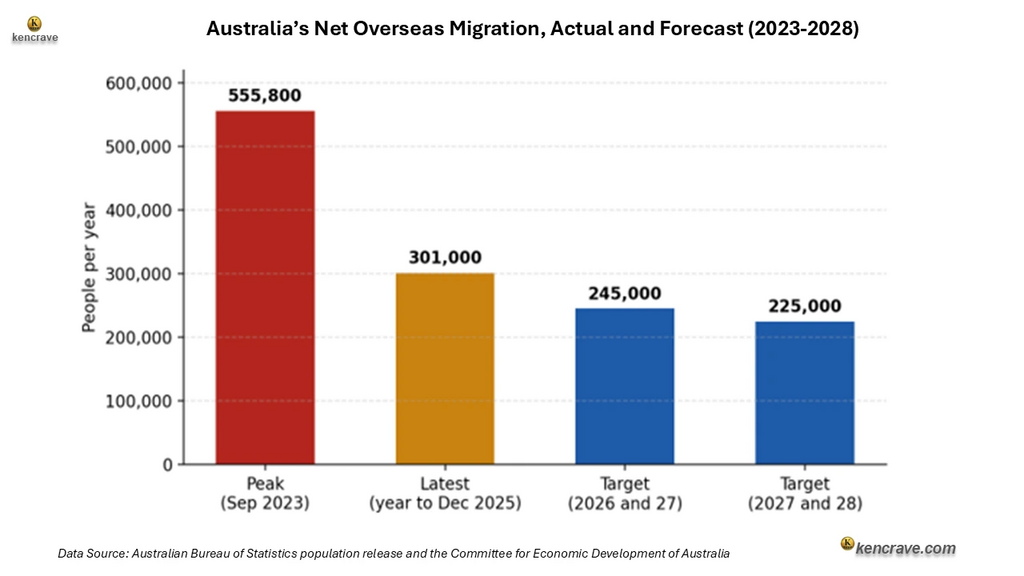
Australia is tightening temporary migration rules with the goal of reducing net overseas migration from around 301,000 in the year ending December 2025, before decreasing to 245,000 in 2026-27 and 225,000 in 2027-28.
The changes restrict international students bringing family members, tighten visa switching and extensions, adjust working holiday arrangements, and increase enforcement against visa overstayers.
The policy responds to a real problem. Australia's population grew by about 412,500 people in 2025, and net overseas migration accounted for about 301,000 of that growth. Housing, infrastructure and cost of living pressure have become central economic concerns.
But migrants are not only consumers of housing and services. They are also workers, taxpayers, students, entrepreneurs and exporters through education. This report looks at a key question: can Australia reduce migration to ease pressure on housing and infrastructure without impacting the economy negatively?
Migration helps provide workers, skills, tax revenue, and export income. The answer is not just about how many migrants Australia accepts. It also depends on which migrants are reduced, which are kept, and whether the economy can replace the workers, skills, and income that are lost.
Australia's Key Migration Numbers: Targets, Population and Economic Indicators
Australia's net overseas migration has moderated significantly from post-pandemic peaks, reaching approximately 301,000 people in the year to December 2025.Population growth over the same period was approximately 412,500 people, with migration remaining a major driver of overall population growth (Australia Bureau of Statistics, 2026).
The Australian Government has set lower migration planning assumptions for coming years, targeting:
245,000 net overseas migrants in 2026-2027.
225,000 net overseas migrants in 2027-2028.
The Permanent Migration Program remains capped at 185,000 places per year, with around 70% allocated to skilled migrants, reflecting an ongoing focus on addressing workforce and skills shortages.
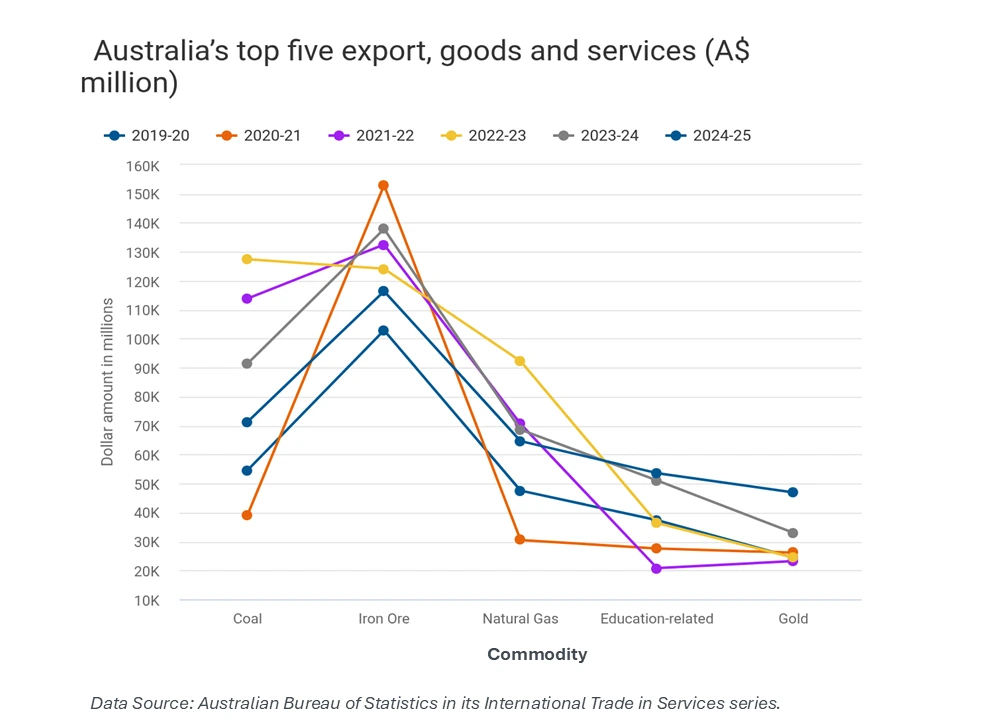
Migration also delivers substantial economic benefits. According to the ABS Balance of Payments data, international education generated approximately A$53.6 billion in export earnings in the year to June 2025, making it one of Australia's largest export sectors.
Line graph of Australia's five largest exports from 2019-20 through 2024-25, highlighting export values for iron ore, coal, natural gas, education-related services, and gold in Australian dollars (A$ million), based on Australian Bureau of Statistics trade data.
Fiscal modelling suggests migration has a significant long-term impact on government finances:
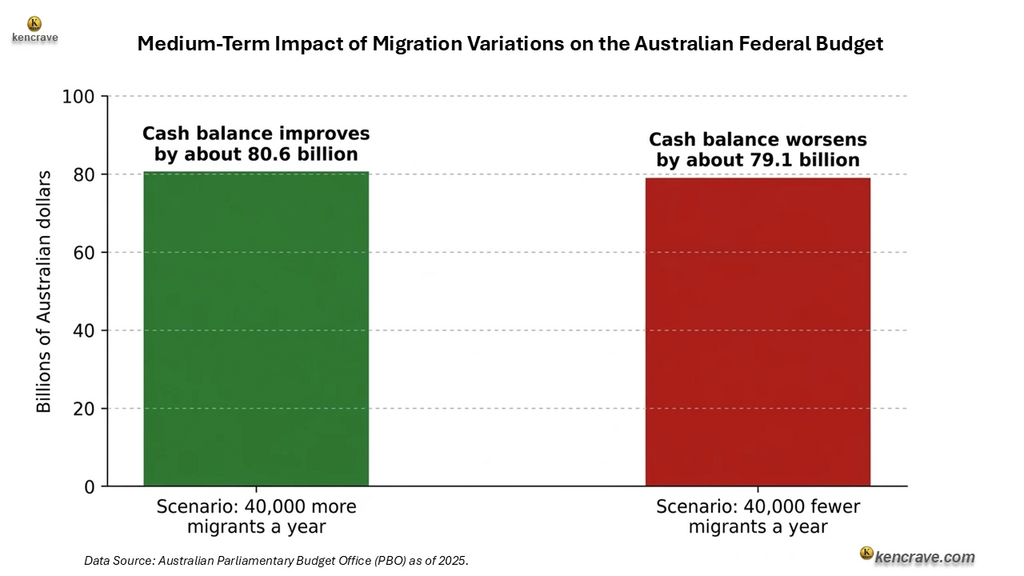
40,000 additional migrants per year are estimated to improve the medium-term fiscal position by approximately A$80.6 billion.
40,000 fewer migrants per year are estimated to reduce the medium-term fiscal position by approximately A$79.1 billion.
International education exports (FY2024-2025): A$53.6 billion
Fiscal gain from +40,000 migrants annually: +A$80.6 billion
Fiscal impact from −40,000 migrants annually: −A$79.1 billion
Australia’s Historical Migration Overview and Comparative Cases
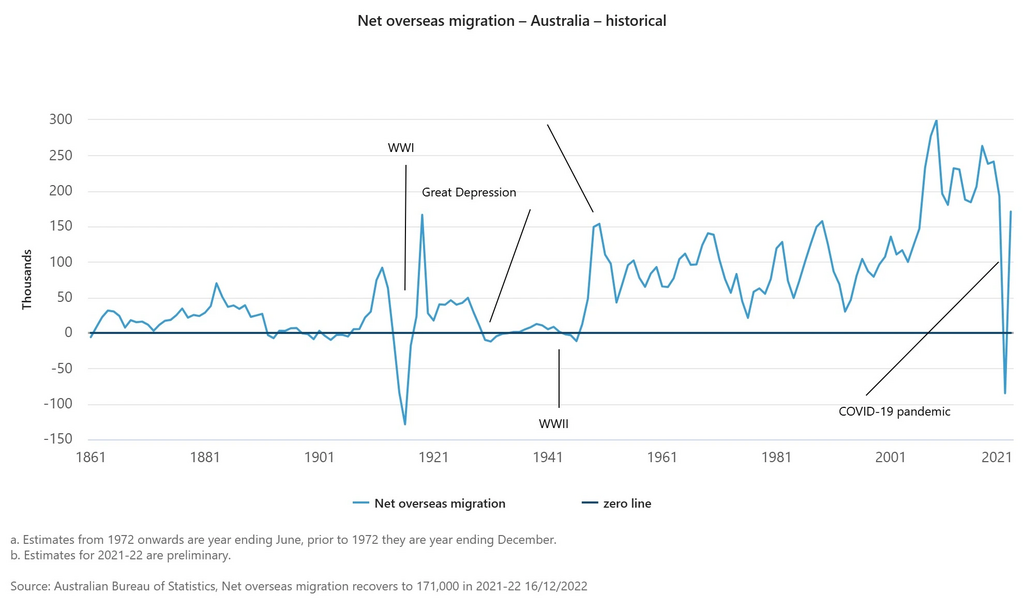
Australia has reduced migration during previous periods of economic adjustment. In the early 1990s, net overseas migration fell sharply, from about 86,000 in 1990-1991 to about 30,000 in 1992-1993.
In the early 2010s, migration also declined from about 300,000 in 2008-2009 to 180,000 in 2010-2011. However, migration increased again to more than 230,000 in both 2011-2012 and 2012-2013.
The current policy differs from these earlier periods because it sets explicit targets for net overseas migration of 245,000 in 2026-2027 and 225,000 from 2027-2028. It also places greater emphasis on managing temporary migration, particularly international students and other temporary visa holders.
Note: Historical evidence does not provide clear evidence that migration cuts alone lead to large or lasting reductions in housing costs.
Historical line graph of Australia's net overseas migration from 1861 to 2022, measured in thousands of people, illustrating periods of migration growth, negative migration during major disruptions, and record increases before the COVID-19 pandemic, based on Australian Bureau of Statistics data.
The decline in migration in the early 1990s occurred during a broader economic downturn, making it difficult to separate the effect of lower migration from weaker economic activity. Similarly, the decline in the early 2010s was relatively short lived, as migration increased again soon afterwards.
Recent Australian evidence nevertheless shows that migration can affect housing demand. Research using local area data found that a 1% increase in net overseas migration as a share of the local population was associated with higher house and unit rents (Marcel Peruffo, The University of Sydney 2025).
This suggests that reducing migration could provide some demand side relief, particularly in rental markets, but the historical record does not show that migration cuts by themselves are sufficient to produce sustained improvements in housing affordability.
Overall, previous Australian experience suggests that migration reductions can moderate housing demand, but their effect on housing costs depends on wider economic conditions and the ability of the housing market to increase supply.
The current policy is therefore more likely to affect housing affordability when migration management is accompanied by increased housing construction, faster planning approvals and improved infrastructure provision.
Australia's Comparative Migration Policyto New Zealand, Canada and UK
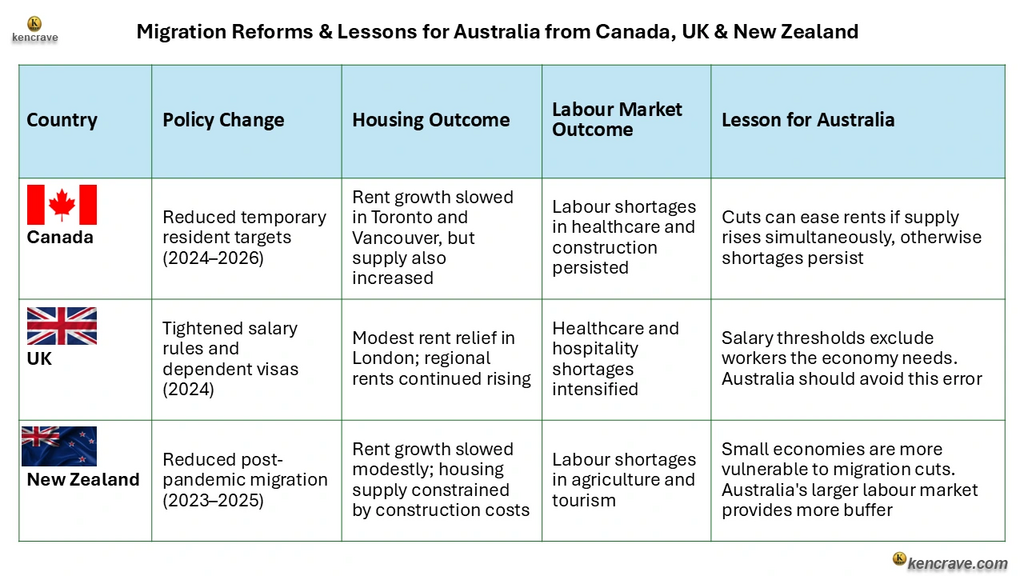
Australia’s Migration approach is similar to recent changes in New Zealand, Canada and the UK. All four countries have tightened temporary migration, especially student and other temporary visa pathways, while continuing to support selected skilled migrants.
New Zealand has reduced migration after a sharp post pandemic increase, while also opening some skilled pathways to address labour shortages. Canada has introduced lower targets for temporary residents and international students while maintaining permanent skilled migration. The UK has tightened salary rules, dependent visas and eligibility for some jobs.
Comparative table analyzing migration reforms in Canada, the UK, and New Zealand, highlighting impacts on housing affordability, labor shortages, workforce growth, skilled migration, and economic policy to inform Australia's immigration and housing strategy.
Migration cuts have eased housing pressure only where supply reform accompanied them (Canada). They have also worsened labour shortages where they were not paired with domestic training (UK, New Zealand). Australia's policy is closest to the UK model having cuts without matching training investment.
Australia is therefore part of a wider policy shift among similar countries. However, the scale and effects of these changes differ depending on housing supply, labour needs and economic conditions.
Effects of Migration Cuts on Relationships with Key Source Countries
Australia’s tighter temporary migration policies could affect its relationships with major source countries in different ways. The main areas of impact are international education, family mobility, temporary employment and people to people links.
India
India is a major source of international students and permanent migrants to Australia. Restrictions on international students bringing family members could reduce Australia’s appeal to some Indian applicants, particularly those seeking longer term study and settlement.
To achieve this, Australia’s government tightened the rules for international students by restricting partner and family visas, targeting "course hopping,". As from July 1 2026, it increased the Student Visa Application Charge (VAC) from AUD $2,000 to A$2,500. With visa rejection rates reaching 28.4%, these changes could significantly slow future student arrivals.
China
China remains a major source of international students. Restrictions on family accompaniment could affect Chinese students who would otherwise consider studying in Australia. However, skilled and research migration pathways remain important, while the broader Australia China relationship is also shaped by trade, investment and strategic interests.
Philippines
The Philippines is an important source of skilled and temporary workers, including workers in healthcare and other services. Tighter temporary migration and working holiday arrangements could reduce opportunities for Filipino workers. This may affect labour mobility and people to people connections between the two countries.
United Kingdom
The UK is less affected by some of the changes because of preferential arrangements under the Australia UK Free Trade Agreement. These arrangements provide greater flexibility for British Working Holiday Makers than for many other nationalities. As a result, the immediate impact on UK migration pathways is more limited.
The immigration effects therefore vary across the four countries. India and China are more exposed through international education and family migration, while the Philippines is more exposed through temporary work pathways.
The UK is comparatively less affected because of its preferential arrangements. Over time, these changes could influence Australia’s attractiveness to students, skilled workers and temporary migrants, with possible implications for education links, labour mobility and people to people relationships.
Australia Migration Rule Changes: Students, Visa Switching, Working Holiday, Overstayer Enforcement
The Australian Government is not simply cutting every migration category by the same amount. The new rules mainly target international students and their dependents, working holiday makers, temporary visa holders trying to switch pathways, and visa overstayers.
Australia intends to keep pathways open for workers in areas the economy considers critical. Sectors such as healthcare, aged care, and specialized construction trades continue to receive priority processing and fast-tracked pathways under the revamped skilled framework to prevent economic bottlenecks.
The Australian Government is trying to reduce population pressure while preserving the migration it sees as economically valuable. Whether that balance can be achieved is the key economic question in this report analysis.
Net Overseas Migration Trend: Down 45% from 555,800 Peak to 301,000 Before New Cuts
Net overseas migration surged after Australia reopened its borders following the COVID nineteen pandemic, reaching a peak of about 555,800 people in the September 2023 quarter. It has been falling since. In the year to December 2025, net overseas migration was about 301,000, already down by roughly 45%t from the peak.
Australia net overseas migration trends and forecasts (2023-2028), highlighting the record migration peak in 2023 and projected declines in annual migration as population growth returns to more sustainable levels.
Takeaway:The Australian government is not responding to migration that keeps accelerating. It is trying to accelerate and lock in a decline that was already underway, while also changing which migrants make up the intake
Migration and Australia Housing Crisis: Why Cutting Numbers Is the Strongest Economic Argument
Housing is one of the strongest economic arguments for reducing migration. Higher migrant inflows increase the number of households, raising demand for rental housing and competition for available properties, which can push up rents.
This pressure is particularly evident in Australia’s largest cities, including Sydney, Melbourne, Brisbane and Perth, where population growth can outpace new housing construction.
However, other factors also contribute to the housing crisis. These include limited housing supply, land availability, planning approvals, infrastructure, financing, and construction costs.
Cutting Migration Could Worsen Housing Shortage
This is a key challenge for Australia: Cutting migration without a reduction in housing. Some migrants who add to housing demand are also the workers who build housing. Lower migration reduces housing demand, but it can also shrink the construction workforce and slow the growth of housing supply.
If Australia aggressively reduces migration without increasing housing construction, planning efficiency and construction productivity, it risks treating a supply problem as mainly a population problem. That is one of the biggest weaknesses to watch as the policy takes effect.
Falling Migration and Australia Labour Market: Wages, Shortages, Who Replaces Migrant Workers
The economic impact of lower migration depends largely on whether domestic workers can fill workforce gaps left by fewer migrants. Where Australian workers are available and able to move into these roles, lower migration can support stronger employment outcomes, higher wages in shortage occupations, increased training investment, and greater labour force participation.
Key Scenarios Could Emerge with Policy in Action for Australia
1. Domestic workers replace migrants
Higher employment among local workers
Stronger wage growth in shortage occupations
Greater incentives for training and workforce development
Increased labour force participation
2. Workers cannot be replaced
Labour shortages intensify
Wages and business costs rise
Lower production and service capacity
Increased inflationary pressures
Slower economic growth
These pressures are most likely to be felt in sectors that already face workforce shortages, including healthcare, aged care, construction, agriculture, hospitality, and education.
The economic outcome differs substantially depending on whether Australian workers, automation, higher wages, outsourcing or simply reduced production ends up filling the gap.
Key Risks Emerging from Australia’s Migration Policy 2026
International Education: Australia’s $53.6 Billion Export Industry at Risk
International education generated about 53.6 billion Australian dollars in export earnings in the year to June 2025, making it one of Australia's largest export industries. Students contribute through tuition fees, accommodation, transport, food, retail, tourism and university research.
A decline in international students means lower university revenue, less student spending, weaker demand for accommodation and retail, and lower education export earnings overall. Because the reforms restrict the ability of many students to bring partners and children, the risk is not only how many students Australia loses, but whether it loses the high value students who have other countries to choose from.
Risk of Losing Skilled Talent
Tighter migration rules could make Australia less attractive to skilled students and workers. People may choose countries that offer better work opportunities, family options and clearer paths to permanent residence. This could affect Australia’s ability to attract highly skilled people from countries such as India and China.
Canada, the United States and Singapore continue to attract skilled workers, students and researchers. If Australia offers fewer opportunities or more restrictions, some applicants may choose these countries instead. This could reduce international student numbers and limit the future supply of skilled workers and researchers.
Australia therefore needs to balance lower migration with clear pathways for skilled workers, students and researchers. Maintaining these pathways could help Australia remain competitive for high skilled talent. This is particularly important for sectors that depend on international skills and knowledge.
Parliamentary Budget Office: Migration’s Medium-Term Fiscal Impact Nears $80.6B Gain vs $79.1B Cost
The Parliamentary Budget Office (PBO) found that migrants typically have a more positive fiscal impact than the population as a whole. This is partly because migrants are more concentrated in working-age groups and generally arrive after many of their education and early healthcare costs have already been incurred overseas.
Comparison bar chart illustrating the fiscal impact of migration variations on the Australian federal budget. The chart shows that 40,000 more migrants annually improve the budget cash balance by approximately A$80.6 billion, while 40,000 fewer migrants annually worsen the cash balance by approximately A$79.1 billion.
The Budget Office estimated that a scenario with 40,000 additional migrants a year would improve the Commonwealth's underlying cash balance by about 80.6 billion Australian dollars over the medium term, while a scenario with 40,000 fewer migrants would worsen it by about 79.1 billion Australian dollars.
This does not imply that Australia should simply maximize migration. It means that migration carries real fiscal benefits as well as costs, and reducing it lowers tax receipts and economic activity even as it eases some service and infrastructure demand.
GDP vs GDP Per Person: Why Living Standards Depend on Migration's Productivity Impact
More migrants equate to more workers, more consumers and more production resulting to an increase in total GDP. But for living standards, GDP per person is a significant factor for consideration. If the population grows by two percent and GDP grows by two and a half percent, income per person rises only modestly. If the population grows by two percent and GDP grows by one and a half percent, income per person falls.
Population growth by itself is not evidence of rising living standards. The real question is whether migrants increase Australia's productive capacity faster than they increase demand.
This depends on skills, productivity, capital investment, infrastructure, housing and how well the labour market matches workers to jobs.
Australia’s Migration Policy Contradictions: Trade-Offs Shaping Housing, Cost of Living and Universities
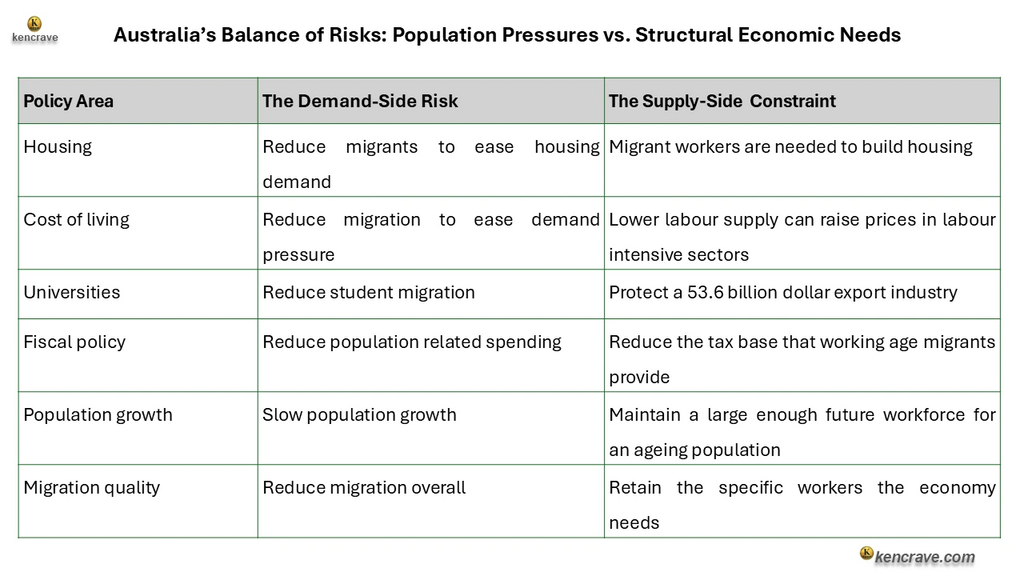
Australia’s migration debate highlights a series of policy contradictions, where reducing migration can help achieve one objective but simultaneously undermine another important economic, fiscal, or social goal.
The Budget Office estimated that a scenario with 40,000 additional migrants a year would improve the Commonwealth's underlying cash balance by about 80.6 billion Australian dollars over the medium term, while a scenario with 40,000 fewer migrants would worsen it by about 79.1 billion Australian dollars.
This does not imply that Australia should simply maximize migration. It means that migration carries real fiscal benefits as well as costs, and reducing it lowers tax receipts and economic activity even as it eases some service and infrastructure demand.
GDP vs GDP Per Person: Why Living Standards Depend on Migration's Productivity Impact
More migrants equate to more workers, more consumers and more production resulting to an increase in total GDP. But for living standards, GDP per person is a significant factor for consideration. If the population grows by two percent and GDP grows by two and a half percent, income per person rises only modestly. If the population grows by two percent and GDP grows by one and a half percent, income per person falls.
Population growth by itself is not evidence of rising living standards. The real question is whether migrants increase Australia's productive capacity faster than they increase demand.
This depends on skills, productivity, capital investment, infrastructure, housing and how well the labour market matches workers to jobs.
Australia’s Migration Policy Contradictions: Trade-Offs Shaping Housing, Cost of Living and Universities
Australia’s migration debate highlights a series of policy contradictions, where reducing migration can help achieve one objective but simultaneously undermine another important economic, fiscal, or social goal.
Comparative table showing the trade-offs between housing demand, cost-of-living pressures, population growth, skilled migration, workforce development, and economic sustainability, highlighting key policy challenges shaping Australia's labor market and long-term economic outlook.
The table above highlights why the Australian government is targeting specific temporary pathways rather than cutting skilled migration across the board.
Who Wins and Loses Under Tighter Australia’s Migration Policy
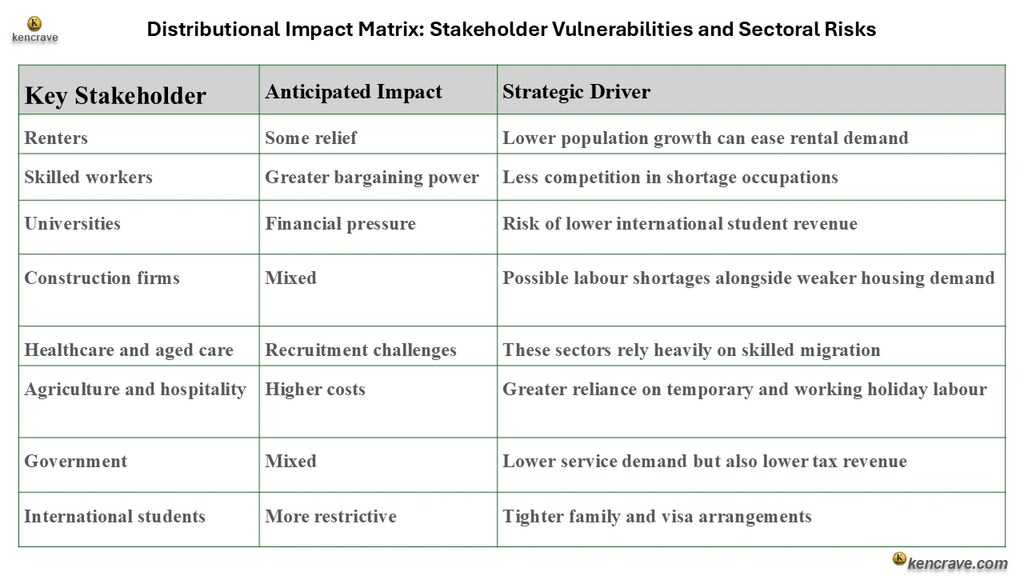
Australia’s migration policies create uneven impacts across different groups, with efforts to reduce migration potentially easing some pressures while creating new challenges for key industries, public finances, and workforce-dependent sectors.
The table matrix below highlights this uneven impacts.
Table showing how changes to Australia's migration levels affect key stakeholder groups, including renters, skilled workers, universities, construction firms, healthcare providers, governments, and international students.
What Could Happen Under Three Migration Scenarios for Australia? Success, Stagnation and Substitution
Successful targeted migration. Australia cuts lower priority migration while keeping critical skilled migration, and housing construction, domestic training, automation and productivity all improve at the same time. This allows lower migration without severe labour shortages.
Demand falls but supply does not respond. Migration falls, but housing construction stays constrained, universities lose students, labour shortages emerge and productivity stays weak. Australia ends up with lower population growth, weaker economic growth, and housing that is still unaffordable.
Domestic substitution succeeds. Australia reduces migration while aggressively expanding vocational training, workforce participation, automation, infrastructure investment and construction productivity, so lower migration is absorbed without major disruption over time.
Stakeholder Recommendations
Australian Government and Treasury
Publish regular, disaggregated data on migration category change.
Pair any cuts with matching investment in housing supply and construction productivity.
Transparently track the fiscal revenue trade-offs as net migration falls.
Universities, Employers and Education Sector
Diversify student recruitment and invest now in domestic training, wages and automation in shortage sectors (healthcare, aged care, construction, agriculture, hospitality).
Seek predictable visa settings for high-value skilled and student pathways.
State and Local Governments.
Fast-track planning approvals and infrastructure for housing in the greatest shortfall areas.
Support regional employers with targeted migration and training programs based on realistic medium-term population forecasts.
Bottom-line: Can Australia Replace What Fewer Migrants Remove?
Reducing migration is not itself an economic solution. It shifts pressure from one part of the economy to another. A decline in migration can ease rental demand and infrastructure pressure, but it can also reduce labour supply, education exports, tax revenue and the pool of workers available to build housing and deliver essential services.
The challenge for Australian government is not simply moving the immigration numberfrom around 300,000 toward 225,000. It is ensuring the migrants who remain in Australia match the country’s economic needs, while domestic skills, productivity, housing supply and labour force participation grow fast enough to fill the gap.
Key Takeaways: what you need to know about Australia's migration cut
Migration is already falling, with net migration having dropped by about 45% from 555,800 to around 301,000.
More cuts are planned as the Australian Government plans to reduce migration further, mainly by tightening rules for students, working holiday makers and visa changes.
A decline in migration may reduce pressure on housing, but migrants also work in construction, so cuts alone may not solve the housing shortage.
The Australian economy may feel the impact as international students bring about A$53.6 billion to Australia, while migrants also contribute to government finances.
Quality migration matters more than numbers.
Key questions people ask about Australia's migration cut
1. Is Australia's migration intake still rising?
No. Net migration peaked at about 555,800 in 2023 and fell to around 301,000 by December 2025.
2. Will cutting migration fix Australia's housing crisis?
Not on its own. It may reduce housing demand, but Australia also needs to increase housing supply. 3. How much does international education contribute to Australia's economy?
International education generated about A$53.6 billion in export earnings in the year to June 2025. 4. Do migrants cost the government money or generate revenue?
Overall, migrants have a positive fiscal impact. The Parliamentary Budget Office estimates that 40,000 additional migrants a year could improve the government’s medium term cash balance by about A$80.6 billion.
5. What is the biggest risk of cutting migration?
If housing, training and productivity do not improve quickly enough, Australia could face labour shortages, weaker education exports and slower economic growth.
6. Can Australia replace the workers and skills lost through lower migration?
Not immediately. Australia would need more local training, workforce participation and automation to fill labour gaps, especially in healthcare, construction, aged care and agriculture.
Sources
This analysis is based on Australian Bureau of Statistics population and migration releases, Parliamentary Budget Office fiscal modelling, Department of Education export income data, CEDA labour market research, peer-reviewed housing research, and comparative policy evidence from Canada, the UK, and New Zealand. It is intended as a practical guide for policymakers, Treasury analysts, university administrators, employers in shortage sectors, and migration researchers operating in Australia's immigration and labour market policy space.