
SouthAmerica
Atome's $665m Paraguay green hydrogen project reached FID in April 2026, but Paraguay revoked the tariff decree seven weeks later. Here's why arbitration followed and what it means for investors.
April 2026, Atome's Villeta project in Paraguay closed a US$665 million financing package. Seven weeks later, the government revoked the electricity tariff decree that the whole package depended on. The project had secured financing, but the funds had not yet been released.
An executed PPA with ANDE remained a lender condition precedent, preventing the first disbursement. On 17 September 2026, Atome served a Notice of Dispute and Intent to Submit a Claim to Arbitration under the UK-Paraguay BIT.
Villeta shows both sides of the green hydrogen industry. The project showed that achieving Final Investment Decision (FID) on purely commercial terms is possible, while also highlighting how sovereign and contract risks can still prevent a financially sound project from moving forward.
Key Takeaways
Key Takeaways
- Villeta reached FID in April 2026 with a US$665 million financing package. Paraguay revoked the tariff decree seven weeks later.
- South America holds 143 hydrogen projects worth approximately US$263 billion. Only ten reached FID between 2024 and September 2025. The bottleneck is policy and commencement certainty, not capital.
- The projects that advance have signed offtakes and settled power pricing. For investors, the question is whether a project can survive a policy change, not whether it can be financed.
Why Villeta Matters For Hydrogen Projects In Latin America
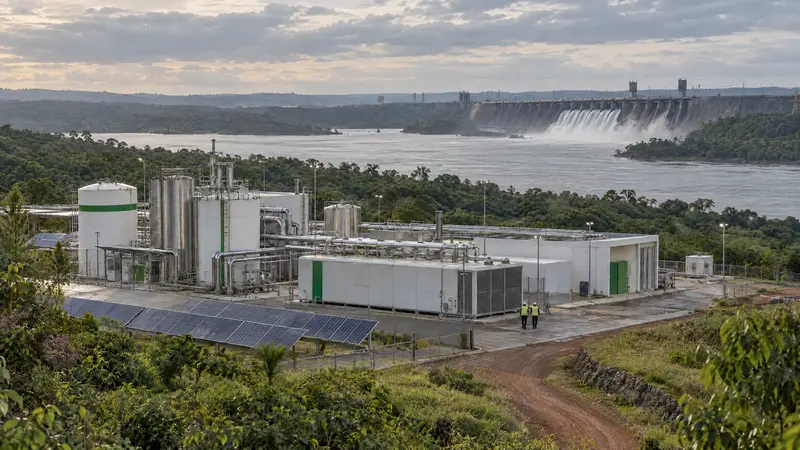
Villeta is the largest electrolysis project to pass FID in Latin America. It turns surplus hydropower into hydrogen, and then into low-carbon fertilizer, with output committed to Yara under a 10-year take-or-pay agreement. Unlike most hydrogen projects globally, it reached FID without dedicated production subsidies or host-government grants. The Villeta hydrogen project is a blueprint for financing green hydrogen derivatives.
How The Villeta Hydrogen Project Was Financed
How The Villeta Hydrogen Project Was Financed
The US$665 million package comprised US$420 million in debt and US$245 million in equity. Atome secured the debt from development finance institutions including IFC (the World Bank Group's private-sector arm), the Inter-American Development Bank's (IDB) Invest, the European Investment Bank (EIB), the Dutch Entrepreneurial Development Bank (FMO) and the Green Climate Fund. Equity for the Villeta project was led by Hy24.
What the project avoided was a production subsidy. Instead, it relied on two commercial foundations: access to low-cost hydropower secured through a long-term agreement and a fully contracted offtake arrangement. The power price was the key assumption underpinning the project's economics. A fixed electricity tariff of around US$30/MWh for 15 years, established by presidential decree, formed the basis of the cost model on which the financing package was built.
Why Did Atome's Paraguay Hydrogen Project Trigger Arbitration After FID?
Why Did Atome's Paraguay Hydrogen Project Trigger Arbitration After FID?
Financing the project was a lengthy process. Atome listed on the London Stock Exchange in December 2021 and initially targeted a final investment decision (FID) by mid-2022. However, setbacks during the engineering phase led to multiple delays, and FID was not reached until April 23, 2026. By then, the project had been under development for more than four years.
Just seven weeks later, on June 9, 2026, Paraguay’s President Santiago Peña repealed two tariff decrees. The replacement framework removed the fixed price structure that had underpinned the project's financing. Atome noted that it received no prior notice or consultation.
The revocation left a critical condition precedent unmet. Lenders required an executed power purchase agreement (PPA) with state utility ANDE before the first disbursement, but the agreement, while negotiated, had not yet been signed.
The revocation left a critical condition precedent unmet. Lenders required an executed power purchase agreement (PPA) with state utility ANDE before the first disbursement, but the agreement, while negotiated, had not yet been signed.
The dispute has since intensified. On September 17, 2026, Atome served Paraguay with a Notice of Dispute and Intent to Submit a Claim to Arbitration under the UK-Paraguay bilateral investment treaty. At the same time, the company notified ANDE of its intention to terminate the 2022 power purchase agreement (PPA), effective at the end of 2026, while stressing that the move should not preclude negotiations on a replacement agreement. However, as of Atome's latest public updates in early October 2026, no new PPA had been reached.
What The Atome Project Means For Investors And Lenders
After years of development, the project was brought to a standstill in a matter of weeks. The lesson for investors and lenders is clear. Political and regulatory risks after financing can be just as critical as commercial and construction risks beforehand. A decree does not provide the same protection as a contract, and the greatest vulnerabilities often lie in the conditions precedent.
After years of development, the project was brought to a standstill in a matter of weeks. The lesson for investors and lenders is clear. Political and regulatory risks after financing can be just as critical as commercial and construction risks beforehand. A decree does not provide the same protection as a contract, and the greatest vulnerabilities often lie in the conditions precedent.
Atome vs. Paraguay Arbitration: Why the PPA Termination Matters
The arbitration notice
On 17 September 2026, Atome served a Notice of Dispute and Intent to Submit a Claim to Arbitration on Paraguay through White & Case LLP. The notice was filed under the UK-Paraguay Bilateral Investment Treaty.
The claim was independently assessed by an internationally reputable damages expert as very substantial, that is, well into nine figures in US Dollars. Atome states this would be one of the largest if not the largest ever claims against the Paraguay State under any bilateral investment treaty.
The notice alleges that Paraguay breached the BIT through a series of acts and omissions, including the revocation of the presidential decrees that underpinned the project and provided long-term certainty over the term and pricing of the PPA. Atome notified the UK Government, as well as the embassies of the EU, France, Germany, and the United States in Paraguay, in addition to the Paraguayan Embassy in London, of the notice's submission.
The PPA termination
On 1 October 2026, Atome submitted a notice to terminate its 2022 PPA with ANDE, effective at the end of 2026. The 2022 PPA was signed in May 2022 and later amended to increase committed power supply to 145MW.
Atome had proposed a standstill agreement with ANDE to suspend obligations while negotiations continued. The parties could not agree on the form of the standstill. Atome stated the termination was necessary to prevent prejudice to ATOME and avoid any potential liability it might incur by remaining bound by the 2022 PPA.
The company stressed the termination should not hinder the efforts to pursue discussions with the Government and ANDE as to a new PPA to ensure the viability of the project.
Where the PPA Stands as of October 2026
As of October 2026, no replacement PPA had been signed. Under the UK-Paraguay BIT, the parties have a three-month period to reach an amicable resolution. If no viable resolution is achieved, Atome will pursue its claim at the International Centre for Settlement of Investment Disputes in Washington D.C.
Paraguay's Attorney General's Office confirmed it received the notice and is analyzing the implications. The office reiterated Paraguay's commitment to legal certainty, respect for investments, and compliance with international commitments.
Atome said it would continue to work in good faith with ANDE and the Government. The company also confirmed it was studying a mirror green fertilizer project in Brazil while awaiting the outcome of PPA discussions.
Why the PPA termination matters
The termination removes the last contractual link between Atome and ANDE. Without a PPA, the project has no power supply. Without power supply, the project cannot operate. The Yara offtake remains in place, but it cannot be fulfilled without electricity.
The dispute centers on the electricity price. Atome sought a fixed tariff of approximately US$30/MWh for 15 years. ANDE's current Pliego 21 tariff for the electro-intensive segment is approximately US$36/MWh. In official investor updates, ATOME declared that electricity represents more than 75% of Villeta's operating expenditure making the power price the project's largest input cost.
What This Means for Other Green Hydrogen Projects in South America
The regional pipeline is large but stalled
According to a new Insight Report from the Energy Industries Council (EIC), South America holds a pipeline of 143 hydrogen projects with combined potential capital spending of approximately US$263 billion. 141 of the 143 projects in the pipeline target green hydrogen. Yet the vast majority remain at early stages. As of September 2025, only ten projects had reached FID since 2024, and five projects have been put on hold.
Chile is watching and already adjusting
As of December 2025, Chile had 83 announced green hydrogen projects, but only 17 are operational, mostly at pilot or demonstration stage. The country's project portfolio of green hydrogen and its derivatives is valued at an estimated US$170 billion. However, Corfo, Chile's economic development agency, announced a strategic shift in June 2026, reorienting its green hydrogen support toward domestic demand and job creation.
The IEA revised down its 2030 global clean hydrogen production projection from 49 million to 37 million tonnes annually. Chile's private sector has already retreated as AES Andes withdrew from its US$10 billion INNA project, EDF cancelled its Magallanes initiative, and TotalEnergies postponed environmental processing of its US$16 billion megaproject.
Brazil's hydrogen pipeline is growing, but FIDs remain scarce
According to EIC-DataStream webinar announcement on 11 February 2026, Brazil had 73 proposed hydrogen projects representing over 43 GW of electrolyser capacity and US$106.5 billion in capital expenditure. The World Bank approved US$134 million in financing for the Ceará green hydrogen hub (Pecém Industrial and Port Complex) in July 2025.
Brazil's National Hydrogen Programme (PNH2), together with recent legislation such as Laws 14.948/2024 and 14.990/2024, establishes definitions, certification rules and fiscal incentives for low-carbon hydrogen. However, grid readiness and transmission expansion continue to strain project progress, particularly to the Northeast region of Brazil.
Uruguay shows what a smaller, financed project looks like
Uruguay's Kahirós project, developed in partnership with Grupo Santander, is the first green hydrogen investment announced by IFC worldwide on December 3, 2025. The Kahiros project secured a US$20 million green loan from International Finance Corporation (IFC). Apart from IFC, the project is also financed by the UN-backed Renewable Energy Innovation Fund (REIF).
It is expected to begin operations by the end of 2026. The project integrates a 4.8 MW solar plant, produces 77 tonnes of green hydrogen annually, and powers 6 fuel-cell trucks for timber transport. IFC notes that fewer than 5% of announced green hydrogen projects worldwide have reached investment stage.
Fortescue's $8.4 Billion Argentina Green Hydrogen Project: Five Years On, Still Pre-FID
On 1 November 2021, Fortescue announced a US$8.4 billion investment in Río Negro, Argentina. The announcement was made at the COP26 climate summit in Glasgow. The plan was to produce green hydrogen. Fortescue aimed to make Río Negro a global export hub by 2030 with a target capacity of 2.2 million tonnes annually. The project remains at feasibility stage. The EIC notes that Argentina is stuck in the pre-FID phase with currency instability, inflation, and policy uncertainty undermining investor confidence for green hydrogen projects in the country.
How Investors Can Make Hydrogen Projects Survive Policy Change
Villeta's setback highlights five checks investors should make before committing capital. The project reached FID with a US$665 million package, but the power price rested on a decree that was later revoked, and the executed PPA was a condition that had to be met before the first disbursement. No investor can eliminate policy risk, but they can reduce how much of it they incur.
- Check what instrument carries the key terms. The problem in Villeta was not the price itself, but how that price was secured. The tariff depended on a presidential decree that could be changed or withdrawn by the government. A signed power contract provides more protection. A tariff or incentive written into law provides more still. Brazil's incentives are embedded in statute (Laws 14.948/2024 and 14.990/2024), although key implementing rules remain unfinished and grid constraints have yet to be resolved. For any project, the critical question is simple: who guarantees the power price, and how easily can it be changed?
- Require key contracts to be executed before financing is announced. Villeta reached FID with the agreed PPA still unsigned. Atome notes that the condition set remained unmet after the decree was cancelled thus first disbursement could not proceed. Investors should treat an agreed-but-unsigned power contract as an open risk.
- Layer protections that do not depend on goodwill. Atome is now relying on the UK-Paraguay investment treaty, having served a notice of dispute on 17 September 2026. The World Bank Group’s insurer MIGA offers political risk cover for losses from expropriation and breach of contract by governments and state-owned entities (MIGA). Investors should check which treaty covers the holding company before investing, because the route and timing of protection depends on how the investment is structured.
- Use the lender group as a stabilizer, with limits. Atome itself noted that IDB Invest and the EIB provide support and financial assistance to ANDE. The Villeta Hydrogen Project shows this is not a guarantee. Development finance institutions can raise the political cost of a reversal since governments value their relationship with multilateral lenders.
A screening question for adoption by investors. For any project, ask: if the host government changes the rules tomorrow, which contract protects us, and who has signed it? If the answer is a decree or an unsigned agreement, the project is not yet as fully financed as it looks.
Bottomline
Villeta proved that the financing model for subsidy-free green hydrogen can work. It also proved that the model can be undone by a single decree. Across the region, the pattern is consistent, suggesting that financing is not the bottleneck, policy stability and offtake certainty are.
Chile's Corfo has already pivoted toward domestic demand and smaller projects. Brazil is building infrastructure but waiting for FID. Uruguay has one project, Kahirós, which is one of the few projects to reach financial close, with operations expected by the end of 2026.
Argentina has a US$8.4 billion announcement, a hydrogen bill pending in Congress, and no enacted hydrogen law.
For investors, the key question is no longer whether a project can be financed, but whether it can withstand a political and regulatory change.
Atome Paraguay Arbitration FAQs: FID, the $665m Financing, PPA Termination and What It Means for Latin America's Hydrogen Pipeline
The Atome–Paraguay dispute turns on four facts: a US$665m financing closed at FID in April 2026, a tariff decree revoked seven weeks later, a PPA terminated effective end-2026, and a nine-figure BIT claim filed in September 2026.
1. Why did Atome file for arbitration against Paraguay?
Paraguay revoked the tariff decrees underpinning Villeta's fixed US$30/MWh power price on 9 June 2026, leaving the lenders' PPA condition precedent unmet. Atome filed a Notice of Dispute under the UK–Paraguay BIT on 17 September 2026.
Paraguay revoked the tariff decrees underpinning Villeta's fixed US$30/MWh power price on 9 June 2026, leaving the lenders' PPA condition precedent unmet. Atome filed a Notice of Dispute under the UK–Paraguay BIT on 17 September 2026.
2. How much is Atome claiming from Paraguay?
Atome says the claims could run into billions in US dollars which is potentially the largest BIT claim against Paraguay.
Atome says the claims could run into billions in US dollars which is potentially the largest BIT claim against Paraguay.
3. Did Villeta reach FID?
Yes. Villeta reached FID on 23 April 2026 with a US$665m package (US$420m debt, US$245m equity). Paraguay revoked the tariff decree seven weeks later, before disbursement.
Yes. Villeta reached FID on 23 April 2026 with a US$665m package (US$420m debt, US$245m equity). Paraguay revoked the tariff decree seven weeks later, before disbursement.
4. Why did Atome terminate its 2022 PPA with ANDE?
The parties could not agree a standstill, so Atome gave notice on 1 October 2026 to terminate the 145MW PPA effective end-2026, avoiding liability while pursuing a new PPA. No replacement has been signed.
The parties could not agree a standstill, so Atome gave notice on 1 October 2026 to terminate the 145MW PPA effective end-2026, avoiding liability while pursuing a new PPA. No replacement has been signed.
5. What does the Atome case mean for Latin American hydrogen?
Financing is not the bottleneck, but policy and contract certainty are. Of the 143 South American hydrogen projects worth about US$263bn, only 10 reached FID between 2024 and September 2025.
Sources
Financing is not the bottleneck, but policy and contract certainty are. Of the 143 South American hydrogen projects worth about US$263bn, only 10 reached FID between 2024 and September 2025.
Sources
- Atome PLC. "ATOME Gives Notice to Terminate 145MW Green Fertiliser Power Deal with Paraguay." Regulatory News Service Announcement, October 1, 2026.
- Atome PLC. "Notice of Dispute and Intent to Submit Claim to Arbitration under the UK–Paraguay Bilateral Investment Treaty." Regulatory News Service Announcement, September 17, 2026.
- Corfo. "Corfo Reorienta Fomento al Hidrógeno Verde con Énfasis en Demanda Interna y Generación de Empleo." Government Press Release, June 30, 2026.
- Energia y Negocios. "Kulfas, Carreras y Fortescue en zona para el desarrollo del proyecto Hidrógeno Verde." News Report, November 2021.
- Energy Industries Council (EIC). "South America Hydrogen Insight Report." Industry Report, December 2025.
- EQS News. "ATOME PLC: Notice of Dispute and Intent to Submit Claim to Arbitration under the UK–Paraguay Bilateral Investment Treaty." Corporate News Release, September 17, 2026.
- Fuel Cells Works. "ATOME Gives Notice to Terminate 145MW Green Fertiliser Power Deal with Paraguay." News Report, October 2, 2026.
- Gasworld. "Atome Threatens Arbitration Against Paraguay over Green Fertiliser Project PPA." News Report, September 16, 2026.
- Gasworld. "Atome to Axe 145MW Green Fertiliser Power Deal as Paraguay Dispute Continues." News Report, October 1, 2026.
- IDB Invest. "IDB Invest Coordinates Financing for Paraguay's First Green Hydrogen Fertilizer Project." Press Release, March 13, 2026.
- International Energy Agency (IEA). "Global Hydrogen Review 2025." Global Report, 2025.
- International Finance Corporation (IFC). "IFC Selects Uruguay for Its First-Ever Global Green Hydrogen Investment." Press Release, December 3, 2025.
- Senado de la Nación Argentina. "Número de Expediente 297/26: Proyecto de Ley de Marco Regulatorio para la Industria del Hidrógeno de Origen Renovable y de Bajas Emisiones y sus Derivados." Legislative Record, 2026.
- World Bank. "World Bank Supports Ceará's Green Hydrogen Strategy to Boost Economic Transformation." Press Release, July 9, 2025.