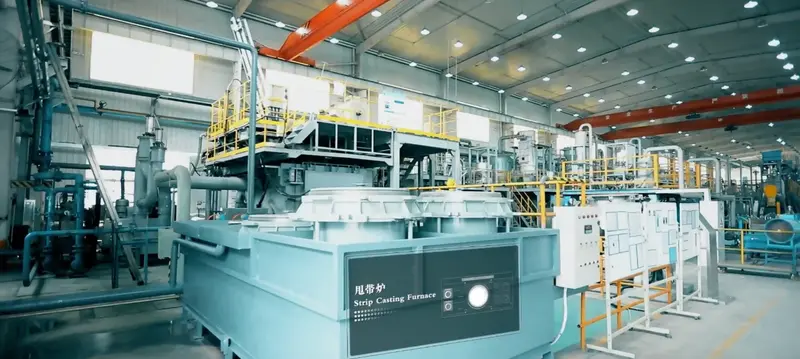
Modern rare-earth processing plant with strip casting furnace used in neodymium-iron-boron magnet production for defense and EV applications. Image Credits: Ideal Magnet Solutions
24 min read
Business
China Rare Earth Dominance 2026, U.S. Defense Supply Chain Risks And Costs
China controls 91% of rare earth refining and 94% of magnet production. Learn about U.S. defense vulnerabilities, the dysprosium price premium, and policy recommendations for supply chain resilience in 2026.
EXECUTIVE OVERVIEW
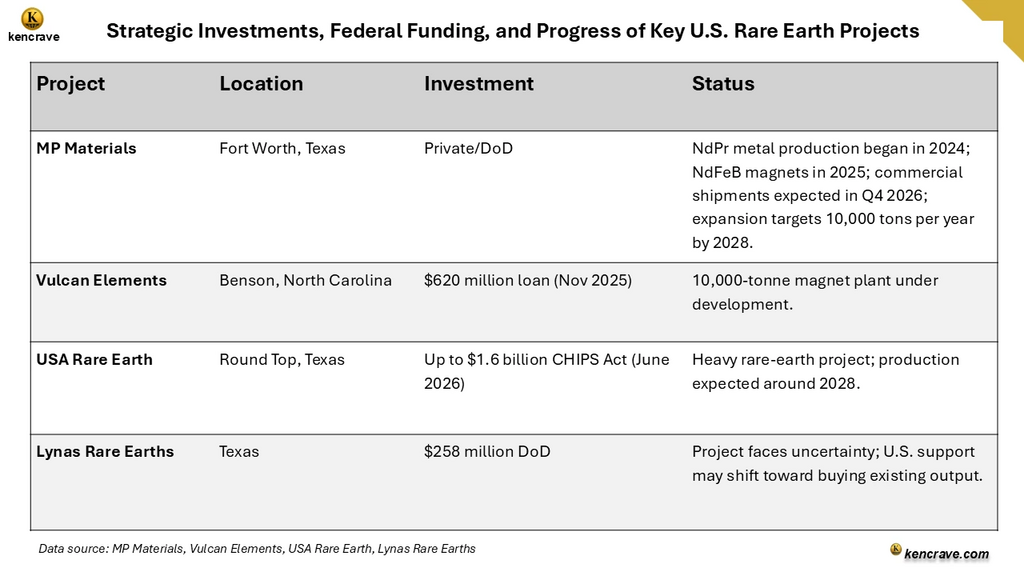
According to IEA 2026 report, China controls 91% of rare earth refining and 94% of magnet production. This has created a strategic vulnerability for U.S. defense and EV supply chains. The U.S. has committed over $2 billion to rebuild domestic capacity through projects like MP Materials (Texas), Vulcan Elements (North Carolina), and USA Rare Earth (Texas).
However, no U.S. facility processes dysprosium or terbium at scale-critical elements for high-temperature magnets used in fighter jets, missiles, and EV motors. Non-Chinese dysprosium costs 4.4× more today and could reach 8.3× by 2027. China's vulnerability is Myanmar, which supplies 98% of its heavy rare earth imports. The analysis concludes with policy recommendations for achieving operational resilience rather than total decoupling.
The Magnet War, China's 91% Refining Dominance Threatens U.S. Defense
China’s dominance of rare earths is the result of a decades long industrial strategy, not geology alone. From the 1980s, China expanded mining and invested heavily in processing and separation, helping its producers become more competitive while many Western operations declined. It then moved further downstream into metals, alloys and permanent magnets, creating an increasingly integrated supply chain.
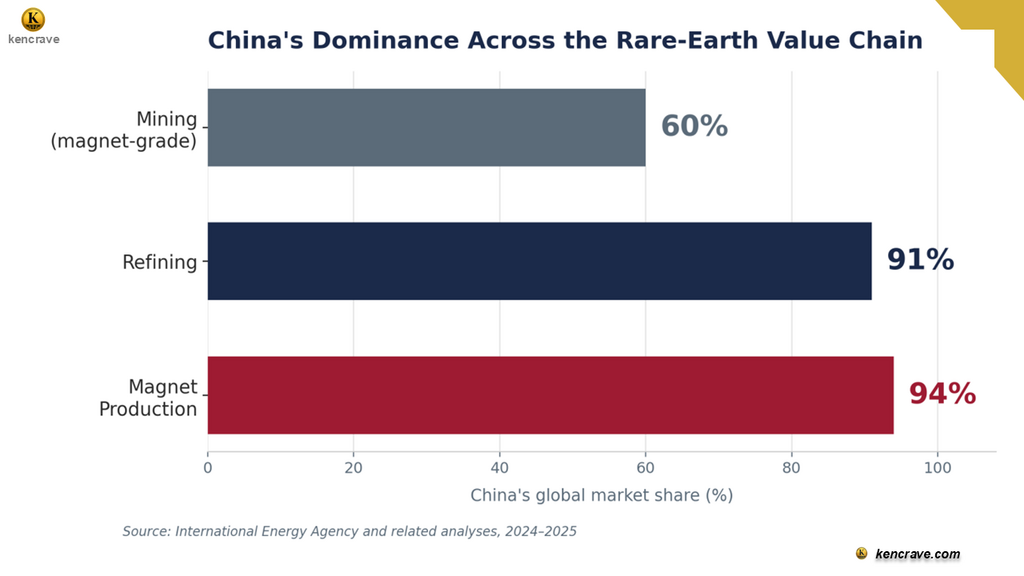
By 2024, China accounted for about 60% of global mined production of magnet rare earths, 91% of refined output and 94% of sintered permanent-magnet production, (International Energy Agency, 2026). This concentration has been reinforced by industrial consolidation, accumulated technical expertise and more recently, export controls. China's 2025 restrictions on several heavy rare earths demonstrated how this supply-chain dominance can translate into significant geopolitical and economic leverage.
What are Heavy Rare Earth Elements (HREEs)?
Heavy rare earth elements (HREEs) are a group of rare earths that includes gadolinium, terbium, dysprosium, lutetium and yttrium. They are generally less abundant and harder to separate and process than light rare earths. Dysprosium and terbium are particularly important because they improve the heat resistance and performance of NdFeB magnets used in electric vehicles, wind turbines, electronics and defence equipment. Their scarcity, processing difficulty and concentrated supply make HREEs strategically important to global industries and supply chains.
The U.S. has spent over $2 billion to rebuild its own supply chain. MP Materials in Texas recently made the first U.S. finished magnet in decades. But the gap is still large. The U.S. still gets an estimated 60–72% of its critical magnet inputs from China. Dysprosium, a key heavy rare earth, costs 4.4 times more outside China today and could cost 8.3 times more by 2027. The U.S. also has no facility that can process dysprosium and terbium at scale.
The real contest is not who mines the most rare earths. It is who can turn them into finished magnets at a competitive cost.
THE DOWNSTREAM DOMINANCE OF RARE EARTHS
Why Rare Earths Matter
Rare earths are not actually rare. The hard part is separating and refining them into pure, usable material. That takes special plants, chemicals and know-how that few countries have built. China's control gets stronger at every step. For the U.S. military, this means roughly 72% dependency on China for some critical inputs. That affects major areas of the U.S. Military: Military jets, naval radar and precision missile actuators.
China's Share of the Rare Earth Supply Chain (60%/91%/94%)
Figure 1: China rare‑earth value chain dominance chart showing 60% mining, 91% refining, and 94% magnet production market share.
How China Built Its Integrated Rare Earth Supply Chain Advantage
China does not just mine rare earths. It controls the whole chain: mining, separation, refining, alloying and magnet making. That means Chinese refiners always have raw material coming in and Chinese magnet makers always have buyers. A country can own large, rare-earth deposits and still depend on China. Owning the rock cannot be equated to owning the industry.
Export Controls as Geopolitical Leverage
On April 4, 2025, China started requiring export licenses for seven rare earth categories. The mentioned categories by China’s Ministry of Commerce and the General Administration of Customs issued were: Samarium (Sm), Gadolinium (Gd), Terbium (Tb), Dysprosium (Dy), Lutetium (Lu), Scandium (Sc). The real issue is not the licenses themselves. It is the imbalance: China can cut supply overnight and building a replacement plant takes years.
There is another problem. According to the European Parliament China's licensing process is opaque. Foreign buyers and allied intelligence agencies cannot predict which shipments will be delayed or denied. That turns supply chain planning into a guessing game and uncertainty in the long run.
THE U.S. RESPONSE TO MAGNET MINING
Public Funding and Policy Support for Domestic Production
The U.S. Department of Defense has spent more than $439 million since 2020 on domestic separation, refining, alloying and magnet manufacturing. That is less than 10% of total U.S. public funding. The CHIPS Act and the Office of Strategic Capital have added over $2 billion more to close the gap further on reliance on critical rare earths from China. Price floors ($110 per kg of NdPr), long-term purchase agreements and low interest loans help protect new plants from Chinese price swings. However, they do not close the full cost gap.
Key U.S. Rare Earth Projects and Their Status
Table 1: U.S. rare earth project investments table showing MP Materials, Vulcan Elements, USA Rare Earth, and Lynas funding and progress.
The Heavy Rare Earth Gap of Dysprosium and Terbium
As of August 2026, No U.S. facility is making dysprosium and terbium at scale yet, most are still under pilot tests. Lynas Seadrift would process these elements, which are essential for defense and EV magnets, but it is unclear whether it will be built. Without heavy rare earth processing, the U.S. will keep depending on China even if American mining expands.
Without dysprosium and terbium, the U.S. cannot make the high-temperature magnets needed for defense in fighter jets, missiles and next-generation EV motors. Washington needs a backup plan: speed up Round Top's heavy-REE development, sign offtake deals in Africa, or set up defense-stockpile release protocols.
To fix the 1.2 trillion dollars rare earth crisis, it is estimated that the U.S. would require a time horizon of about 10 years.
Other Rare Earth Elements and the Most Sought-After Elements
Beyond neodymium, praseodymium, dysprosium and terbium, other rare earth elements are also important to modern industries. Cerium and lanthanum are widely used in catalysts, glass polishing, batteries and specialised alloys, while yttrium and europium are important in electronics, lasers, displays and lighting.
Samarium is used in high temperature magnets, including those used in some defence technologies, while gadolinium has important applications in medical imaging and nuclear technology. Although these elements may not attract as much attention as the magnet rare earths, they remain important for different industrial and technological applications.
The most strategically important rare earths are neodymium, praseodymium, dysprosium and terbium, mainly because of their role in high-performance permanent magnets. These magnets are essential for electric vehicles, wind turbines, industrial motors, electronics and some defence systems.
China remains the leading producer and processor, while countries such as Australia, the United States, Brazil and Madagascar are developing alternative sources. Myanmar is also an important source of heavy rare earth feedstock, particularly for dysprosium and terbium, although much of this material is processed through Chinese supply chains.
The main challenge is not just simply accessing rare-earth deposits, but control of the entire supply chain from mining to processing and manufacturing. China has built a strong position in separation, refining and permanent-magnet production, giving it influence over global supplies even when the minerals are mined in other countries.
In 2024, China accounted for about 60% of mined magnet rare earths, 91% of refined output and about 94% of sintered permanent-magnet production, (IEA). This concentration makes rare earths a strategic issue for countries seeking secure supplies for clean energy, advanced technology, industry and defence.
Recycling Rare Earths represents a Small but Growing Contributor
In January 2025, the U.S. The Department of Defence gave $5.1 million to Rare Resource Recycling Inc. (REEcycle) under Title III of the Defense Production Act to restart a recycling facility. It is expected to recover about 50 tonnes of rare-earth oxides per year, with over 98% recovery rates for neodymium and dysprosium. That is about 0.025% of global demand. Recycling is worth building, but it may not replace mining at industrial scale any time soon.
WHY NON-CHINESE RARE EARTHS COST MORE
The Cost Premium for Ex-China Rare Earths
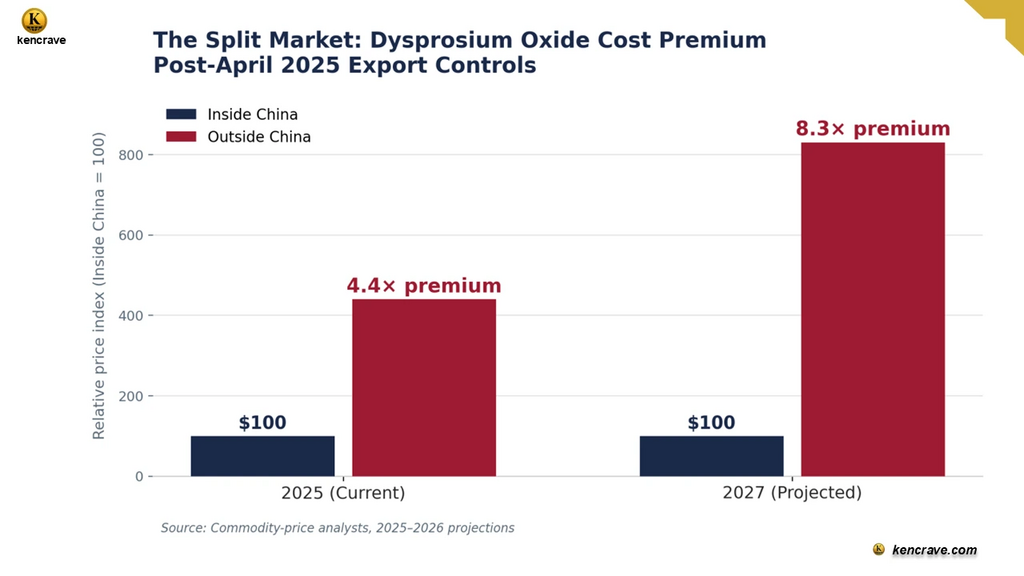
China's advantage is not just geology. It is decades of investment in large plants, trained workers and supplier relationships. The April 2025 export controls created a split market. Dysprosium oxide now costs 4.4 times more outside China than inside. It is expected that the gap will widen to 8.3 times by 2027 as per various reports.
That extra cost hits EV makers, wind turbine companies and defense contractors. Defense buyers accept the premium because security matters more than price. Commercial buyers feel pressure to switch to cheaper alternatives.
Figure 2: The cost gap for dysprosium oxide inside China versus outside China.
The Risk of a Chinese Price Crash
China has followed such strategies before. Between 1985 and 2004, export rebates drove prices so low that U.S. refining shut down. In 2010 and 2011, China embargoed Japan, sent prices soaring, then flooded the market again once it had secured its position.
New U.S. plants need steady, high prices to pay off construction debt. A formal cost-curve analysis would show the exact danger zone, likely $45-65 per kg of NdPr, where China can still make money while U.S. plants go broke despite their price floors. Current price floors at $110/kg as of August 2026 provide some protection.
But if China keeps prices below U.S. break-even for 18-24 months, even guaranteed buyers may not be enough to save the plant. Counter-cyclical subsidies or tariffs which don’t exist as of August 2026, would be needed to bridge the gap.
Can Companies Substitute or Avoid Rare Earths?
To some extent, this is possible. A company such as Tesla plans to remove rare earths from its next EV motors. Ferrite magnets already exist. But they are about 30% heavier, or need to spin 50% faster to match performance. For defense uses in precision missiles, jet actuators, submarines, there is no real substitute. NdFeB magnets with dysprosium and terbium will likely stay essential through 2030.
THE GLOBAL PICTURE OF ALLIES, AFRICA AND CHINA'S WEAK POINT
Allied Intelligence and Supply Chain Partnerships
The U.S. has rare-earth partnerships with Australia and Japan, both signed in October 2025. These are not just trade deals. They include sharing production data, refining technology assessments and early warnings about supply disruptions. Canada and Europe are also activtity in this case. But real resilience needs more resources in more regions and a clear map of which companies, including Chinese state-owned subsidiaries, control refining plants abroad.
Africa: An Underdeveloped Opportunity
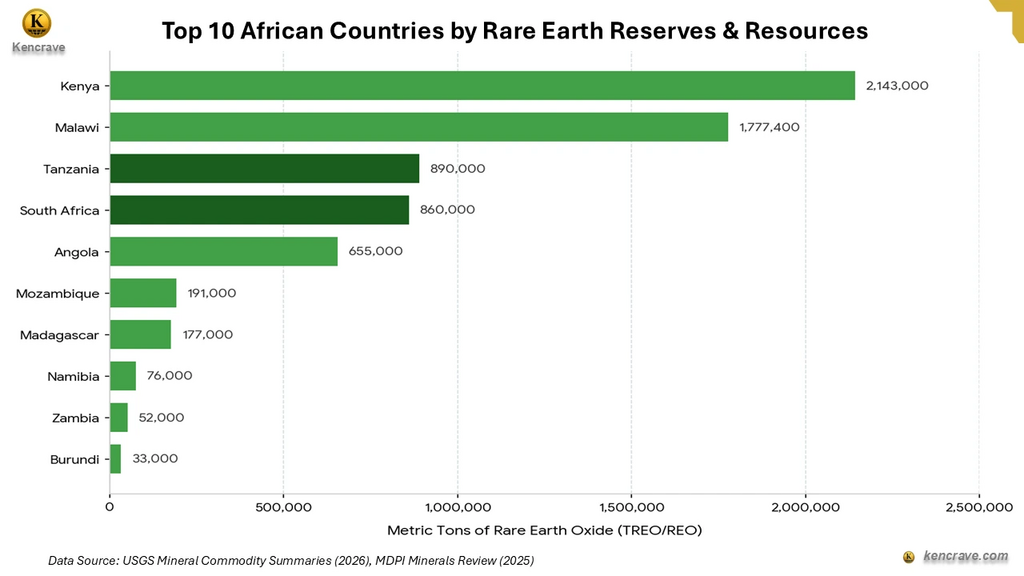
Africa holds 10-15% of the world's rare-earth reserves, including large amounts of heavy rare earths. Yet it has only recently become a focal point of U.S. planning through new DFC funding commitments and the development of the Lobito Corridor logistics route. Burundi's Gakara mine has been inactive since 2021. Uganda's Makuutu project is still in the feasibility stage. Tanzania's Ngualla project is Chinese-owned, raising questions about whether Western buyers could even access it. Africa’s poor infrastructure, governance problems and China's head start all limit how fast the West can move.
Africa rare earth reserves chart showing top TREO countries including Kenya, Malawi, Tanzania.
Key insights from Africa's rare earth reserves
Kenya leads the continent. With approximately 2.14 million metric tons, it holds the largest rare earth reserves in Africa, positioning itself as a potential global player in critical mineral supply chains.
Malawi follows closely. At 1.78 million metric tons, it’s emerging as another major source of rare earth elements, which are vital for technologies like electric vehicles and renewable energy systems.
Tanzania and South Africa. Both countries are around 0.86–0.89 million metric tons, showing strong mid-tier potential for industrial development and export diversification.
Angola with 655,000 metric tons, rounds out the top five, indicating Southern Africa’s growing importance in mineral resources.
The rest of the list consisting of Mozambique, Madagascar, Namibia, Zambia, and Burundi have smaller reserves (below 200,000 metric tons each), but still represent strategic opportunities for exploration and investment.
Takeaway: East Africa (Kenya, Malawi, Tanzania) dominates the rare earth landscape, suggesting a regional concentration of these critical minerals. This could reshape Africa’s role in global supply chains for high-tech and green industries
Myanmar: China's Single Point of Failure
China's dominance has a vulnerability: Myanmar. In 2023, Myanmar supplied about 41,700 tonnes of heavy rare-earth oxides to China. That is roughly 98% of China's heavy rare-earth imports. This material comes from environmentally damaging mining in areas controlled by armed militias.
Fighting in Myanmar's Kachin region briefly disrupted exports in early 2025, causing a short price spike before China used its stockpiles to absorb the shock. If a bigger disruption happens, China's heavy rare-earth processing would run short of raw material. That would be an opening for a more diversified global supply chain, but only if non-Chinese heavy-REE capacity is ready.
STRATEGIC ASSESSMENTOF U.S.' RARE EARTHS
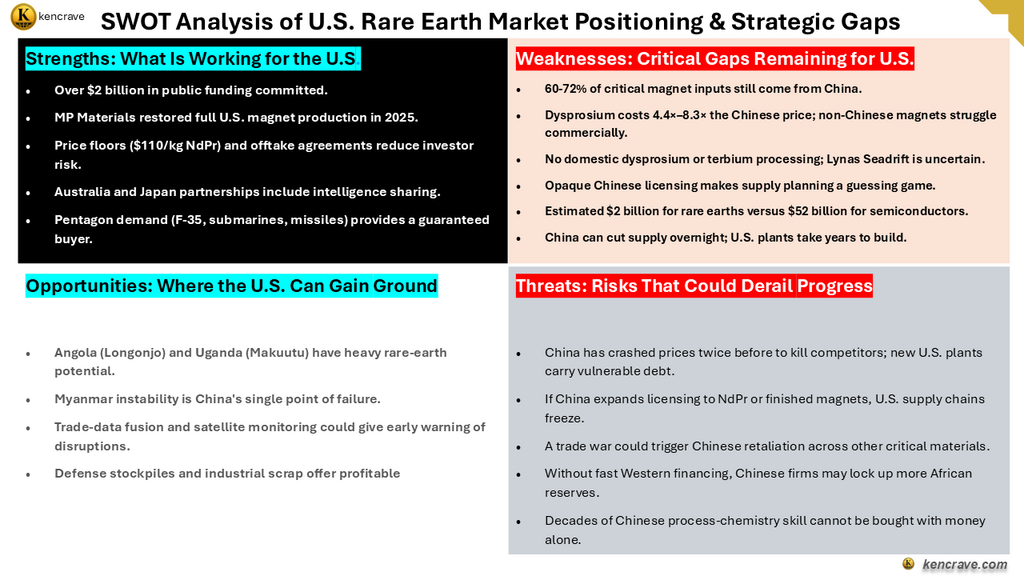
China’s dominance of rare earths is the result of a decades long industrial strategy, not geology alone. The below SWOT Analysis looks at what is working, what is not, where the openings are and what could go wrong for the U.S. in Rare Earth Marketing positioning.
Table 2: SWOT analysis of U.S. rare earth market showing strengths, weaknesses, opportunities, and threats in global supply chain.
COST CURVE AND BREAK-EVEN ANALYSISFOR RARE EARTHS
It is not enough to say China has a cost advantage. Policymakers need hard numbers: what it costs to produce a kilogram of rare-earth metal at each stage, where each U.S. project breaks even and at what price China could deliberately crash the market to kill American competition.
The Global Cost Curve for Rare Earth Production
China's integrated supply chain produces NdPr at the lowest cost in the world. That is because its plants were built long ago. Its chemical supply chains are mature and it benefits from massive scale. Non-Chinese supply chains face higher costs at three specific stages: separation (specialized chemicals and waste handling), refining (energy-intensive processes) and magnet manufacturing (sintering, coating and quality control).
The result is a steep cost scenario where China sits at the bottom, the U.S. and Australian output sits well above. If infrastructure gaps close in Africa, the supply chain of rare earths could land in the middle because of lower labor costs and lighter rare-earth grades.
U.S. Break-Even Economics and Price Floors
The $110/kg NdPr price floor is the estimated break-even point for new domestic separation and metal production, plus a small margin to pay down construction debt. MP Materials' Independence facility, now producing commercial metal and magnets, is likely operating at or near this level. Vulcan and USA Rare Earth are still pre-revenue. They need prices to stay at or above $110/kg to survive their ramp-up period.
Western heavy rare earth price floors have now been established at $575/kg for dysprosium and $2,050/kg for terbium, providing a clear economic pathway for high-temperature magnet production outside of China.
China's Pricing Risk ($45-65/kg)
A full cost-curve study would pinpoint the danger zone. The best estimate is $45–65 per kg of NdPr. At that level, China can still turn a profit while U.S. plants lose money even with their price floors and guaranteed buyers. Current policy does not model this scenario. If China sustains prices in the danger zone for 18–24 months, new U.S. plants could go bankrupt. Counter-cyclical subsidies or emergency tariffs, none of which exist today, would be needed to keep them alive.
The Resilience Premium and Commercial Viability
Buying non-Chinese rare earths means paying a 'resilience premium', extra cost per kilogram for geopolitical security. The Pentagon absorbs this as a cost of doing business. However, EV and wind companies do not. The key question is whether that premium shrinks as U.S. and allied capacity grows or stays wide because China's scale advantage is simply too large.
If the premium stays above 3× for NdPr and 5× for dysprosium, commercial buyers will keep switching to ferrite or rare-earth-free designs. That would leave non-Chinese supply dependent on defense demand alone, a market which is small to justify billions needed for a full domestic chain.
Strategic Priority for Investment
The best return is not just in mining but mostly on closing the heavy rare-earth refining gap and cutting separation costs. Every dollar spent on dysprosium and terbium capacity fixes a problem rated 'Critical' impact with 'Weak' mitigation. New mining projects should come with binding promises to process the output domestically or through allied refiners. Otherwise, the rare earths will continue flowing to China.
TECHNOLOGY AND HUMAN CAPITAL: CHINA'S COMPETITIVE ADVANTAGE
China's Dominance in Rare-Earth Innovation
A 2026 patent analysis using EPO PATSTAT data found 22,040 patent families related to rare-earth technologies were filed between 2014 and 2024. Chinese applicants accounted for about 81% of these patents, showing China's strong position in rare-earth technology. The study also found that Chinese universities and research institutions play an important role, indicating a strong connection between research and industry (MTC Berlin, 2026).
How China Links Rare-Earth Research to Industrial Advantage
China’s lead is not simply a result of producing more patents rather reflects decades of interaction between research institutions, universities and industry. Nearly 30% of the rare-earth patent families in the 2026 landscape involved universities or research institutes, showing the importance of links between scientific research and industrial application.
Japan remains an important technological competitor, particularly in high-performance magnet technologies, while the United States and Europe retain strengths in advanced materials, recycling and downstream applications. However, evidence suggests that China has developed a deeper technology base across the wider rare-earth supply chain, while other countries are only beginning to rebuild capabilities that were lost as processing moved overseas.
The Human Capital Gap: Rebuilding Skilled Expertise
The gap is also identified in experience and skilled people, not just laboratories and patents. Rare-earth separation requires specialised knowledge in hydrometallurgy, solvent extraction, chemical engineering, metallurgy and process control and this expertise is difficult to develop without operating commercial-scale facilities.
Countries such as the United States can invest in new mines and processing plants but rebuilding the workforce and technical knowledge needed to operate these facilities efficiently will take time. This creates a major difference between building physical capacity and developing a genuinely competitive rare-earth industry.
Global Investment Trends in Rare Earth Capability
The United States, Japan, Europe, Australia and other countries are therefore increasing investment in critical-mineral research, processing, recycling and domestic manufacturing. Japan has maintained a long-term focus on supply-chain diversification and advanced magnet technology, while the United States has accelerated efforts to develop domestic mining, refining and magnet production.
Australia is also expanding beyond mining into processing, while Brazil and other emerging producers are attracting investment into new rare-earth projects. IEA finds that the global pipeline remains uneven. Planned mining capacity outside China is expanding faster than refining and magnet manufacturing, leaving processing and downstream production as the major barriers to diversification.
China’s advantage has been built through decades of investment in research, industrial learning, processing infrastructure, patents and skilled labour. Other countries can develop alternative mines, but without comparable separation, refining, metallisation and magnet-manufacturing capabilities, they may simply replace dependence on Chinese ore with dependence on Chinese processing technology. Closing this gap requires sustained investment in R&D, specialised training, commercial-scale demonstration plants, recycling and partnerships between universities, governments and industry.
RISK MATRIX: PRIORITIES FOR DECISION-MAKERS
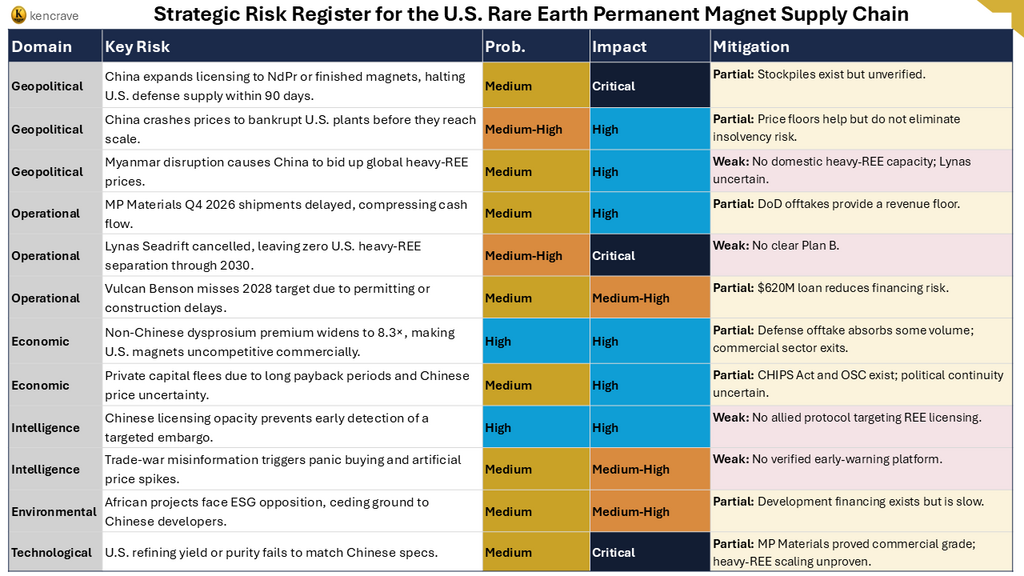
The visual below shows key risks in various spheres and mitigation adopted or to be adopted with various levels of risks in play.
Table 3: U.S. rare earth supply risk register table showing geopolitical, operational, economic, and technological vulnerabilities with mitigation strategies.
VARIOUS SCENARIOS THE RARE EARTHS COULD PLAY OUT BY 2030
There are several ways in which the risks and opportunities between China and U.S. could play out by 2030. This is segregated into either most possible (Managed Dependence); increasingly possible (Strategic Diversification); less likely possible (Accelerated Decoupling)
1. Scenario 1, Most Possible: Managed Dependence
The U.S. builds some alternative suppliers, but China stays dominant. Even if MP Materials and Vulcan succeed, the U.S. will likely still import over 60% of its magnet rare earths from China. The heavy rare-earth gap stays open, leaving defense actuators and high-performance EV motors exposed to Chinese licensing decisions. This path requires the least policy change.
Projects in Angola, Texas and North Carolina deliver on schedule. The non-Chinese price premium narrows to under 3×. China's market share shrinks, but it remains a major player. Two things must happen: (1) a heavy-REE facility comes online and (2) allied intelligence networks gain real-time visibility into Chinese licensing and stockpile decisions.
China expands export controls, Myanmar supply is badly disrupted, and trade tensions escalate into a broader conflict. Costs rise. Both sides build duplicate infrastructure. Misinformation strains allied intelligence cooperation. The biggest danger is not one big embargo. It is a rolling, unpredictable licensing regime that keeps U.S. manufacturers in constant uncertainty. Resilience, not total self-sufficiency, is the realistic goal.
Strategic Recommendations for U.S. Players
1. U.S. Intelligence Community, DoD, Commerce Department, Allied Governments: Track the Whole Chain, Not Just Mines
Map the corporate networks, especially Chinese state-owned subsidiaries, that control refiners and magnet plants abroad. Invest in predictive tools that combine trade data, satellite imagery and policy indicators to spot trouble before it hits the factory floor.
2. DoD (buyer), Congress (funding), Mining/Processing Firms (USA Rare Earth, Lynas): Close the Heavy Rare-Earth Gap as the Top Priority
Without dysprosium and terbium, the U.S. cannot make the high-temperature magnets needed for defense actuators and next-generation EV motors. Washington needs a backup plan: speed up Round Top's heavy-REE development, sign offtake deals in Africa, or set up defense-stockpile release protocols. 3. Treasury/Commerce Departments, Domestic Producer: Stress-Test Price Protection Against a Chinese Price Crash
Model what happens if China holds NdPr prices at $45–65 per kg for 18–24 months. Design counter-cyclical subsidies or emergency tariffs to keep domestic plants alive through the storm.
4. DoD (funding), Recycling Firms (REEcycle), Magnet Manufacturers: Scale Recycling Beyond the Pilot Stage
Help REEcycle and similar projects move from small demonstrations into commercial operations tied to actual magnet production. Recycling will not replace mining, but it can shore up supply in defense stockpiles and other high-value niches.
5. U.S. DFC, Allied Governments, African Governments, Mining Firms: Build Allied Supply Chains, Including in Africa.
Back Canadian, European and carefully chosen African projects with development financing and long-term purchase agreements. Speed matters. Every year of delay raises the odds that Chinese state-backed firms lock up more African reserves.
6. DoD (offtakes), Private Investors, Domestic Producers: Provide Long-Term Demand Certainty for Investors
Private investors will not fund new plants unless they know buyers will be there. Long-term government purchase agreements and price-support mechanisms give companies the confidence to build and repay their debt.
7. DoD, Commerce Department, Federal Reserve: Aim for Measurable Operational Resilience
Cutting all ties with China would be expensive and probably unnecessary. The right goal is operational resilience: how many days can the F-35 supply chain, submarine maintenance queue and EV motor assembly line keep running if Chinese supply stops tomorrow? Until that number is tracked, policy is flying blind.
Bottom Line: Securing the Magnet Chain
China's advantage was never just about owning rare-earth deposits. It comes from building a complete industrial system, mining, processing, refining and magnet-making, at a scale no other country has matched. The 60%, 91% and 94% figures for magnet rare earths show how that dominance deepens at every step.
The U.S. has recognized the problem and is responding with money, new policy, recycling programs and international partnerships. The open question is whether these efforts add up to something that works: an alternative supply chain that is not just secure, but cheap enough to actually compete.
The cost curve says affordability depends on three things: closing the heavy rare-earth gap, cutting separation costs and surviving a potential Chinese price crash. Those three factors, not how much rock is dug out of the ground, will decide whether the U.S. achieves real resilience or simply manages its dependence.
The competition has shifted from who owns the mine to who controls the magnet. That is where the next phase of U.S.-China rivalry will be decided.
Key Takeaways
China controls 91% of global rare earth refining (IEA, 2026).
Non-Chinese dysprosium costs 4.4× more; expected to reach 8.3× by end of 2027.
U.S. has committed $2B+ to domestic rare earth production.
No U.S. facility currently processes dysprosium/terbium at scale.
Myanmar supplies 98% of China's heavy rare earth imports.
China holds 81% of rare earth patents (2014-2024).