
NorthAmerica
Jensen Huang's exit leaves Nvidia facing succession, federal probes, and regulatory risk. What comes next for the AI chip giant and its stock.
Key Takeaways
- Huang's abrupt exit ends a 33-year era that built Nvidia into the dominant AI chip supplier and a $5T company.
- The resignation is scandal-driven by personal relationships which triggered federal probes, board review, and litigation risk.
- Fundamentals hold despite a $600–880B value wipeout.
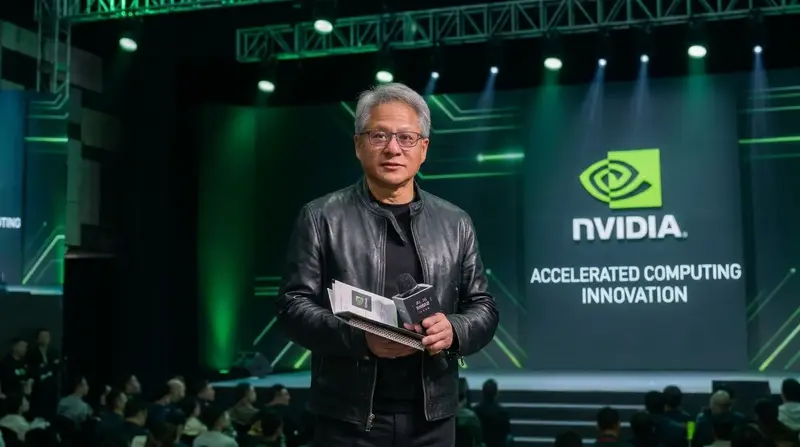
Nvidia announced on November 12, 2026, that co-founder Jensen Huang has resigned with immediate effect as president, chief executive officer, and a member of the company's board.
His departure ends a 33-year tenure leading the chipmaker. During that period, Nvidia grew from a graphics processor company into one of the world's most valuable technology firms and a central player in the artificial intelligence industry.
Three Decades of Growth
Huang co-founded Nvidia in 1993 with Chris Malachowsky and Curtis Priem. He served as the company's only CEO from its founding.
Nvidia initially focused on graphics chips for video games. A major turning point was in 2006 when it launched the CUDA software platform. CUDA enabled Nvidia's graphics processors to perform a broader range of computing tasks beyond graphics rendering. That decision proved critical. It positioned Nvidia's chips for emerging artificial intelligence workloads years before AI became mainstream.
Under Huang's leadership, Nvidia evolved from a gaming hardware company into the dominant supplier of AI computing infrastructure. At its peak, Nvidia became the first publicly traded company in history to reach a $4 trillion market valuation on July 9, 2025. It later went on to surpass $5 trillion in October 2025, before falling back below $4 trillion in November 2026.
Its chips, networking products, and software platforms became widely used by major technology companies, governments, and AI research organizations.
Why Huang Stepped Down
Huang's resignation follows a series of personal and national security-related controversies that emerged in early November 2026.
In late October 2026, reports surfaced about Huang's relationship with Alice Huang, an executive at Megaspeed, a Singapore-based data company and major Nvidia customer. U.S. intelligence officials reportedly suspect she has links to Chinese intelligence operations.
Huang denied sharing sensitive information or violating national security rules. However, the reports triggered federal investigations into possible export-control violations. Nvidia's board also launched an independent review with outside legal counsel.
On November 8, Huang issued an internal apology to Nvidia. The situation intensified on November 11 when The New York Times reported that Huang had also been involved in a separate relationship with Kimberly Powell, Nvidia's vice president of healthcare.
The allegations raised concerns about compliance with company governance policies, particularly those involving workplace relationships, reporting structures and conflict of interest.
What Happens Next for Nvidia Leadership
To maintain leadership continuity, Nvidia's board appointed Chief Financial Officer Colette Kress as interim CEO. Kress will continue serving as CFO while the company searches for a permanent chief executive.
Board Chair Harvey Jones stated that Nvidia's operations, customer commitments, and product development plans will continue as scheduled.
Potential Successors
The board is considering both internal and external candidates to take over as the next CEO for Nvidia.
Internal candidates
Colette Kress is viewed as a leading contender. She has served as Nvidia’s CFO since 2013 and is well known to investors.
Other senior engineering and operating executives could also receive consideration. An internal appointment would likely help preserve Nvidia's existing culture and strategic direction.
External candidates
Nvidia may also seek an outside executive with extensive experience managing large technology companies and navigating regulatory challenges.
Nvidia may also seek an outside executive with extensive experience managing large technology companies and navigating regulatory challenges.
Former Apple CEO Tim Cook, who became Apple's executive chairman in September 2026 is a likely replacement for Huang Jensen. Cook's name has been mentioned by several public figures, including President Donald Trump, although there is no indication that he is formally being considered by Nvidia's board.
Stock Outlook for Nvidia after Resignation of Huang Jensen
Stock Outlook for Nvidia after Resignation of Huang Jensen
Investors reacted negatively to the leadership change. Nvidia's market value has fallen by an estimated $600 billion to $880 billion in early November. Shares also dropped between 8% and 10% in early trading following the resignation announcement.
In the short term, Nvidia stock is likely to remain volatile due to investor sentiments regarding the company.
Investors are assessing several issues at once. These include the loss of Nvidia's long-time leader, federal investigations, congressional scrutiny, potential shareholder litigation and the next CEO to take over the company.
Despite these concerns, Nvidia's core business and fundamentals remains strong. Demand for its AI products continues to exceed supply, and the company maintains a substantial order backlog for its next generation of chips.
What Investors Should Watch
Three developments are likely to shape Nvidia's outlook over the coming months:
- November 17 earnings guidance: Does management maintain its product roadmap and growth expectations without Huang?
- The scope of federal investigations: Do the inquiries remain focused on individuals, or do they expand to examine Nvidia's operations and compliance practices?
- The CEO search: Does the board choose an operational leader focused on execution, or a figure with broader political, regulatory, and international experience?
Bottom Line: The Real Test Starts Now
The market's initial reaction appears driven more by uncertainty than by any change in Nvidia's underlying business.The key question is whether investors view Huang's departure as an isolated leadership issue or as a sign of deeper problems.
Unlike many founder-led companies, Nvidia's competitive position does not depend solely on one individual. Its CUDA software ecosystem, long-term product pipeline, and strong demand for AI chips were built over many years. These are company assets that extend beyond Huang's leadership.
As a result, Nvidia's future will depend less on replacing its founder and more on how effectively the board manages the transition. Several steps could help restore confidence. These include giving interim CEO Colette Kress a clear mandate, providing transparent updates on ongoing investigations, and establishing a credible timeline for selecting a permanent chief executive. Investors are likely to focus on those issues as much as on the company's financial performance.
The Biggest Risk Remains Regulatory
The national security investigations are the most significant source of uncertainty. If the inquiries remain focused on Huang's conduct, the impact on Nvidia may be limited. However, if regulators broaden their review to include the company itself, the risks become more substantial.
Potential regulatory restrictions would pose a challenge for any future CEO, regardless of experience or background. The speculation around former Apple CEO Tim Cook taking over also highlights another consideration. The board may be looking beyond technical expertise and operational execution. It may place greater emphasis on a leader's ability to navigate complex geopolitical and regulatory environments.
The next phase for Nvidia will be defined by whether Nvidia's business strengths can outweigh the uncertainty created by leadership and governance concerns.