New 50% US tariffs on Canada: who really pays? Explore the full trade war timeline, retaliation costs, and the real burden on families and businesses.
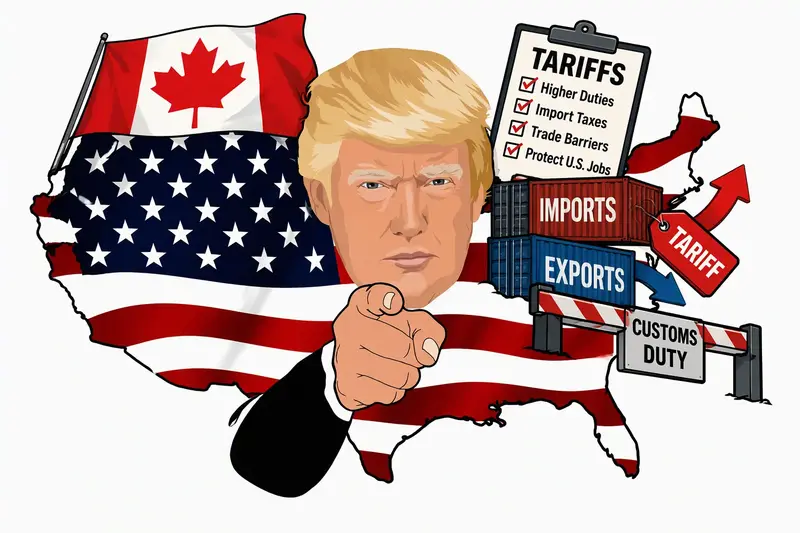
On August 22, 2026, the United States imposed 50% tariffs on a range of Canadian goods. The tariffs cover approximately $20 billion worth of trade, affecting over 550 products. These include electronics, furniture, apparel, sporting goods, industrial machinery, and plastics.
What is Trade Nationalism. It is an economic approach in which a country prioritizes and protects its own industries, workers, and products over foreign competitors.
Key Takeaways
The tariffs bypass the Canada-United States-Mexico Agreement (CUSMA/USMCA): The new 50% tariffs apply regardless of whether goods qualify for preferential duty-free trade. This creates unprecedented uncertainty for businesses with no expiry date.
U.S. importers and consumers bear the overwhelming cost: According to research from the Kiel Institute, U.S. buyers bear 96% of the tariff cost, as foreign exporters absorb only 4% of the burden.
Canadian consumers pay through retaliation: Canada's retaliatory counter-tariffs impact roughly C$27.6 billion ($20 billion USD) in U.S. annual exports. They cost consumers billions and raise living costs for families.
Where It All Started
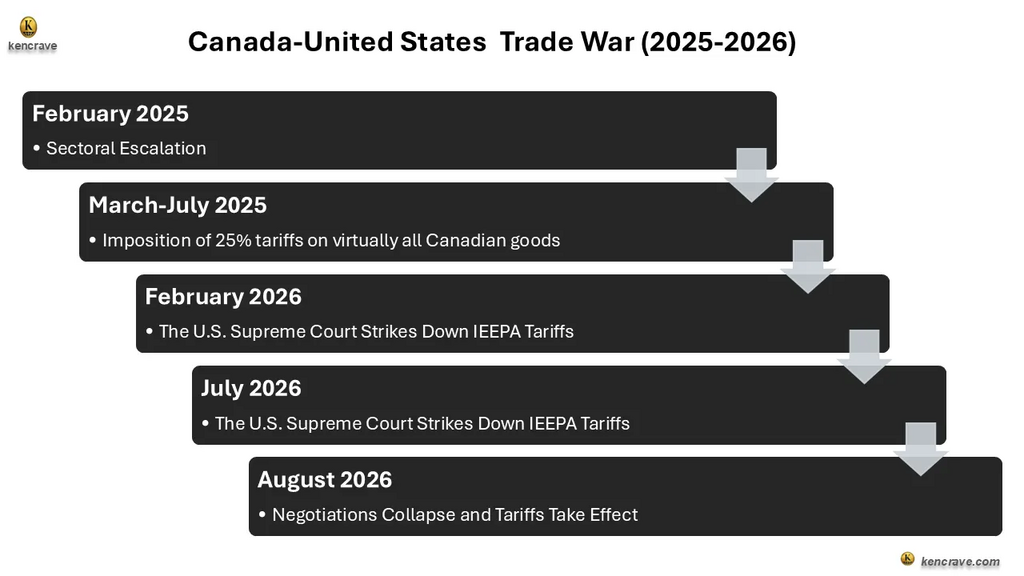
February 2025: Imposition of 25% tariffs on virtually all Canadian goods
The tariff conflict began on February 1, 2025, when President Trump signed an executive order imposing 25% tariffs on virtually all Canadian goods and a reduced 10% tariff on energy. He used the International Emergency Economic Powers Act (IEEPA), citing border security and fentanyl trafficking.
Canada retaliated almost immediately, announcing counter-tariffs on 30 billion Canadian dollars worth of U.S. goods to take effect as of March 4, targeting items like orange juice, wine, appliances, and apparel.
March–July 2025: Sectoral Escalation
On March 12, U.S. tariffs on steel and aluminum took effect, prompting Canada to levy a second base of retaliation on C$29.8 billion in U.S. goods. By June 4, Trump's 50% tariffs on Canadian steel and aluminum came into effect. On July 31, Trump raised the baseline tariffs from 25% to 35% after Ottawa failed to reach a trade deal.
February 2026: The U.S. Supreme Court Strikes Down IEEPA Tariffs
A critical turning point came on February 20, 2026. The U.S. Supreme Court ruled 6-3 that the IEEPA did not authorize the President Trump to impose these tariffs, invalidating the legal basis for the "fentanyl tariffs." However, the ruling did not affect tariffs imposed under Section 232 of the 1962 Trade Expansion Act.
July 2026: The U.S. Pivots to Section 338
The administration turned to Section 338 of the Tariff Act of 1930. This provision allows the president to impose tariffs of up to 50% on countries that discriminate against U.S. commerce.
On July 20, 2026, President Trump signed three proclamations imposing 50% tariffs on Canadian goods. He cited discrimination in motor vehicles, dairy, and alcoholic beverages. Crucially, vehicles and auto parts were excluded from the final active list, while items like hockey equipment, wine, and cement were included
August 2026: Negotiations Collapse and Tariffs Take Effect
The Section 338 tariffs were initially set for August 19 but were suspended for three days for last-minute talks. Negotiations broke down on August 21 after the U.S. introduced demands that Canada said undermined its sovereignty.
Canadian Prime Minister Mark Carney said the Trump administration's terms were unacceptable. He noted that U.S. negotiators introduced restrictions on Canada's trade deals with other countries at the eleventh hour. The tariffs officially took effect at 12:01 a.m. on August 22, 2026.
Timeline infographic of the Canada–United States trade war (2025–2026), highlighting sectoral escalation in February 2025, 25% tariffs on most Canadian goods, U.S. Supreme Court rulings on IEEPA tariffs in 2026, and the collapse of trade negotiations leading to tariff implementation in August 2026.
How the Canadian Government Responded
Retaliatory Counter-Tariffs
On September 8, 2026, Canada's retaliatory tariffs officially took effect. They matched the U.S. levies dollar for dollar by targeting C$27.6 billion of U.S. products. According to the Department of Finance Canada Product List, the new targeted counter-tariffs are concentrated in steel and aluminum, dairy, appliances, agricultural equipment, pulp and paper, plastics, and electronics. Tariff rates are set at three tiers: 15%, 25%, and 50% to match corresponding U.S. rates.
A new poll by the Angus Reid Institute found that 62% of Canadians said the retaliatory tariffs were "about right under the circumstances," and 64% believed Canada would emerge stronger by reducing dependence on the U.S.
Domestic Support Package
Alongside its retaliatory tariffs, Ottawa announced a 7.5 billion Canadian dollar relief package for affected businesses and workers. The package targets four main areas:
$2 Billion for Canada Strong Diversification Fund. This is meant tosupport medium-sized companies with capital maintenance and project reviews.
$3.5 Billion for Employment Insurance and Worker Support. This extends EI eligibility rules, waives waiting periods, and provides training grants to the workers affected
$1.5 Billion for Regional Tariff Response Initiative: Administered by Canada's seven regional development agencies meant to boost non-repayable loan caps from $1 million to $3 million for small and medium-sized businesses.
$500 Million for Business Development Bank of Canada (BDC). This is meant to help businesses address short-term cash flow needs, alongside specialized support for the forestry, steel, and aluminium sectors.
Who Bears the Cost of the 50% Tariffs?
The 50% tariffs are paid by private businesses and households on both sides of the border, not by governments.
The Direct Cost Falls on Importers: When Canadian goods arrive at a U.S. port of entry, the American importer must pay the 50% duty to U.S. Customs and Border Protection. The same applies in reverse for Canadian importers.
The Direct Cost Falls on Importers: When Canadian goods arrive at a U.S. port of entry, the American importer must pay the 50% duty to U.S. Customs and Border Protection. The same applies in reverse for Canadian importers.
Canadian Households and Businesses Bear the Retaliation Burden: Economist Trevor Tombe estimated that Canada's counter-tariffs cost Canadian consumers nearly $4 billion, hitting lower-income households hardest. Families with children pay roughly $250 more per year. The Canadian Federation of Independent Business (CFIB) noted that roughly 63% of small exporters have had to absorb much of the U.S. tariff cost directly to retain clients.
How Will the Tariffs Affect Long-Term Trade?
Bilateral trade volumes in affected categories are projected to decline due to the 50% penalty. According to estimates from various analysts, 50% tariffs on $20 billion of imports could trim between 0.3% to 0.6% off Canada's short-term GDP.
Canada is accelerating diversification away from U.S. trade reliance. The nation is pursuing stronger economic and defense partnerships with Europe and the CPTPP bloc. Concurrently, the legal pivot to Section 338 removes standard CUSMA safety nets. This ensures a volatile, high-uncertainty trade environment that depresses cross-border investment.
Summary
There exists no clear winner in this format of counter-tariffs between the U.S. and Canada, as families on both sides of the border bear the rising cost of commodities. This economic friction is evidence as to why the U.S. is looking increasingly toward the economics of domestic onshoring, while Canada is rapidly pursuing global trade diversification to alleviate vulnerabilities stemming from aggressive bilateral trade policies.