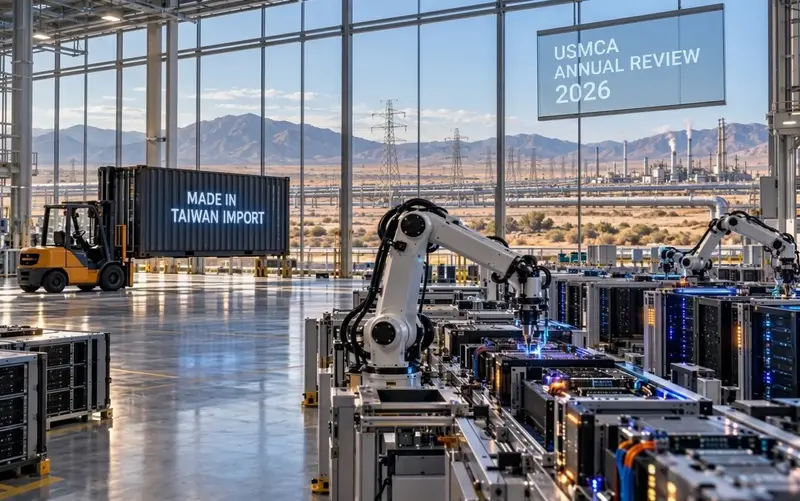
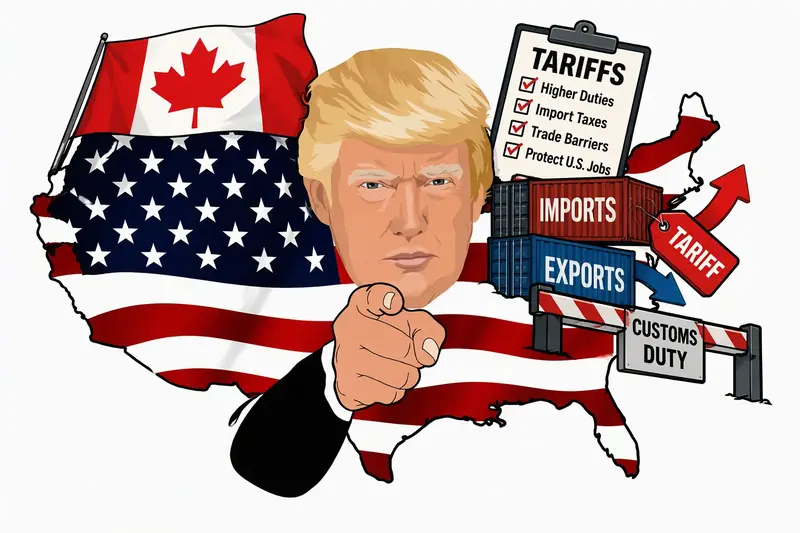
The duality of Mexico's nearshoring boom, advanced AI server assembly driven by imported Taiwanese components, under the USMCA review. Image credits: Elizabeth via KenCrave.
16 min read
Business
Mexico Tops Us Suppliers: Usmca Risks To Nearshoring
Mexico overtook China as top US supplier in 2025. This analysis examines USMCA review risks, 3%–7% AI-server local content, durability of nearshoring, investment and policy roadmaps.
Executive Summary
Mexico has overtaken China as the top supplier of goods to the US market, a shift driven by four reinforcing forces: the US-China tariff gap, cost dynamics, preferential access under United States-Mexico-Canada Agreement (USMCA), and geographic proximity. Mexico's high-tech exports surged as US buyers diversified away from China, and USMCA rules have anchored Mexico into North American supply chains.
However, this position is not guaranteed. The US refusal to renew USMCA in 2026, opting instead for annual reviews, has introduced structural uncertainty that is already freezing fixed investment.
As the US threatens to tighten rules of origin to target Chinese content, Mexico must transition from an assembly hub to a true manufacturing base to protect its top supplier status.
Key Takeaways
The Tariff Gap Is the Engine, but USMCA Is the Anchor. Mexico's 3% effective tariff rate versus China's 22% triggered its rise, but USMCA is what legally anchors that advantage. If the US tightens rules of origin during the annual review, Mexico's cost advantage could narrow rapidly.
The AI Boom Is an Assembly Case, Not a Production one. Mexico's $82.9 billion high-tech export boom relies heavily on imported Asian components, with local content in AI servers at just 3%–7%. This makes the sector highly vulnerable to US crackdowns on Chinese content and China transshipment.
Policy Uncertainty is Already Costing Mexico Money. The USMCA annual review is actively dragging on the economy, with fixed investment contracting 6.3% in 2025. Fitch projects just 0.7% growth in 2026, reflecting how policy uncertainty delays long-term capital commitments.
How Mexico Became the United States Top Supplier
In 2023, Mexico overtook China as the largest exporter of goods to the United States. Mexico ranked first among suppliers of US goods imports in 2025, followed by Canada and China. It was also the top US trading partner in goods in 2025, with total goods trade of $872.8 billion.
This rise is usually described as nearshoring that is relocating production, or sourcing from suppliers to a nearby country rather than a distant one. The goal is to shorten supply chains and cut delivery times and risk.
Mexico’s rise is not the product of any single factor. It results from four forces reinforcing each other: geopolitics (US-China tensions and tariffs, and the push to diversify away from China), cost dynamics (rising Asian costs, competitive Mexican labor, and lower freight and inventory expenses), trade agreements (preferential access under USMCA, formerly NAFTA), and geographic proximity.
The Four Forces Behind Mexico's Rise
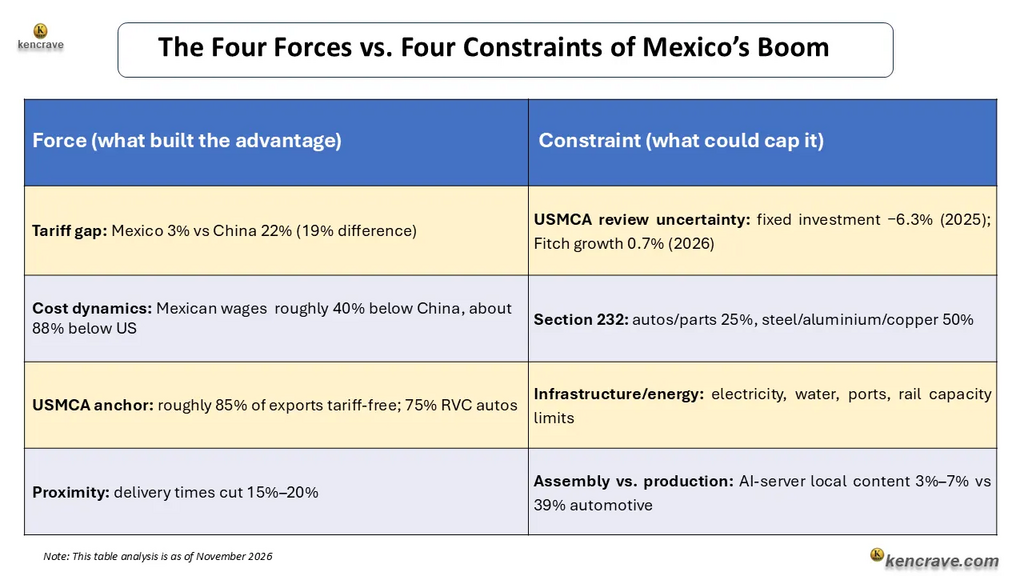
While tariff gaps, lower wages, USMCA access, and geographic proximity propelled Mexico to the top position, policy uncertainty, Section 232 duties, infrastructure bottlenecks, and shallow local content pose immediate headwinds.
Comparison of Mexico’s economic growth drivers and structural constraints, highlighting nearshoring advantages, USMCA trade benefits, labor cost competitiveness, tariff differentials, infrastructure challenges, supply chain risks, and manufacturing value-added limitations.
Geopolitics: The US-China Tariff Gap
The tariff gap between China and Mexico is one of the most direct and quantifiable incentives for US buyers to shift sourcing. According to Mexico's Economy Secretary, Marcelo Ebrard, speaking in October 2026, Mexico faces an average effective tariff rate of 3%, while Chinese goods face 22%. This gap of roughly 19 percentage points continues to redirect US sourcing toward Mexico.
The US Trade Representative,Jamieson Greer, acknowledged that Mexico captured roughly 25% of the reduction in the US trade deficit with China.
Mexico's high-tech exports to the US grew by 46% in 2025 while China's fell by 45%, making Mexico the top high-tech supplier to the US market. In the first half of 2025 alone, Mexican high-tech exports reached $66.6 billion, ahead of China's $35.4 billion.
Cost Dynamics: The Wage Gap Is Real, but Tariffs and Freight Matter More
Mexican manufacturing wages remain roughly 40% lower than China's and 88% lower than the US. USMCA-qualifying goods enter the US duty-free, while Chinese goods face the tariff rates above. Proximity cuts delivery times to days rather than weeks, reducing inventory carrying costs.
Trade Agreements: USMCA Rules of Origin for Automotive
About 85% of Mexican exports to the US remain tariff-free under USMCA. USMCA requires 75% regional value content for passenger vehicles and core parts, 70% North American steel and aluminium sourcing. The labor value content rule requires 40%–45% of a vehicle's production by value to be made by workers earning at least $16/hour.
However, the US signaled it wants to revisit these rules during the USMCA review.
Geographic Proximity: Nearshoring Delivery Times
Mexico's geographic proximity, long-standing participation in North American production networks and political alignment with the U.S. make it a natural candidate for nearshoring in North and Latin America Supply chain.
Mexico Business News notes that proximity reduces delivery times by 15%–20% and minimizes logistical and political risks associated with Asian supply chains.
What Could Cap Mexico's Advantage: USMCA Review, Section 232, and Infrastructure
Mexico's rise in the supply chain faces limitations. Four constraints are now visible in the 2026 data, and each one cuts directly against the four forces that made Mexico the top supplier.
USMCA Review Uncertainty Is Already Freezing Investment
The World Bank projected Mexico's economy to grow by just 1.4% in 2026 and 1.8% in 2027, noting that the uncertainty associated with the USMCA review continues to weigh on investment.
Section 232 Tariffs: USMCA Compliance Is Necessary but No Longer Sufficient
Under Section 232, autos and auto parts face a 25% tariff, while steel, aluminium, and copper products face 50%. Country-specific rates and provisions apply to the UK and Russia, and to qualifying Canadian and Mexican products, for steel and aluminium products. (Congressional Research Service [CRS], 2026).
Mexico's Economy Secretary, Marcelo Ebrard, has been negotiating with the United States to reduce the auto tariff from 25% to 15%. The Wall Street Journal reported that US Commerce Secretary, Howard Lutnick, opposed substantial reductions in the 25% auto tariff and the 50% steel and aluminium tariffs. Ebrard disputed that characterization. He said Lutnick had never expressed rejection of those reductions to him. Ebrard, however, acknowledged that the fourth formal round of talks has not yet been scheduled, and he hopes it would take place before the end of 2026.
The result is a challenge: Mexico's USMCA compliance rate is high, but compliance no longer guarantees tariff-free access.
Mexico Industrial Park Electricity and Water Bottlenecks
The World Bank identifies reliable infrastructure and energy services as essential conditions for raising productivity and investment. It also warns that capacity limitations in electricity generation and transmission, water systems, roads, ports, rail, and digital connectivity may prevent companies from expanding in regions that would otherwise benefit from nearshoring.
Water and electricity availability have become particularly important for industrial parks, which require predictable access before committing long-term capital. Mexico's growth ceiling is not demand but the physical capacity to absorb the investment that demand would otherwise bring.
Mexico's Assembly vs. Production Gap: Why 3%–7% Local Content Matters
According to Mexico's National Institute of Statistics and Geography (INEGI) Monthly Survey of the Manufacturing Industry (EMIM), manufacturing output grew 4.1% year-over-year in August 2026. The growth was driven by petroleum products, electronics, and machinery. However, manufacturing employment fell 1.0% year-over-year in the same month, marking 42 consecutive months of decline.
The S&P Global Mexico Manufacturing PMI fell back from 50.3 in September to 49.5 in October 2026, with factory output declining at the fastest pace in six months.
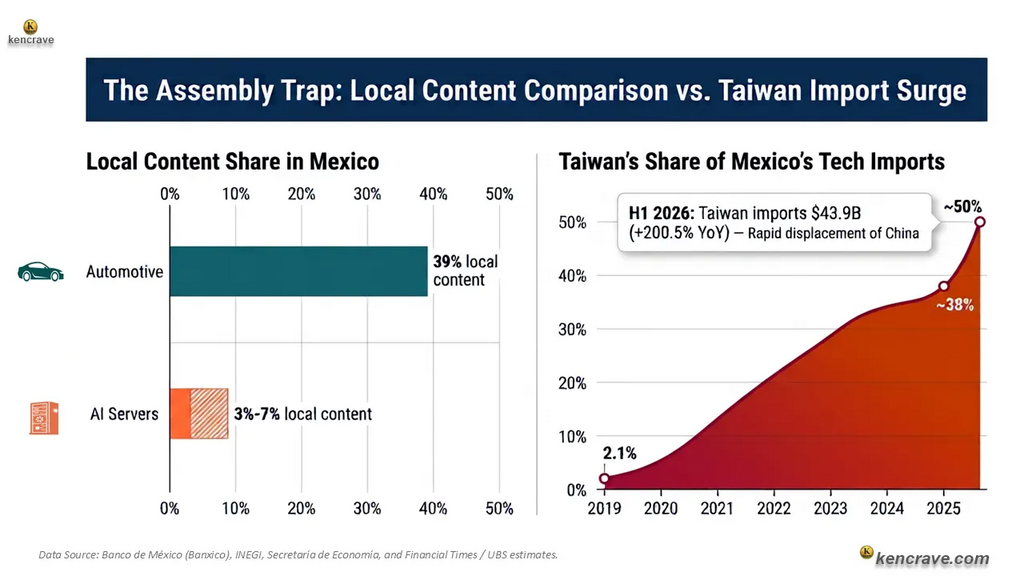
Mexico's electronics export boom relies heavily on imported components. BBVA Research estimates that local content in Mexico's AI server assembly is only 3%–7%, compared with 39% in the automotive industry.
Comparison of Mexico’s AI hardware manufacturing ecosystem, contrasting local content participation in automotive and AI server industries with Taiwan’s growing share of Mexico’s technology imports, highlighting nearshoring, supply chain dependence, semiconductor imports, and advanced manufacturing challenges.
Taiwanese firms (Foxconn, Wiwynn, Pegatron, Quanta, Inventec) route AI server components through Mexican assembly under USMCA to serve US cloud providers, accelerated by US–China tensions and nearshoring. Taiwansupplied about 38% of Mexico's tech imports in 2025, rising to nearly 50% by Q4, largely displacing China.
If the United States tightens rules of origin during the USMCA review to target Chinese content, the economics of routing components through Mexico for final assembly would deteriorate. The model's viability depends on tariff-free entry, not on domestic value creation. That is exactly the advantage Washington is now threatening to remove.
Is Mexico's Nearshoring Advantage Built to Last? Policy Arbitrage vs. Industrial Depth
The four supply chain forces have reshaped North American production. The institutional framework that made Mexico the top supplier (USMCA) is now the source of its greatest uncertainty. Mexico's number one position rests on a set of rules that are being renegotiated.
Investment is already pricing in the uncertainty
Fitch Ratings noted that USMCA's annual review essentially preserves the status quo by maintaining current trade rules but keeping them subject to continued uncertainty. Fitch also reported that fixed investment in Mexico contracted 6.3% in 2025 amid USMCA uncertainties, and projects growth of just 0.7% in 2026. Companies have not left Mexico, but they appear to be demanding higher returns or faster payback periods because the rules that make a factory profitable could change at each annual review.
The tariff advantage is real, but policy-driven, not structural
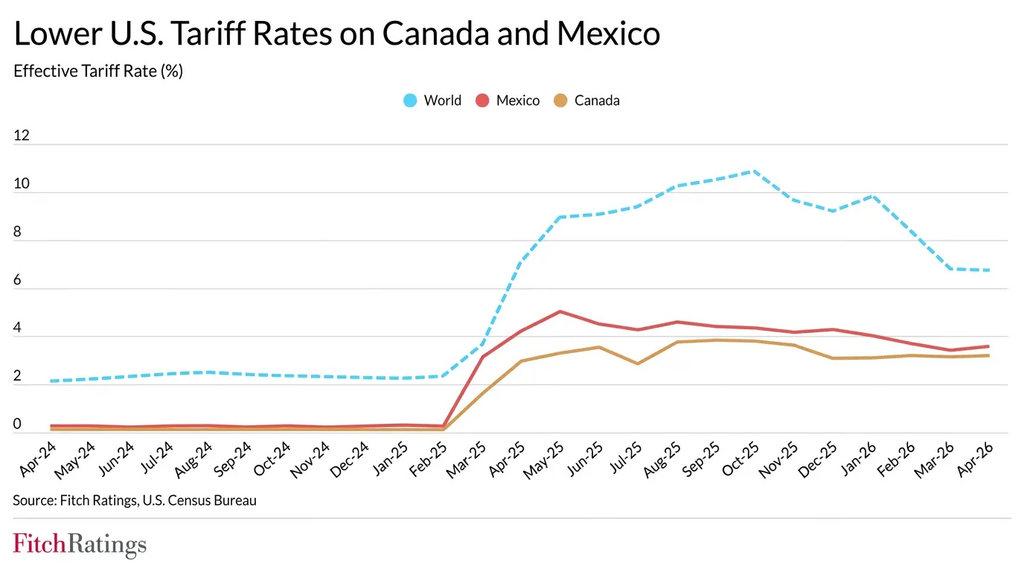
Fitch calculates Mexico's effective tariff rate at approximately 3.6%, based on trade data through April 2026, against headline tariffs of around 10%. That gap exists because of USMCA carveouts. If those rules tighten during the review, particularly on Chinese content, the gap narrows. Fitch's base case is that the agreement is eventually renewed before 2036, but a new deal may be on less advantageous terms for Mexico and Canada.
Line chart comparing U.S. effective tariff rates on imports from Mexico, Canada, and the global average, highlighting lower tariff exposure for North American trading partners and the impact of regional trade integration on cross-border commerce.
Mexico AI Hardware Export Growth: Concentrated and Fragile
Mexico’s computer-equipment exports reached $82.9 billion in the first half of 2026. S&P Global noted that these exports grew 172.1% year over year during that six-month period. The boom rests on imported inputs, as Taiwan’s share of Mexico’s total imports rose from 2.1% in 2019 to 13.4% in the first half of 2026. Banxico data show that imports from Taiwan in the first half of 2026 reached $43.9 billion, up 200.5% compared to the same period in 2025.
Washington's push to tighten North American content rules for AI hardware targets this exact structure. The likely response is not withdrawal but relocation: Taiwanese and other Asian suppliers may build component plants in Mexico, the U.S., or Canada to preserve tariff-free access. That outcome would deepen Mexico's industrial base, but only if the investment arrives before the rules tighten.
Mexico Trade Indicators to Watch in 2027: USMCA Review, Investment, AI Exports
The USMCA annual review. This is a key variable to watch to ascertain whether rules of origin are tightened, particularly regarding Chinese content, and whether Section 232 tariffs on autos and steel are reduced.
Investment recovery. Fitch projects investment growth of 0.7% in 2026 and 1.4% in 2027. The World Bank projects GDP growth of 1.4% in 2026, 1.8% in 2027, and 2.2% in 2028.
AI export durability. Mexico's data center equipment exports reached $82.9 billion in the first half of 2026, a 172% increase from the same period a year earlier, exceeding automotive exports of $74.8 billion. The number to watch is the 3%–7% local content in AI servers, compared with 39% in the automotive industry.
Whether export growth translates into domestic activity: a key factor is whether surging exports result in domestic industrial activity or remain assembly-heavy with imported components.
Policy Recommendations for Government and Trade Officials
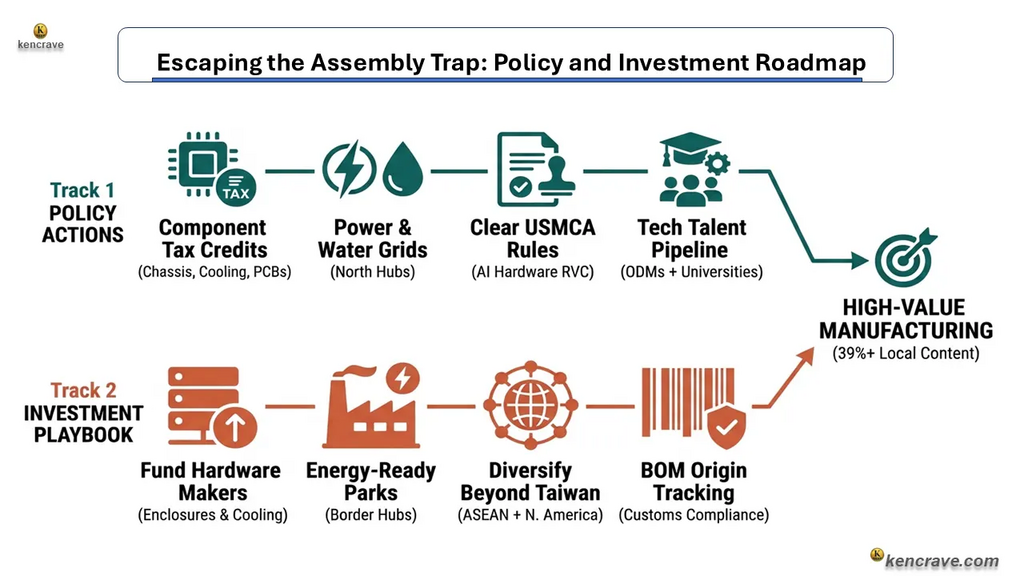
1. Incentivize Higher-Value Component Manufacturing: Redirect tax credits and Plan México nearshoring incentives from final assembly toward high-value inputs such as server chassis, thermal management systems, power supply units (PSUs), and printed circuit boards (PCBs).
2. Accelerate Power and Water Infrastructure Upgrades: Expand clean energy transmission, substations, and industrial water capacity in key manufacturing hubs such as Chihuahua, Nuevo León, and Jalisco to support component fabrication and data center testing.
3. Strengthen USMCA Compliance and Certainty: Work with U.S. and Canadian counterparts ahead of USMCA reviews to establish clear regional value content (RVC) rules for AI hardware, reducing the risk of anti-circumvention measures on imported components.
4. Build a Specialized Advanced Manufacturing Workforce: Partner with technical universities and leading contract manufacturers, including Foxconn, Quanta, and Wistron, to expand training programs in semiconductor packaging, PCB design, and industrial automation.
Investment Recommendations for Investors and Supply Chain Operators
1. Invest in High-Value AI Hardware Components: Focus capital on Mexican and joint-venture manufacturers producing server enclosures, liquid-cooling systems, cable assemblies, and industrial transformers, where local production can scale most quickly.
2. Prioritize Energy-Ready Industrial Assets: Target industrial parks and logistics hubs with secured power capacity, modern infrastructure, and bonded warehousing near major U.S. border crossings.
3. Diversify Component Sourcing Beyond Taiwan: Reduce supply chain concentration risk by qualifying suppliers across Southeast Asia (Vietnam, Malaysia, Thailand) and North America for passive components, substrates, and other critical inputs.
4. Strengthen Supply Chain Traceability: Implement automated compliance and origin-tracking systems to verify bill-of-materials (BOM) provenance, improve customs readiness, and mitigate tariff and regulatory risks.
Roadmap for advancing Mexico’s AI manufacturing sector, outlining policy reforms and private investment strategies to increase local value creation, strengthen semiconductor and hardware supply chains, develop technical talent, improve infrastructure, and support high-value manufacturing growth.
Bottom Line: Policy Arbitrage, Not Productivity, Defines Mexico's Supplier Status
Mexico's position as the United States' top supplier is driven more by policy arbitrage than by productivity gains. USMCA rules made it cheaper to route production through Mexico than to build a fully integrated manufacturing base there. That distinction matters because arbitrage opportunities disappear when the rules change, and those rules are now subject to annual review.
The question is not whether Mexico retains its ranking in 2027. It is whether Taiwanese and other Asian manufacturers use this window to expand beyond assembly into component production before Washington tightens rules-of-origin requirements. If they do, today's trade advantage could evolve into a durable industrial base. If they don't, Mexico may keep its ranking without much to show while the underlying value chain shifts elsewhere.
The next phase of Mexico's story will be determined not by export volumes only but by industrial deepening. The winners will be the countries that convert temporary trade advantages into permanent manufacturing capability.
Frequently Asked Questions
1.Did Mexico overtake China as the top US supplier?
Yes. Mexico ranked first among US goods-import suppliers in 2025, with $872.8 billion in total goods trade, ahead of Canada and China.
2. What is Mexico's tariff rate versus China's?
About 3%–3.6% versus 22%, which is a roughly 19-point gap driven largely by USMCA carveouts.
3. What is the USMCA annual review?
The US declined to renew USMCA in 2026, replacing it with annual reviews that keep current rules but subject them to renegotiation each year. The shift has already contributed to a 6.3% fixed-investment contraction in 2025.
4. Why is Mexico's AI server assembly vulnerable?
Local content is only 3%–7% (versus 39% in automotive), leaving the model exposed to US rules-of-origin tightening on Chinese content.
5.What does industrial deepening mean for Mexico?
Moving beyond assembly into component production. This is the difference between routing goods through Mexico and building lasting manufacturing capability there.