The image illustrates a projected split within Europe's gig economy in 2025 between traditional gig workers and AI specialists and earnings disparity. Image credits: Kencrave
8 min read
Business
Europe’s Gig Economy Split [2025 Data]: 43 M At €15/Hour Vs. Ai Specialists At €120/Hr
Imagine a Lisbon coder rocking Upwork from a sunlit café, or a Berlin courier weaving through the streets with a Deliveroo order. Europe’s gig economy is no longer a side hustle, it’s a multi-billion-euro driver of flexible work, reshaping the continent’s labor landscape with just a tap on a smartphone.
The Platforms Powering Europe’s Freelance Boom
Digital platforms like Fiverr, Deliveroo, Bolt, and Upwork are turning smartphones into on-demand job hubs, matching talent to work in seconds, whether it’s designing logos in Milan or delivering lunches in London.
The platform workforce grew from 28.3 million in 2022 to an estimated 43 million by 2025(Littler Mendelson P.C.)
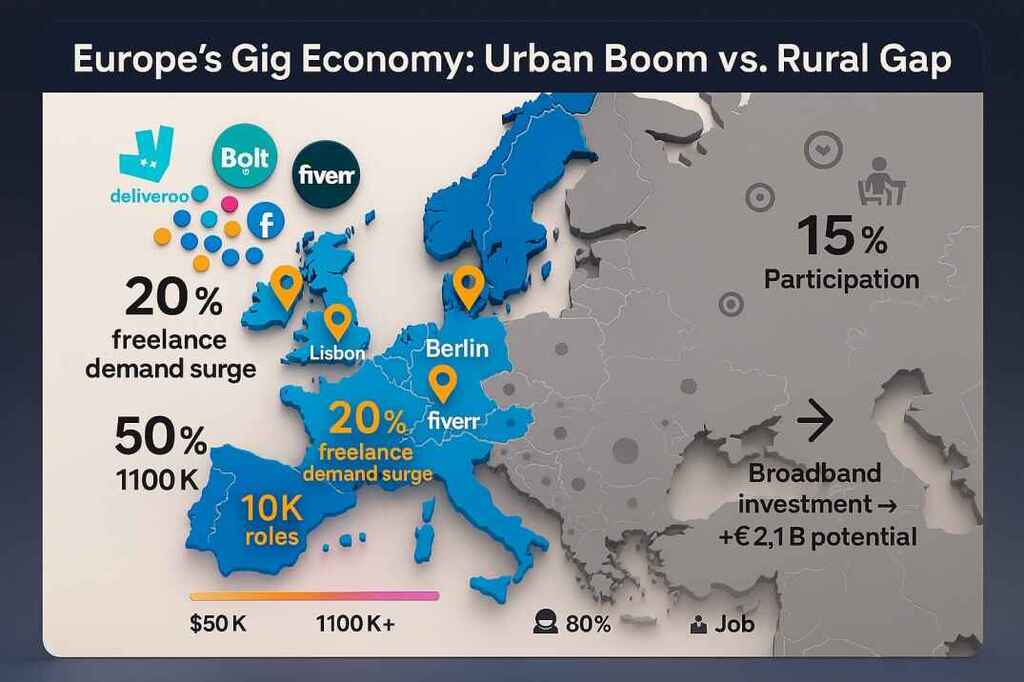
Cities like Berlin and Lisbon have 20% jumps in freelance demand, with fewer than half of those workers earning over $50,000, and just 13% crossing $100K annually.
City Lights vs. Village Nights: The Urban–Rural Gig Divide
The digital divide is stark:
70% of freelancersare under 35 and based in cities; only 15% of rural workersparticipate in gig platforms, with 80% still preferring traditional employment (World Bank).
Rural freelancers face slow internet, limited digital confidence, and social expectations tied to traditional work.
Elena, a freelance copywriter in rural Hungary, shares: "Bad Wi‑Fi kept me offline for months, only after NGO training did gigs become reliable."
But there’s hope: investing inbroadband access, localized digital training,and community co-working hubs could unlock huge untapped potential outside urban centers.
From Lisbon’s laptops to rural buffer zones: Europe’s gig economy surges past 1100K roles, yet broadband gaps risk leaving remote talent behind as cities rake in €2.1B through platforms like Deliveroo and Fiverr.
AI in the Driver’s Seat: Reinventing the Gig Workforce
Artificial Intelligence is shifting the gig job landscape:
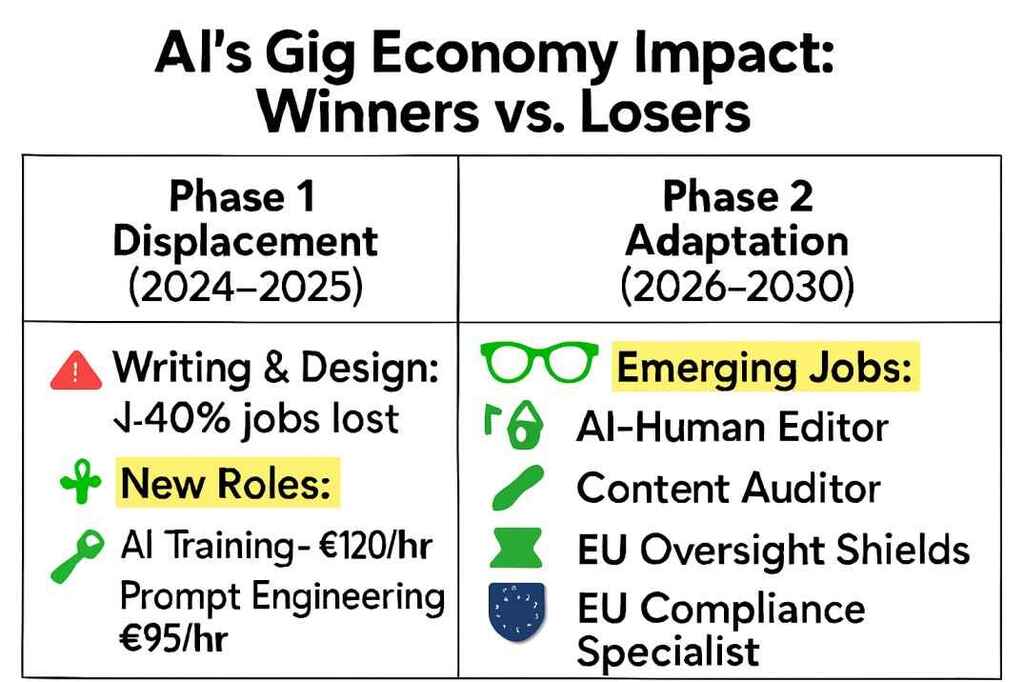
High-income roles like AI prompt engineering and model training are now paying up to €120/hour.
Anna, an Amsterdam-based designer, explains: "Three clients vanished to AI tools in 2024. I had to pivot to AI-prompted design to stay competitive."
This is fueling a new "tech elite" among freelancers. and sidelining those without upskilling opportunities.
AI Reshapes the Gig Game: Writers and designers face early losses, but high-paying roles like Prompt Engineers and EU Compliance Specialists rise as the new frontier
Fairness in the Algorithm Age: EU Rules in the Mix
In December 2024, the EU enacted the Platform Work Directive (EU 2024/2831):
It legally presumes gig workers are employees under platform control, granting them rights to benefits and human oversight of automated decisions (Taylor Wessing, Crowell & Moring).
Member states must transpose the law by December 2026.
Yet problems persist:
54% of workers lack benefits like health insurance and paid leave.
38% earn between $10–$14.99/hour, whilewomen earn 18–23% less (Taylor Wessing).
The Persistent Gender Pay Gap: Why Women Earn Less in the Gig Economy
While the platform economy promises equal access, data reveals entrenched disparities: 18-23% earnings gap persists across major platforms (Taylor Wessing, 2024).
Structural causes:
Algorithmic bias:Platforms prioritize "reliability metrics" that disadvantage women with care responsibilities.
Gig segregation: Women cluster in lower-paid care/service roles while men dominate tech/transport.
Bargaining disparity: Male freelancers negotiate rates 25% more often (Upwork internal data).
Motherhood penalty: Algorithms interpret childcare gaps as "low availability".
Case Study: Uber's Successful Adjustments Uber UK's 2022 reforms narrowed their gender earnings gap by 8% through:
Blinded trip assignments: Removed driver gender from dispatch algorithms.
Flex+ program: Paid waiting time for drivers with care responsibilities.
Dynamic pricing caps: Limited surge pricing on school/hospital routes.
Location-based bonuses intended to help women actually rewarded male cyclists in wealthy urban areas (LSE study, 2024).
Peak-hour quotas for female riders led to account sharing with male partners.
Customer tipping bias persisted, with male riders receiving 19% larger tips (Deliveroo internal data).
Key Lessons Emerging:
Simple fixes fail: Gender-neutral algorithms often perpetuate existing biases.
Local context matters: Solutions must address regional work patterns.
Transparency is crucial: Workers need to understand how pay systems function.
Policy Solutions Gaining Traction:
France's 2023 "Gig Equity Law" now requires bias testing before algorithm updates.
Berlin's revised "Fair Crowdwork" program ties funding to verifiable pay equity gains.
EU Directive Article 12 amendments will audit platform interventions annually.
Platform workers across France, Italy, and Germany are mobilizing, calling for algorithm transparency, fair pay, and legal protections.
Strategic Roadmap: Tailored Actions for the Gig Economy’s Future
To sustain the momentum and build a fair, inclusive, and scalable future for gig work in Europe, key stakeholders must align their actions across specific time horizons:
For Platforms Short Term (0–2 years):
Improve algorithm transparency and simplify how pay is calculated.
Introduce baseline pay guarantees and dispute resolution tools.
Medium Term (3–5 years):
Localize platform infrastructure to better serve rural and underserved regions.
Launch skilling and certification programs in high-demand digital tasks (e.g., AI labeling, UX design).
Long Term (6–10 years):
Develop hybrid platform ownership models that offer equity or dividends to workers.
Integrate benefit systems (healthcare, pensions) directly into platform ecosystems.
For Investors
Short Term (0–2 years):
Invest in platforms with strong ESG alignment, labor transparency, and early compliance with EU regulations.
Prioritize gig startups focused on financial inclusion, fair pay, and algorithmic accountability.
Medium Term (3–5 years):
Back ventures expanding into rural gig markets or developing AI-integrated freelance ecosystems.
Support platforms offering portable benefits and career progression frameworks.
Long Term (6–10 years):
Fund platforms pioneering cross-border labor solutions and multi-sector gig ecosystems.
Encourage industry coalitions or investment vehicles that promote ethical AI use in labor matching and compensation.
For Policymakers
Short Term (0–2 years):
Begin transposing the 2024 EU Platform Work Directive into national law.
Conduct regulatory audits on platforms to enforce worker rights, data use transparency, and pay equity.
Medium Term (3–5 years):
Build an EU-wide framework for portable benefits, including sick leave, retirement, and unemployment insurance.
Incentivize digital infrastructure in rural areas to close participation gaps.
Long Term (6–10 years):
Regulate AI and automated decision-making systems used by gig platforms.
Harmonize platform labor laws across the EU to prevent a “race to the bottom” in worker protections.
For Gig Workers Short Term (0–2 years):
Join digital worker cooperatives or forums for legal support and bargaining power.
Track income and hours to evaluate the sustainability of gig work and prevent burnout.
Medium Term (3–5 years):
Reskill in growth areas like AI prompt engineering, remote IT support, or project management.
Explore creating personal brands and client rosters for more stable freelance income.
Long Term (6–10 years):
Participate in shaping digital labor laws through advocacy or citizen assemblies.
Transition into portfolio careers, combining gig work, consulting, and passive income streams.
A Stakeholder's Summary of Strategic Recommendations over the Short-term, Medium term and Long term
By aligning on this strategic roadmap, stakeholders can unlock the full potential of the European gig economy, ensuring it remains flexible, inclusive, ethical, and built for long-term resilience.
The Road Ahead: Will Europe Level the Gig Playing Field?
Europe’s gig economy is no fringe phenomenon, it’s becoming mainstream. But the future hinges on whether digital opportunity is inclusive and fair:
Will rural communities gain real access?
Can regulation keep up with platform innovation?
Will tech-driven inequalities be addressed before they widen?
Europe can still shape a future where flexible work is not just scalable, but equitable,but only if it invests wisely in people, technology, and policy.
The gig economy is here. But the question remains: will it work for everyone?
![Europe’s Gig Economy Split [2025 Data]: 43 M At €15/Hour Vs. Ai Specialists At €120/Hr](/uploads/blog/imageb/126/Europe_s_Gig.jpg)

.jpg)