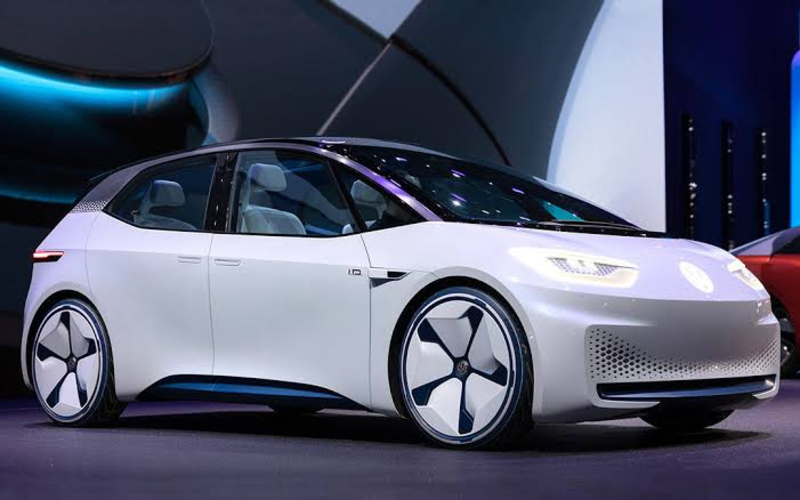
Volkswagen ID concept electric car showcased at an auto exhibition, sleek white hatchback with aerodynamic design representing Volkswagen’s innovation in sustainable EV technology. Image Credits: cc-by-sa 4.0 Matti Blume
13 min read
Business
Volkswagen 2030 Plan: 100 K Job Cuts, Eu Ev Delay, China Ev Rise And Investment Strategy
Volkswagen's 2030 survival plan through 100k job cuts, 50% fewer models, and a delayed EU EV ban. Why Chinese automakers are the long-term winners and European stocks remain high-risk.
Executive Summary
Volkswagen’s Future Plan 2030 (100,000 job cuts, 50% model reduction, 75% complexity slash) is a survival response to an 80% China sales collapse, uncompetitive German costs, and U.S. tariffs. The EU’s proposed 2035 ban relaxation to 90% confirms that industrial survival now outweighs climate goals with Chinese EV makers (BYD, SAIC, Chery) and Asian battery/semiconductor suppliers being the structural winners. For investors, European automakers remain high-risk turnaround plays through 2028, with long-term value shifting decisively toward China’s EV ecosystem.
Key Takeaways
Labor wins are tactical, not strategic. Unions blocked plant closures and brand spin-offs, but 100,000+ job losses and de-skilling through complexity reduction will permanently weaken German auto labor power.
Policy reversal buys time, not competitiveness. The EU’s softened 2035 ban delays EV infrastructure investment and extends petrol lifecycles but does nothing to close the cost/tech gap with Chinese rivals.
Consolidation is a high likely scenario. Expect mergers, partnerships, state bailouts, or bankruptcies among weaker European players and smaller suppliers especially in Italy and France within 2-5 years.
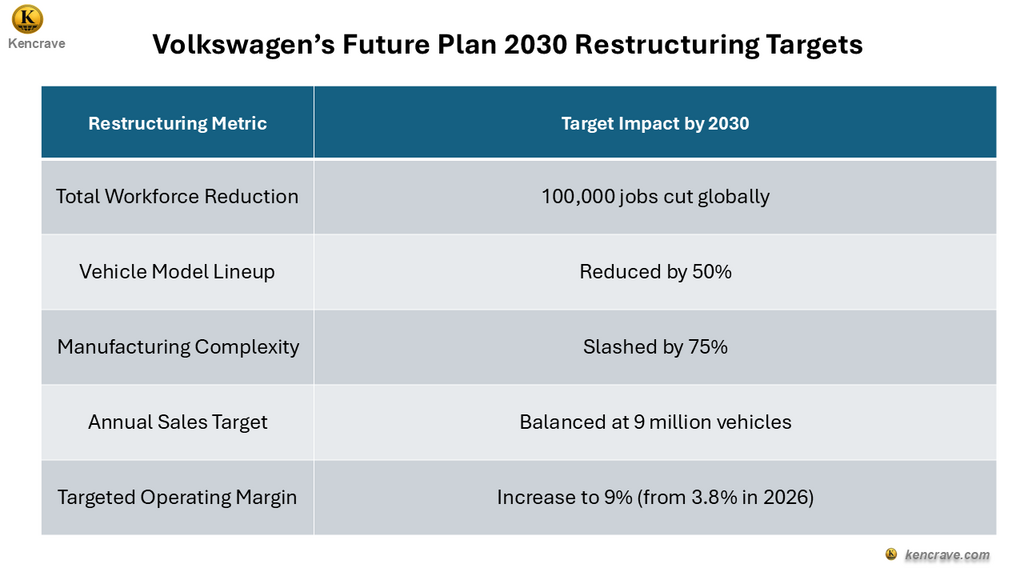
Volkswagen on September 3, 2026, announced an additional 50,000 job cuts. This follows a board meeting that unanimously approved the Future Plan 2030, which aims to cut more than 100,000 jobs by 2030. The company also aims to reduce its model lineups by approximately 50% by 2035 and is reviewing the production capacities of four German plants that is Emden, Zwickau, Hanover, and Neckarsulm.
Volkswagen will also slash vehicle offering complexity such as trims and optional features by 75% to maximize manufacturing efficiency. The automaker is targeting annual sales of nine million vehicles and an operating margin of 9% by 2030.
The scale of the restructuring resulted in months of intense pushback from German labor groups. The company also received backlash from the local government of Lower Saxony, which holds a 20% voting stake in the company. Union leaders successfully warded off immediate factory closures on home soil and blocked management's proposal to entirely spin off the core VW passenger car brand.
However, they also noted that the company is in a dire operational crisis, forcing it into a massive restructuring and survival plan. "In this crisis situation, we fought hard for good solutions," said Christiane Benner, Deputy Chair of the Supervisory Board and First Chairwoman of IG Metall.
Volkswagen 2030 restructuring plan chart detailing global job cuts, reduced vehicle lineup, simplified manufacturing, balanced 9‑million‑unit sales target, and profit margin increase to 9%.
Why Volkswagen is Struggling
A decline in automotive sales in China. China was a cash cow for the company's brands. However, the company's sales have dropped more than 80% over the past 10 years, as Chinese brands sell cheaper electric vehicles locally, making it hard for the company to subsidize its international operations. First-half 2026 sales data show the VW brand down 10.9% year-over-year, with Porsche down 16.5% and Bentley down 13.6%.
Lower profits in Europe. Volkswagen has encountered a rough market terrain in Europe, as sales keep dwindling due to low demand. This has been influenced by the high price of automobiles and inadequate charging infrastructure to support the scale of EV adoption in Europe's market.
Low margins for electric vehicles (EVs). The company has made massive investments in shifting its production lines to support electric vehicles. Since EVs are more expensive to manufacture and face slower-than-expected demand in Europe, they tend to generate lower profit margins than traditional combustion-engine cars.
An increase in costs. The company is unable to compete with global rivals such as BYD due to rising labor and energy costs in Germany. According to BYD's Q1 2026 financial results, the Chinese automaker reported revenue of 150.2 billion yuan, with exports continuing to scale globally despite a 55% year-on-year net profit drop driven largely by foreign exchange losses.
The tariffs factor. Heavy U.S. import tariffs have cost the company billions of euros. This has hit the profit margins of its premium high-end brands from its Audi and Porsche divisions, which traditionally offset low profits from other divisions.
The Volkswagen situation is not much different from other automotive players, especially in European markets. The industry is in a structural downturn, mainly driven by high energy costs, declining consumer demand, and stiff competition from highly subsidized Chinese brands like BYD.
Which automakers are most at risk from the European auto crisis?
Several major brands operating in the European Markets face these challenges:
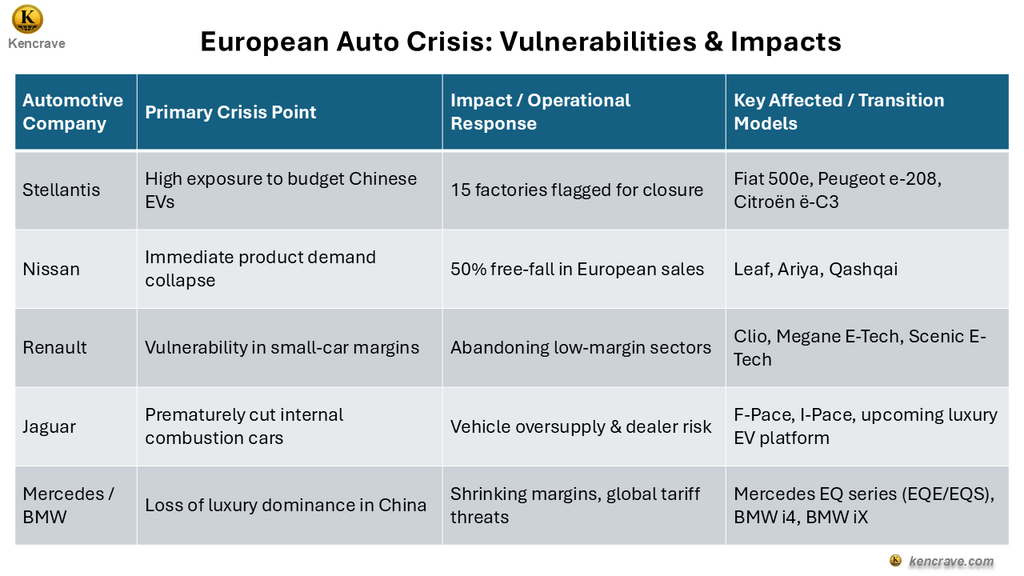
Stellantis (Peugeot, Fiat, Citroen, Chrysler, Jeep): Stellantis, the automotive giant created from the merger of Fiat Chrysler and the PSA Group, is facing severe financial strain and massive overcapacity. The company has already flagged more than 15 factories for closure, with industrial production declining by 23% in countries such as Italy.
Nissan: The Japanese automaker is also experiencing a decline in European sales. The company has failed to capture the market with its EVs and hybrid vehicles.
Renault Group: While the company has been consistent in producing automobiles in France, it also faces stiff competition from Chinese automotive manufacturers. This is because Renault relies heavily on producing smaller and affordable B-segment vehicles. This is similar to Chinese imports like SAIC's MG and Chery's sub-brands (Omoda and Jaecoo), making it incredibly difficult for Renault to maintain its market share without severe discounting.
Jaguar Land Rover (JLR): The company is also experiencing challenges in its transition phase into electric vehicles. Jaguar made the highly controversial decision to discontinue almost all of its traditional petrol-powered models to reinvent itself as an ultra-luxury, all-electric brand.
Mercedes-Benz and BMW: For decades, Mercedes and BMW generated massive profit margins by exporting high-end cars to China. Today, Chinese domestic buyers are abandoning foreign luxury cars for tech-heavy, homegrown luxury EVs. According to tracking by EV.com, Mercedes-Benz sold 551,900 vehicles in China last year, down 19% year over year, while BMW delivered 625,527 units, a 12.5% decline.
European auto crisis chart showing vulnerabilities and impacts for Stellantis, Nissan, Renault, Jaguar, Mercedes, and BMW. It details factory closures, sales declines, margin pressures, and EV transition challenges across major carmakers.
To prevent a total industrial collapse, the European Commission proposed a revision to its strict environmental rules on the absolute 2035 ban on combustion engines. The December 2025 proposal replaces the existing 100% fleet-wide CO₂ reduction target with a 90% reduction target compared to 2021 levels.
Manufacturers may compensate for the remaining 10% through flexibility mechanisms, including the use of e-fuels and biofuels and the incorporation of low-carbon steel. This revision is aimed at giving European luxury automotive manufacturers time to survive the influx of EVs and high-end vehicles from Chinese automotive manufacturers.
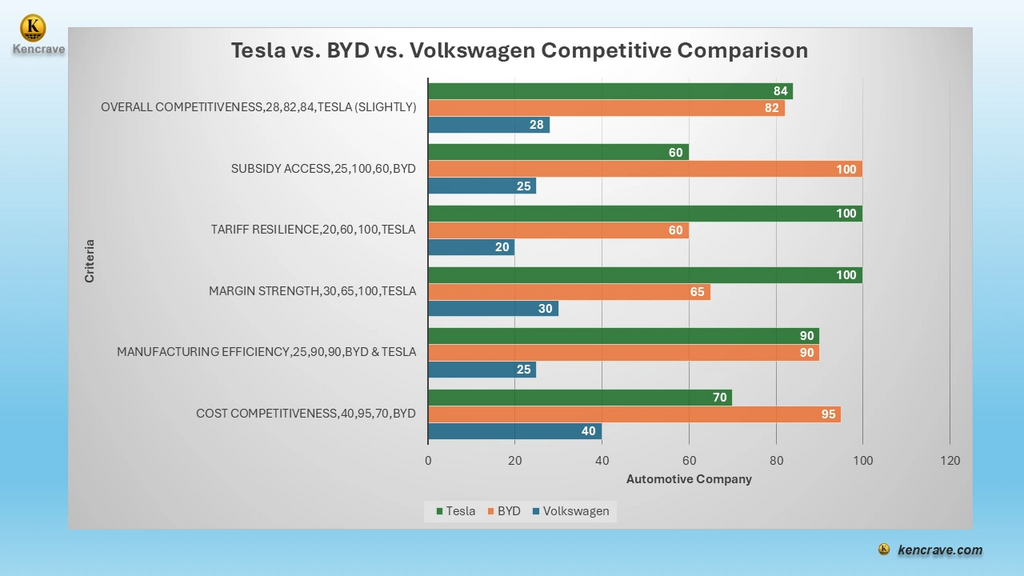
Tesla vs BYD vs Volkswagen competitive comparison chart showing scores for efficiency, cost, and market strength across six criteria.
Key Summary Insights on Tesla vs BYD vs Volkswagen:
Tesla: Best in profitability, tariff resilience, and overall competitiveness.
BYD: Strongest in cost efficiency and subsidy access.
Volkswagen: Significantly behind in most categories, facing structural challenges.
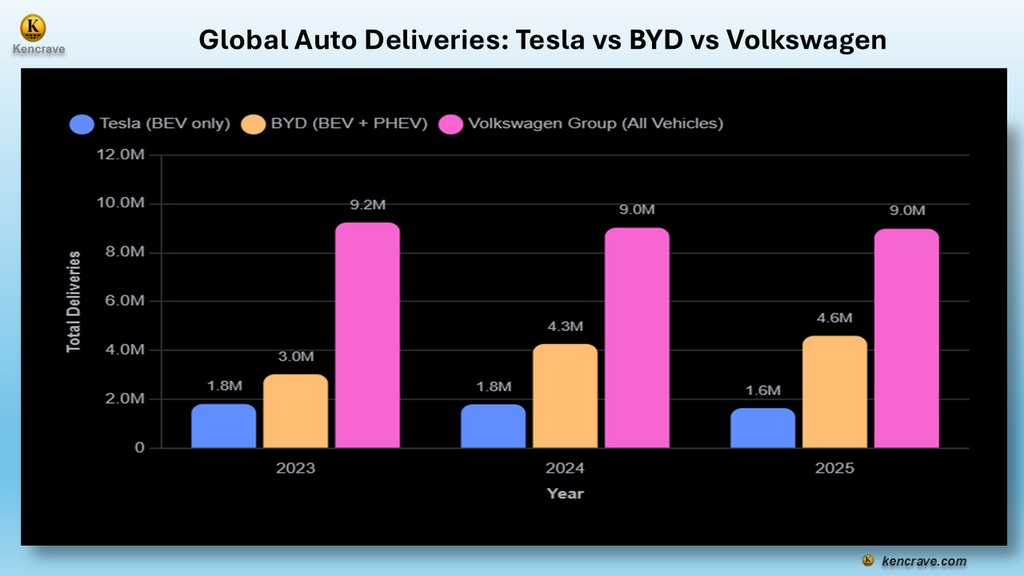
Global auto deliveries chart comparing Tesla BEV sales, BYD hybrid + EV growth, and Volkswagen Group total vehicle volumes from 2023 to 2025, highlighting BYD’s surge and Volkswagen’s scale dominance.
Key Insights in Global Auto Deliveries: BYD vs Tesla vs Volkswagen
Scale Gap: Volkswagen still operates on a completely different level of scale. Despite all the attention on the EV transition, it sells roughly twice as many vehicles as BYD and more than five times Tesla’s volume every year. The legacy giant remains the dominant force in total global output.
BYD’s Rapid Rise: BYD is the fastest‑growing player in the group. Its sales jumped over 41% in 2024, passing 4 million units reflecting its aggressive plug‑in hybrid strategy and expanding international footprint.
Tesla’s Plateau: Tesla has hit a ceiling. Its BEV sales peaked in 2023 at 1.81 million and have been declining since, dropping 8.65% in 2025 as global demand shifts toward more affordable hybrid options.
What This Means for the Automotive Industry
1. The European Production-for-Export Model Points to a Structural Decline
For decades, European automakers relied on high-margin exports to China to subsidize their home factories. With Chinese brands now dominating their own market (and VW sales down 80%), that market is in a dead zone. The industry must now restructure to produce for Europe only. This means the massive overcapacity by Volkswagen's European capacity currently exceeds demand by more than 500,000 units per year will likely force permanent plant shutdowns across the continent.
2. A Survival Mode for the Automotive Companies
Weaker players (Nissan, JLR, Renault) are struggling to transition to EVs, while stronger ones (VW, Mercedes, BMW) are cutting deeply to stay alive. This is likely to result in consolidations through mergers or joint acquisitions. Also, bankruptcies or state bailouts for smaller suppliers and possibly entire brands, especially in Italy and France, are likely to occur.
As a result, two types of markets could emerge: Chinese EVs dominating the mass-market and tech-luxury segments, while European legacy brands focus on ultra-premium or niche performance vehicles. According to Volkswagen's official "Future Plan 2030," the company is targeting a 9% operating margin and addressing 500,000 units of overcapacity, confirming the severity of the structural adjustment.
3. The EV Transition is Slowing, Not Accelerating
The EU's proposed revision to relax the 2035 combustion-engine ban to a 90% reduction target shows that the industry is in survival mode in Europe, superseding climate ambitions. This is highly likely to result in slower investment in EV charging infrastructure across Europe and extended lifecycles for petrol/diesel models, delaying the full-scale EV shift. The European Commission has confirmed that after 2035, plug-in hybrids, range extenders, and mild hybrids will not be automatically excluded from the EU market.
4. The Cost Structures are Unsustainable
European automakers may fail to match Chinese rivals on labor, energy, or component costs. The 75% reduction in model complexity (trims/options) at VW is a signal for simplification in the automotive industry. As a result, this is likely to lead to fewer vehicle variants, less customization, and more standardized cars globally.
For Investors (Opportunities and Risks)
1. Short-Term Scenarios, High Risk
European auto stocks (VW, Stellantis, Mercedes, BMW) are likely to remain under pressure due to falling Chinese sales, tariff impositions from the U.S., and rising labor/energy costs. Dividend declines are expected, as cash and reserves are redirected towards restructuring and survival rather than focusing on shareholder returns.
Labor strikes and political interference (as seen with Lower Saxony) represent governance risk, which would make turnaround execution unpredictable. Volkswagen expects operating costs of 31 billion euros, with 37 billion euros in overhead costs and a target of 135 billion euros for capital expenditures and R&D between 2027 and 2031.
2. The Long-Term Play
Investors should be cautious and treat European automakers as turnaround ground, not growth stocks. Key items to watch are 2030 job-cut targets, EV profitability, and China's automotive manufacturing policies and strategy. BYD's Q1 2026 financial results show even the dominant Chinese player experienced a 55% net profit drop due to foreign exchange losses and intense domestic competition, but its revenue of 150.2 billion yuan slightly exceeded expectations.
3. The Dominant Players: Chinese EV Makers and Tech Suppliers
BYD, SAIC, Chery, and others are structurally advantaged due to lower costs, government subsidies, and a massive domestic market. These could be viewed as the long-term growth plays in the EV space. BYD's Q1 2026 deliveries reached 700,000 units despite a 30% year-on-year decline. Battery and semiconductor suppliers especially Asian and U.S. firms will benefit regardless of which automaker survives. This is because all legacy players must source EV components for manufacturing EVs.
4. Tariffs as a Negative Effect
U.S. tariffs are already negatively impacting legacy brands such as Porsche and Audi. This is likely to continue over the medium term and may force premium brands to shift production to the U.S. or accept lower margins. EU retaliatory tariffs on Chinese EVs could cushion European players temporarily. However, this could force China to enact counter-policies that would cut off battery material exports to Europe. This would devastate European production and result in higher prices for vehicles in an already strained European market.
Investment Strategy Recommendations (Investor Type and Core Focus)
Growth-oriented: Favor Chinese EV makers, battery producers, and semiconductor firms over legacy European automakers.
Value/Income: Avoid or be cautious on European auto stocks until restructuring plans show clear progress (post-2028). Dividends are unsafe.
High-Risk: Consider companies such as Volkswagen and Stellantis if you believe they can successfully execute the 2030 plan and if government bailouts provide a floor.
ESG/Climate-focused: Re-evaluate exposure to climate-related environments. The delayed EV transition means European automakers are now lagging on climate commitments, making them less attractive for green portfolios.
Bottomline: The Next Decade of European Auto
For Volkswagen and its stakeholders, the next decade will be defined by survival over growth, with heavy job losses, reduced complexity, and a delayed EV transition. Chinese competitors are likely to continue dominating the markets, while European governments, unions, and management are all in a defensive, reactive mode trying to manage decline rather than lead transformation in the automotive industry.