
Europe
A Strategic Analysis of Community Energy Funding Wave and the Heritage Planning Bottleneck Constraining Faith-Sector Solar Deployment in UK.
Executive Summary
Faith organizations in the UK are moving from climate advocacy to renewable energy ownership, financed through a three-pillar architecture: internal denominational green funds, state-backed community energy grants, and zero-capex community partnerships.
The Church of England has pledged £40 million to its Net Zero Carbon Programme for 2026–2028, part of a £160 million commitment through 2034. On 17 September 2026, Great British Energy released the £30 million Community Fund the first funding batch of up to £1 billion.
A structural hold-up threatens the pace of deployment. Roughly 78% of Church of England parish churches are listed, and heritage planning remains the main constraint. For Grade I and Grade II* churches, obtaining consent can be especially difficult. Decision-makers must assess the visual impact of the proposal and determine whether any "less than substantial harm" to the building's heritage significance is justified by the project's public benefits.
Historic England's guidance has eased since 2023, but policy reform is still needed to reconcile heritage preservation with climate action. In much of Europe, heritage consent is similarly restrictive, but feed-in tariffs and streamlined approvals have driven faster deployment.
In Asia, net metering and CSR mandates have scaled rooftop solar on temples, mosques and gurdwaras. In North America and Australia, tax credits and direct-pay provisions support faith-hosted projects. The UK's funding architecture is comparatively well developed, but planning is its clear bottleneck.
The core strategic insight
Faith groups have solved the finance problem through financial innovation, but not the planning problem. Zero-capex partnerships eliminate capital constraints. However, they cannot by themselves resolve heritage consent. Design, siting and early engagement still decide outcomes of solar installation in churches.
How UK Faith Groups Became Renewable Energy Owners
UK faith groups are shifting from climate advocacy to renewable energy ownership. This shift is driven by the rising energy costs that threaten the viability of historic buildings, denominational net-zero commitments, and a new wave of government funding for community energy.
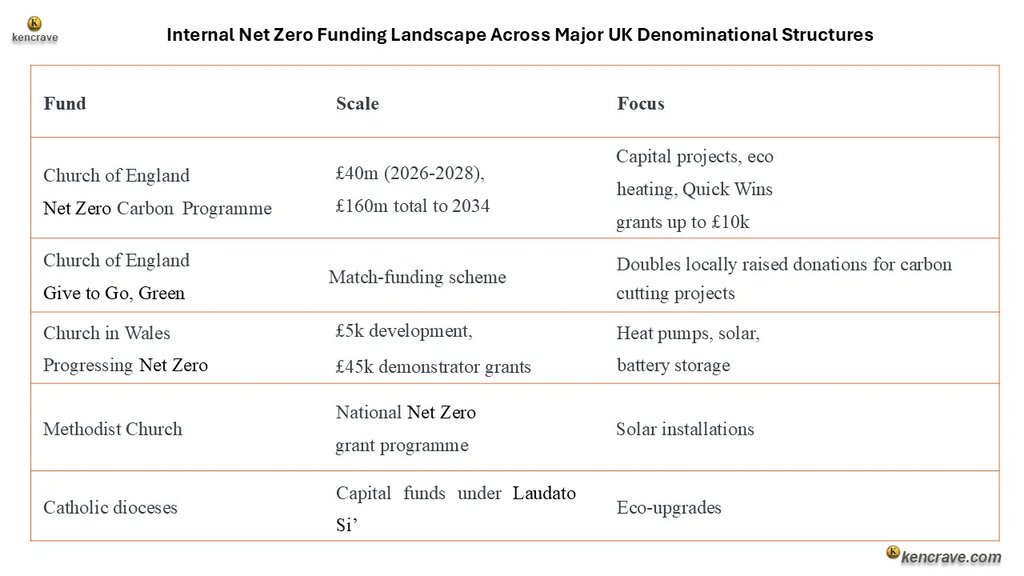
The Church of England has committed to net zero carbon emissions by 2030, with the Net Zero Programme extended to 2034 and £160 million in total allocated funding. The Methodist Church operates a national Net Zero grant programme, and Catholic dioceses run capital funds under the Laudato Si’ framework. Major UK Muslim charities have funded mosque solar projects, and Sikh community foundations have supported Gurdwara solar.
Great British Energy’s People’s Power programme, launched on September 17, 2026, explicitly targets community-owned energy assets. CEO Dan McGrail stated: “Our vision is that every community should have the chance to build and own its own renewable energy. These grants will give community organisations and local authorities the practical support they need to get clean energy projects off the ground.”
THE FUNDING ARCHITECTURE OF FAITH BASED SOLAR PROJECTS IN UK
Faith-based solar projects in the UK are funded through three main mechanisms:
- Denominational green funds from organizations such as the Church of England, Church in Wales, Methodist Church, and Catholic dioceses help churches cover project costs through grants and low-cost financing.
- Public funding and government support such as Great British Energy's Community Fund, Scotland's CARES programme, the Welsh Government Energy Service, and VAT relief reduce development risks and capital costs.
- Community energy partnerships enable a co-operative or community benefit society to finance, own, and maintain the solar installation, while the congregation purchases the electricity through a long-term power purchase agreement (PPA).
These funding sources can be combined. Church funds support early-stage work and small projects, grants help close funding gaps, and community partnerships eliminate upfront capital requirements altogether. Together, they address the primary financial barriers to solar deployment.
Internal Denominational Green Funds
The Church of England’s Net Zero Programme includes the Decarbonizing Churches Grant Fund, opening to all dioceses from June 2026, and the Quick Wins Grant Fund, which provides up to £10,000 for smaller projects like LED lighting, pew heaters, and insulation.
State-Backed and Public Grants Faith-based solar projects in the UK
Government funding support for faith-sector solar is available at three levels. At the UK level, Great British Energy's Community Fund supports community-owned clean energy projects and is primarily accessed through community energy groups and local authorities.
At the devolved level, Scotland's CARES programme and the Welsh Government Energy Service provide funding, technical assistance, and project support for community buildings, including places of worship. A clear example in this case is the Gwyrdd Bangla Project across seven mosques.
At the fiscal level, 0% VAT on eligible solar PV installations lowers overall project costs until March 2027. In practice, direct grants to congregations are uncommon. Public funding is most effective when faith organisations work with community energy groups or local authorities to deliver projects.
The table below shows key focus areas of the Great British Energy Community Fund.
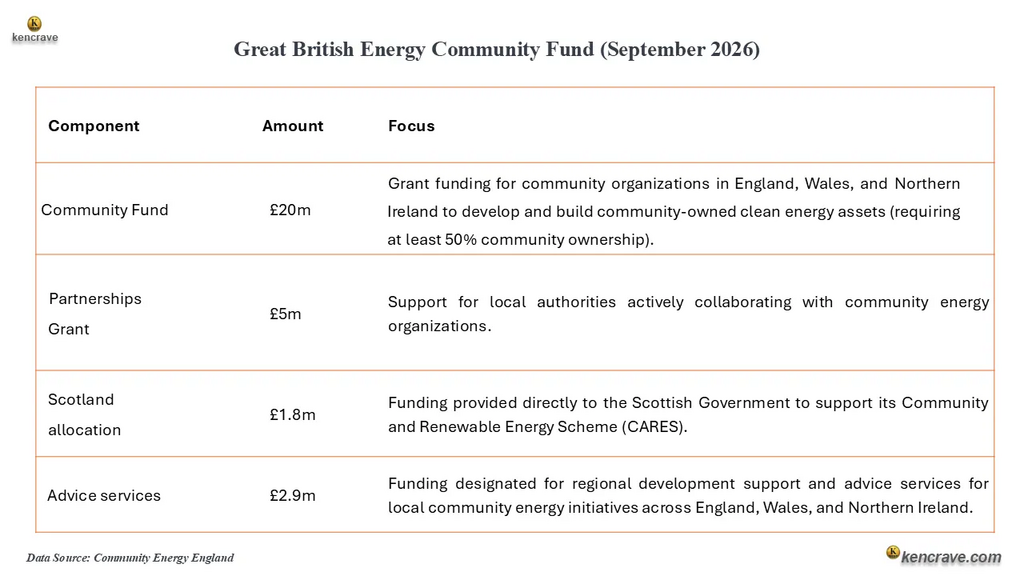
Projects must demonstrate that the community will hold a defined legal and financial interest and that a defined share of project benefits will be retained by, or delivered to the local community
Community Energy Partnerships (Zero-Capex Models)
One of the fastest-growing funding model for faith buildings without capital is partnering with community energy organizations through Power Purchase Agreements (PPAs) or shared ownership structures.
The Northumberland Community Energy Limited (NCEL) Model
NCEL is a not-for-profit Community Benefit Society formed in 2023 and operates as a cooperative. The organization:
- Raises capital funds for pre-development work through grants and loans.
- Leases roof space from community buildings.
- Installs and maintains solar PV and battery systems at no cost to the building. 4. Sells solar electricity to the building at 15p per kWh under 20-year PPAs 5. Manages all risks, including insurance, grid connection and maintenance.
This resulted in 9 buildings installed, 95 buildings in pipeline, goal of 100 installations by 2030.
THE HERITAGE PLANNING BOTTLENECK IN FAITH BASED SOLAR APPROACH
The Scale of the Challenge
It is estimated that 78% of Church of England parish churches are listed as Grade I, Grade II*, or Grade II. The planning system often treats heritage conservation and clean energy objectives as competing priorities, rather than recognizing that both can be achieved together.
The National Planning Policy Framework (NPPF) Framework
The National Planning Policy Framework places significant weight on protecting listed buildings and requires planning authorities to balance any heritage impact against the public benefits of a proposal.
In practice, however, the climate and financial benefits of solar projects are often not considered sufficient to outweigh concerns about harm to heritage assets. As a result, heritage considerations can remain a significant barrier to solar installations on listed faith buildings.
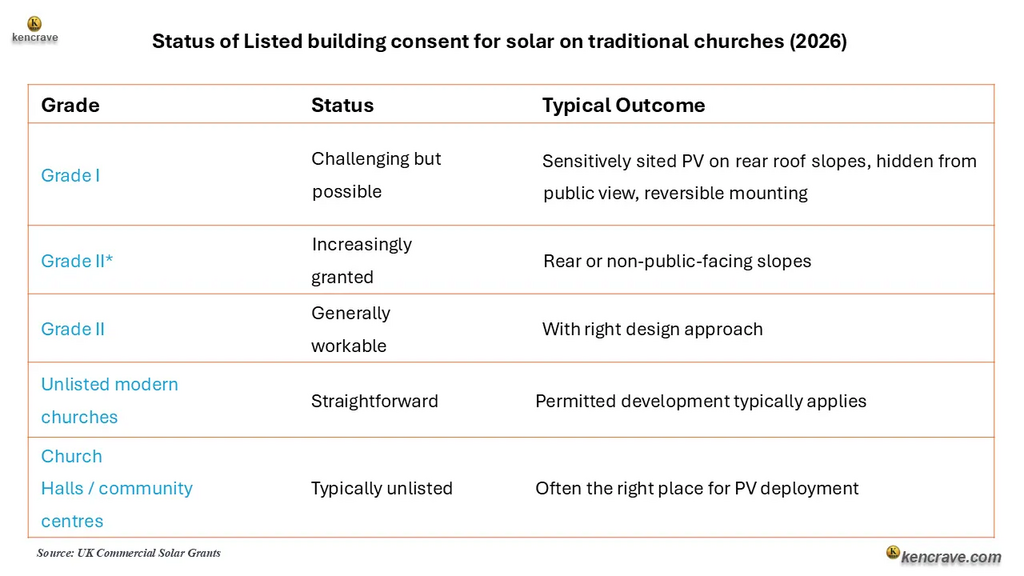
UK’s Solar Consent Landscape by Grade
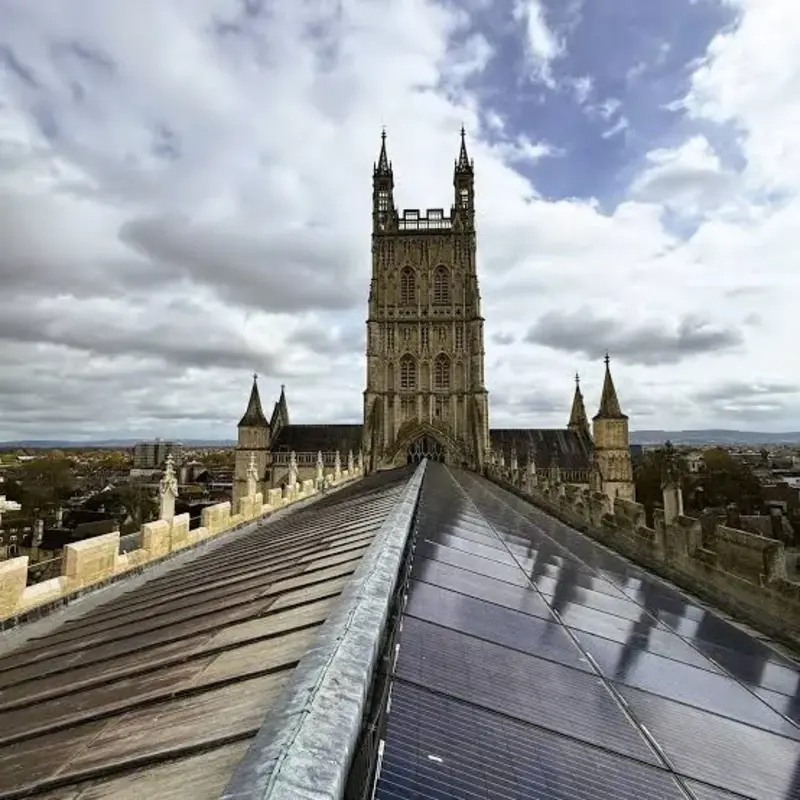
Historic England's guidance indicates that solar panels are generally easier to install on places of worship where roof surfaces are hidden from public view, such as behind parapets or on internal roof slopes that cannot be seen from ground level.
Despite this guidance, planning rules remain restrictive. In December 2024, the UK Government confirmed that it had no plans to extend permitted development rights to allow solar panel installation on listed buildings where the panels are not visible from street level.
But the UK Government noted that the policy could be reviewed in the future. Consequently, faith organizations seeking to install solar panels on listed buildings must continue to apply for listed building consent on a case-by-case basis.
But the UK Government noted that the policy could be reviewed in the future. Consequently, faith organizations seeking to install solar panels on listed buildings must continue to apply for listed building consent on a case-by-case basis.
The Parallel Approval Process Across Different Jurisdictions
For Church of England buildings, solar installations typically require both planning permission and faculty approval. The faculty jurisdiction system, administered by ecclesiastical courts, regulates most alterations to church buildings, including renewable energy projects.
How it interacts with planning permission:
- Some churches are exempt from listed building consent (ecclesiastical exemption) but still require faculty approval.
- Others require both planning permission and faculty approval.
- The relationship is complex and varies by diocese in UK.
Case of Successes and Refusals of Solar Installations in UK’s Churches
Case-selection note: The following case studies are illustrative, not representative. They were selected to show what success looks like and why failure happens. They do not constitute a systematic sample.
Cases Where Community Solar Installation Has Been a Success in UK
St Paul’s West Hackney
An East London church installed 104 solar panels, four air source heat pumps, and three Tesla storage batteries following a £170,000 investment. Funding for this installation came from Stokey Energy, Hackney Council’s Community Energy Fund, and the London Olympics Legacy Fund. The parish’s £40,000 contribution was estimated to be recouped within four years. The system now generates about 70% of the church’s energy, producing 46 MWh annually.
Sketty Mosque, Swansea
Received a Smart Local Energy System comprising a 22.5 kW roof-mounted solar array, 100 kWh battery, three 50 kW EV charging points, underfloor heating, and two 13.2 kW air source heat pumps. Funding ran through April 2026.
Gwyrdd Bangla Project, South Wales
The Bengal Dragons Foundation worked with the Welsh Government Energy Service to install solar across seven mosques. The project delivered 0.22 MW of renewable capacity, with 100% capital funding from Ynni Cymru. Forecasted savings is 335 tCO₂e over the project lifetime.
Cases Where Community Solar Installation Has failed in UK
St Anne's Church, Ings (Lake District)
A proposal to install solar panels on this Grade II listed church was cancelled because planners concluded that the visual impact on the historic building and surrounding landscape outweighed the project's benefits. The case highlights a common challenge for small rural congregations: modest energy generation and carbon savings can make it difficult to demonstrate sufficient public benefit to overcome heritage concerns.
The Old Church, Hill Deverill (Wiltshire)
A redundant Grade II* church which is no longer in regular worship use, sought consent for a scheme combining PV with a change of use. The consent was refused and the project cancelled highlighting the redundancy trap. This indicates that buildings with the greatest financial need for energy savings are often those with the weakest public benefit case because they lack an active congregation.
The Society for the Protection of Ancient Buildings (SPAB)
SPAB supports the use of solar energy on historic buildings where it is carefully designed and installed. It emphasises reducing energy demand first, minimizing impacts on historic fabric, and using reversible installation methods wherever possible. For faith organisations, early engagement with SPAB can help identify and address conservation concerns before a planning application is submitted.
Implementation risks beyond planning for Solar Installation:
- Faculty approval requirements. Church of England churches may need both planning permission and approval through the faculty system, which can lengthen project timelines and add complexity.
- Structural constraints. Many historic roofs require assessment before solar panels can be installed, and necessary reinforcement can significantly increase project costs.
- Grid connection challenges. Rural churches can face costly and time-consuming grid connection upgrades, which are a common source of project delays.
- Insurance and maintenance. Zero-capex PPAs transfer these risks to the co-op, which is a key argument for the partnership model but the co-op must still price them into the 15p/kWh tariff.
- Governance and approvals. Solar projects often require approval from multiple decision-making bodies, which can slow progress, particularly for multi-site schemes.
- Heritage assessment costs. Heritage and impact assessments can be a significant upfront cost, creating a financial barrier before any planning or faculty approvals are secured.
Overall, planning outcomes depend more on project design and stakeholder engagement than on the listed status of the building itself. Solar projects are more likely to succeed when panels are discreetly located, minimize impacts on historic fabric, and are developed through early consultation with heritage stakeholders. Conversely, proposals with greater visual impact or more extensive alterations to historic buildings face a higher risk of refusal.
WHAT THE UK CAN LEARN FROM SUB-SAHARAN AFRICA, SOUTH ASIA, NORTH AMERICA AND AUSTRALIA
Internationally, the main barriers to faith-sector solar vary by region. In the UK and much of Europe, heritage and planning requirements are often the primary challenge. In other regions, such as parts of Sub-Saharan Africa and South Asia, financing and grid access can be more significant constraints.
In North America and Australia, project uptake is more commonly influenced by organisational capacity and available financial incentives. Compared with these regions, the UK's funding mechanisms are relatively well developed; while planning and heritage requirements remain a key barrier to deployment.
Middle East and North Africa
In the Middle East and North Africa, faith-sector solar projects are typically delivered at a larger scale and are often supported by governments or public institutions. These initiatives are commonly focused on mosques and major religious sites, with key challenges relating to electricity networks, energy demand, and broader energy-sector policies.
The main lesson for UK is the value of coordinating projects at scale. This allows solar installations on faith buildings to contribute not only to energy savings but also to wider public and policy objectives.
Asia
In Asia, there is rapid rooftop solar growth on temples, mosques, gurdwaras, and churches. This is driven by net-metering and corporate social responsibility (CSR) mandates such as India's CSR rules, Indonesia's mosque solar programmes, and Taiwan's temple PV.
Common challenges include grid connections, the stability of solar support schemes, and the suitability of existing roof structures. A key lesson for the UK is that policies allowing organisations to receive value for surplus electricity can significantly improve the economics of faith-sector solar projects and encourage wider adoption.
Sub Sahara Africa
In Sub-Saharan Africa, faith buildings serve as anchors for off-grid and mini-grid solar. Kenya’s and Nigeria’s church and mosque hybrid systems and missionary-hospital solar are clear examples in the Sub-Saharan region.
However, key challenges face faith organizations in solar sector that is: securing funding, managing financial risks, and maintaining systems over the long term. A key lesson for the UK is the role that faith organizations can play as trusted community networks, helping to engage people and build support for local energy initiatives.
Europe (non-UK)
In much of Europe, faith-sector solar projects face similar heritage and planning constraints to those in the UK, but stronger financial incentives help support deployment. Examples include Germany's EEG feed-in tariffs, the Netherlands' SDE++ scheme, France's Fonds Chaleur programme and simplified approval processes for solar on religious buildings, and Denmark's parish-council solar co-operatives.
The main barriers remain heritage consent and grid congestion. European experience suggests that feed-in tariffs and streamlined approval processes have been more effective than grant funding alone in expanding solar deployment on faith buildings.
North America and Australia
In North America and Australia, faith-sector solar projects are often supported by financial incentives such as the US Investment Tax Credit (ITC) and Australia's Small-scale Technology Certificates (STCs). Churches frequently participate as hosts for community solar projects, enter into power purchase agreements (PPAs). They ake part in initiatives such as US Solar on Churches programmes and Australian parish bulk-buy schemes. The main challenges are navigating tax-related requirements for non-profit organisations and addressing ageing roof infrastructure.
A key difference from the UK is the availability of mechanisms such as the US direct pay provisions under the Inflation Reduction Act, which allow non-profits to access tax-credit benefits directly and improve project economics.
Four key themes emerge from Faith Based Solar Approaches in different regions:
- Net metering and feed-in tariffs are often more effective than grants. They create a reliable revenue stream that can attract third-party investment. In the UK, long-term PPAs serve a similar role following the withdrawal of feed-in tariffs.
- Heritage and planning requirements are a more significant barrier in the UK and Europe than in most other region. This reinforces the case for planning reform to support solar deployment on historic faith buildings.
- Faith organizations can act as powerful delivery networks. They can help to aggregate demand, standardize projects, and reduce costs, as seen in parts of Asia and Africa. UK denominations (Church of England, Methodist, Catholic) have similar networks but have made limited use of them for collective procurement.
- The UK's funding model combines internal faith-sector support, public funding, and community energy partnerships. However, this approach is most effective where a strong community energy sector exists. In many other countries, governments or utilities perform the role that community energy organizations play in the UK.
COMMERCIAL OPPORTUNITY AND VALUE CREATION FROM SOLAR ENERGY
The faith based solar approach offers commercial opportunities to community energy cooperatives, faith groups, solar installers, government and local communities.
The table below represents who and how they benefit in community solar projects.
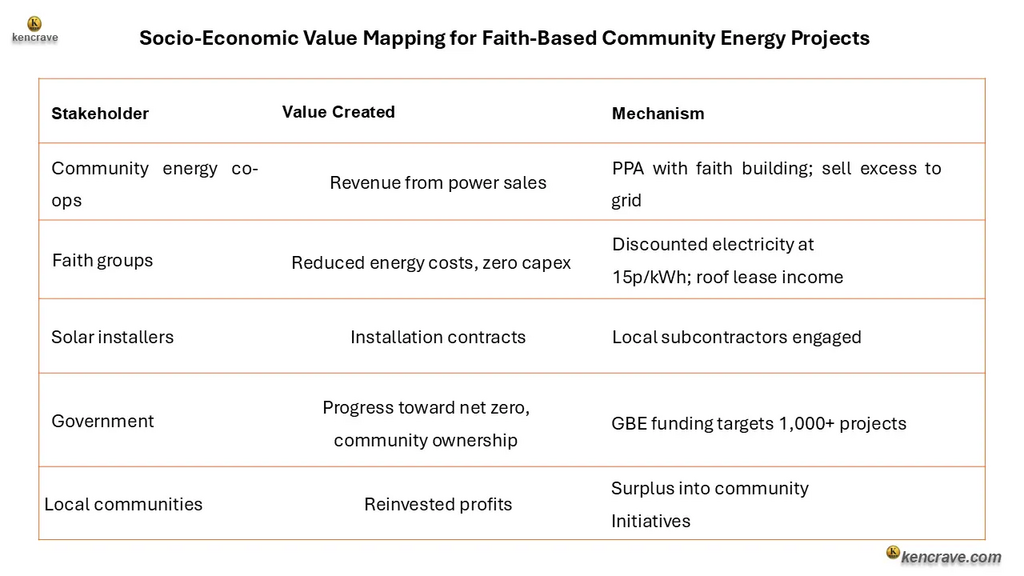
The Core Commercial Insight
The zero-capex PPA model is one of the fastest-growing trend because it bypasses the two biggest barriers for faith groups: lack of capital and inability to take on long-term debt. NCEL’s model of leasing roof space and selling electricity at 15p/kWh creates a viable commercial proposition for both the community energy society and the faith building.
Key metrics from NCEL:
- 31 KWp installed capacity, 50 kWh battery storage at first two sites.
- 9 installations completed, 95 buildings in pipeline.
- 98% energy self-sufficiency at installed buildings.
- Goal of 100 solar installations by 2030.
STAKEHOLDER RECOMMENDATIONS
Addressed Parties: Faith Groups Community Energy Organisations, and Policymakers
Faith Groups
Explore Zero-Capex Partnerships First
Action: Contact Community Action Northumberland, NCEL, or local community energy organizations before seeking capital grants. The PPA model eliminates upfront costs and risk.
Timeline: Immediate
Engage Heritage Consultants Early
Action: For listed buildings, commission heritage impact assessments and explore
concealment options (rear slopes, parapet hidden roofs, ground-mounted alternatives) before applying for consent.
Timeline: Before planning application
Target Church Halls First
Action: Church halls and community centres are typically unlisted even where the main church is listed, making them the right place for initial PV deployment.
Timeline: Short Term
For Community Energy Organizations
Target Faith Buildings with Large South-Facing Roofs
Action: Mosques and gurdwaras tend to be larger modern buildings (post-1980) without listed status. Prioritise these for faster deployment.
Timeline: Ongoing
Develop PPA Templates for Religious Governance
Action: Faith buildings have unique governance structures (PCCs, trustees, diocesan authorities). Develop standardized lease and PPA templates that address these.
Timeline: Short-term (3-6 months).
Apply for GBE Community Fund
Action: The £30m Community Fund is open to community energy groups. Applications opened September 17, 2026.
Timeline: Immediate
Policymakers
Action: Clarify NPPF Guidance on Climate Benefits
Timeline: Medium term
Action: Extend Permitted Development Rights
Timeline: Long-term
Action: Support Community Energy Societies
Timeline: Ongoing
Summary: The Faith-Energy Transition And Its Structural Limitations
Faith groups are no longer just preaching about climate change but also building renewable energy infrastructure. The three-pillar funding model through internal denomination funds, state grants and community PPAs is enabling this transition. The zero-capex PPA model emerging as the most scalable solution for capital-constrained congregations.
But the pace is constrained by a planning system that treats heritage preservation and climate action as competing, not complementary goals. Until NPPF guidance is clarified to weight climate benefits more heavily, the most ambitious projects on the most historically significant buildings will continue to face refusal.
Faith groups have solved the funding problem through financial innovation. As of 2026, one of the major bottleneck is regulatory. The £30m GBE Community Fund and the £160m Church of England commitment have created the capital architecture. What remains is the political will to reform heritage planning rules that currently prevent faith buildings from becoming renewable energy assets.
Key Takeaways
- Denomination funds de-risk, grants close gaps, PPAs remove upfront capital. One mechanism alone leaves value on the table.
- Concealment and early engagement decide planning outcomes more than listed status.
- Halls, community centres, mosques and gurdwaras consent faster thus deploy there first.
- PPAs shift insurance, grid and maintenance to the society but that risk must be priced into the tariff.
- Feed-in tariffs and net metering have scaled faith solar faster than grants alone; UK PPAs now fill that role.
FAQs: Faith Based Solar Approach in UK
1. What is the Great British Energy Community Fund?
A £30m fund launched September 17, 2026 as part of up to £1bn for community-owned energy projects, explicitly targeting community energy groups and local authorities.
2. Can faith groups apply for the GBE Community Fund?
Faith buildings are eligible through community energy partnership routes. Most faith buildings are charities and can partner with community energy organizations to apply.
3. Can listed churches install solar panels?
Yes, but it is difficult. Grade I churches require sensitively sited PV on hidden slopes; Grade II* and Grade II churches have more permissive pathways.
4. What is a zero-capex community energy model?
A community energy co-operative finances and installs solar on a faith building. The congregation gets discounted electricity (typically 15p/kWh); the co-op sells excess to the grid and retains surplus for community benefit.
5. How much can a faith building save with solar?
NCEL’s PPA model sells electricity at 15p/kWh. St Paul’s West Hackney generates 46 MWh annually, covering an estimated 70% of its energy needs. Savings depend on building size and energy consumption.
SOURCES
This strategic analysis draws on primary government policy documents, denominational funding disclosures, community energy case studies, and specialist reporting.
- GOV.UK, "People's Power projects to give more control over local energy," 2026.
- GOV.WALES, "Gwyrdd Bangla Project, South Wales: Solar installation on mosques," 2025.
- GOV.UK, "Award 53385 – Smart Local Energy System installed at Sketty Mosque," 2026.
- Church of England, "General Synod Spending Plans 2026–28," 2026.
- Church of England, "Net Zero Carbon Programme Grants for Churches," n.d.
- Church in Wales, "Progressing Net Zero Project," 2026.
- Methodist Church, "Building Sustainable Hope," 2025.
- Northumberland Community Energy Limited, "NICRE Case Study," n.d.
- Community Action Northumberland, "NCEL Progress Report," n.d.
- Net Zero North East, "Northumberland Community Energy Ltd Case Study," 2024.
- The Independent, "New £30m solar and clean energy fund opens," 2026.
- BBC, "East London church goes green with £170k upgrade," 2025.
- EIBI, "Communities offered funding to develop local clean energy projects," 2026.
- Carbon3 UK, "Renewable Energy for Religious Buildings," 2025.
- Oxford City Council, "Heritage Retrofit Guidance," n.d.
- Historic England, "Solar Electric Panels and Slates on Listed Places of Worship," n.d.
- Commercial Solar Grants UK, "Solar for UK Churches & Faith Buildings," 2026.
- Parliament Today, "Communities given more control over local energy," 2026.
- Church of England, "Questions Notice Paper," 2026.