In an era defined by climate urgency and heightened consumer awareness, L’Oréal stands as a testament to the powerful synergy between beauty and purpose. Much like the world’s most resilient ecosystems, the company has cultivated a balanced approach to growth, demonstrating that a rich legacy and ambitious sustainability goals can flourish in tandem (L’Oréal, 2020).
For over a century, L’Oréal has not just survived—but thrived—by reinventing itself while staying true to its core values. Its journey offers a masterclass in corporate longevity, blending innovation, ethics, and financial discipline to build a future-ready enterprise. A Century of Transformation: From Vision to Global Leadership
Founded in Paris in 1909 by Eugène Schueller, L’Oréal began with a singular focus:safe synthetic hair dyes. This scientific foundation laid the groundwork for what would become a global beauty empire driven by R&D and social responsibility.
In 2013, L’Oréal launched Sharing Beauty With All, its first comprehensive sustainability program, setting measurable targets across its value chain. In 2020, it followed with L’Oréal for the Future, a 2030 roadmap that deepens its environmental and social commitments, aligning with the United Nations Sustainable Development Goals (SDGs).
Leadership Transitions and Styles
L’Oréal has consistently nurtured internal talent, favoring continuity and institutional knowledge. Its leadership evolution reflects shifts in business priorities as shown in the following table.
L’Oréal's Leadership Transition
L’Oréal's Dominant leadership styles across history lean toward transformational, visionary, and adaptive leadership, anchored in innovation, ethics, and long-term sustainability.
Guiding Principles: Mission, Vision, and Core Values
L’Oréal’s mission is “to offer the best of beauty to all,” emphasizing global reach, quality, efficacy, and safety.
Its vision, Beauty that moves the world, reflects a commitment to empowerment through beauty, driven by innovation and responsibility.
Core valuesinclude: Innovation, Sustainability, Responsibility, Transparency, Diversity, and Inclusion.
Ethical Leadership and Commitments
L’Oréal is a perennial honoree on the Ethisphere Institute’s list of the World’s Most Ethical Companies, a testament to its ethical governance and stakeholder engagement. Key initiatives include:
Cruelty-free testing: Using reconstructed human skin technology (e.g., EpiSkin) to eliminate animal testing.
Gender equity: Women represent 54% of leadership roles, and gender pay equity is audited regularly.
Ethical sourcing: More than 1,600 inclusive sourcing partnershipswith fair-trade and social enterprises.
Inclusive beauty: Formulating products for over 40 skin tones and across diverse hair types, exemplified by the Lancôme Teint Idole andL’Oréal Paris True Match ranges.
Digital ethics: Embracing responsible AI development, especially in beauty diagnostics tools like Modiface.
Employee Culture: Empowering People and Fostering Purpose
L’Oréal is known for a high-performance, innovation-driven, cult-like culture that promotes individual purpose and global impact. Its “Sense of Purpose” initiative has helped strengthen employee engagement and retention globally.
Loreal's Key pillars of employee experience
Competitive compensation and wellness benefits.
Career development with international mobility.
Strong DE&I (Diversity, Equity, and Inclusion) programs with global benchmarks.
Entrepreneurial spirit embedded in performance expectations.
In 2023, L’Oréal ranked among the Top 10 World's Most Attractive Employers(Universum).
Ambitious Sustainability Goals for 2030
L’Oréal’s future program outlines major goals aligned with environmental regeneration, climate action, and social impact:
Carbon neutrality: All sites by 2025.
Packaging: 100% of packaging will be recyclable, refillable, reusable, or compostable by 2030.
Product emissions: 50% reduction in carbon footprint per finished product.
Water usage: All manufacturing sites will have waterloop recycling systems by 2030.
Impact investing: €100 million dedicated to sustainable startups and ecosystem regeneration.
Economic Engine and Resilience: What Drives L’Oréal’s Revenue?
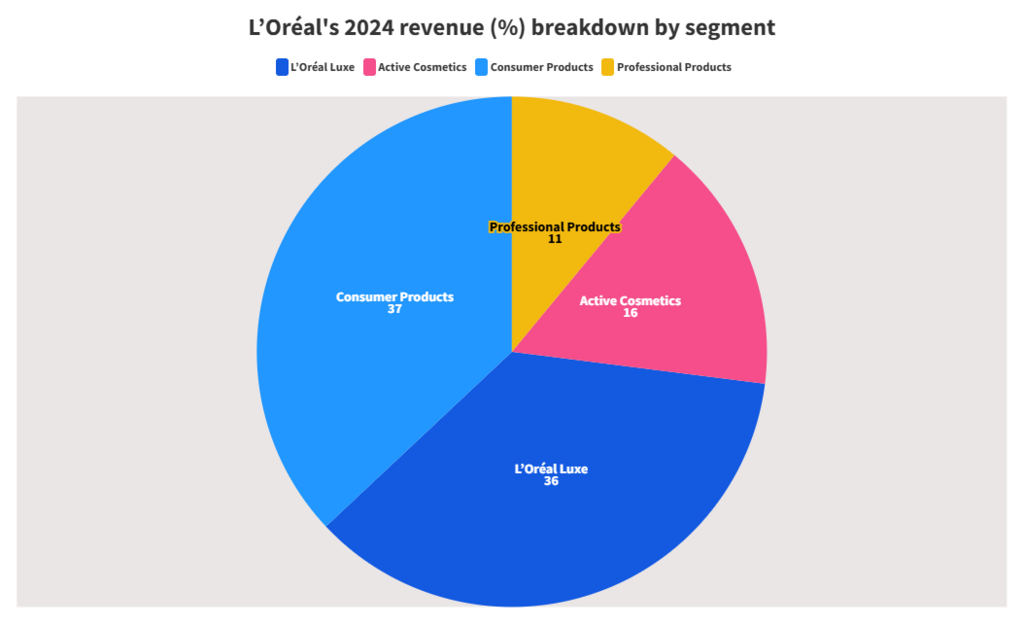
L’Oréal’s primary revenue driver is anchored on its cosmetics and skincare portfolio, structured across four strategic divisions:
L’Oréal Luxe – Luxury beauty and fragrance brands: Lancôme, YSL, Giorgio Armani.
Active Cosmetics – Dermatological brands for sensitive skin: CeraVe, La Roche-Posay, Vichy.
Professional Products – Salon and professional-grade products: Kérastase, Redken, Matrix.
In 2024, L’Oréal reported €43.5 billion in global sales, with Luxe and Active Cosmetics posting the highest growth rates, driven by:
Increased demand for dermocosmetics.
Expansion inAsia and North America.
Premiumization of skincare and clean beauty.
A Pie Chart showing L’Oréal's 2024 revenue (%) breakdown by segment
Green Leadership and Financial Resilience
CEO Nicolas Hieronimus continues to drive value through digitalization, green innovation, and consumer-centric personalization. Under his leadership, L’Oréal:
Achieved carbon neutrality at over 100 sites.
Increased revenue by 7.6% like-for-like in 2024 (L’Oréal Finance).
Deepened investments in sustainable tech and e-commerce, now accounting for 28% of sales.
Innovation Beyond Cosmetics
L’Oréal remains at the cutting edge of beauty-tech and green science through:
Modiface: Augmented Reality and AI-powered skin analysis and virtual try-ons.
Green Science: 95% of ingredients will be biobased, derived from abundant minerals, or circular by 2030.
BOLD (Business Opportunities for L’Oréal Development): Corporate venture capital fund investing in green biotech, regenerative ingredients, and circular economy startups.
Smart packaging: Recyclable pumps and refillable lipstick cases across its brands.
Addressing L’OréalChallenges and Celebrating Achievements
Challenges:
Eliminating single-use plastics from the supply chain.

.png)