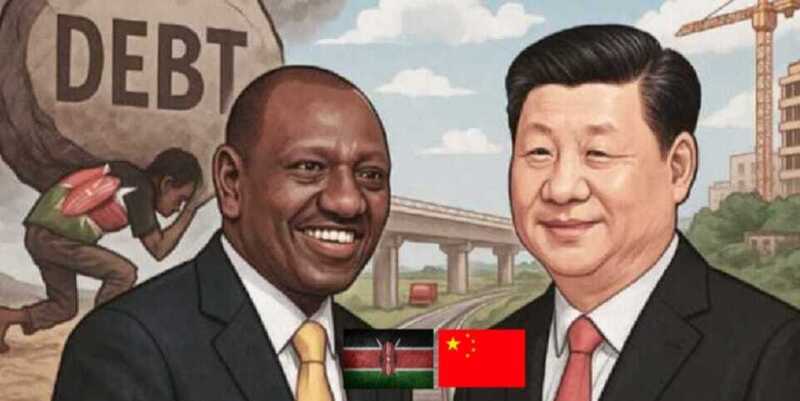
Kenyan President Ruto and Chinese President Xi Jinping, in strategic deals such as Standard Gauge Railway (SGR) seeks to transform Kenya and East Africa. Image credits: Kencrave
Africa
In April 2025, Kenyan President William Ruto initiated a pivotal state visit to Beijing, marking a watershed in Kenya-China relations. During his third visit to China as president, President Ruto engaged in top-level negotiations that resulted in the signing of over 20 bilateral agreements.
These agreements underscore cooperation in vital sectors such as infrastructure, digital innovation, green energy, education, and cultural exchange. As traditional Western partners reduce foreign investment or redirect focus to domestic priorities, Kenya's alignment with Beijing represents a deliberate realignment of global partnerships in pursuit of long-term national interests.
These agreements underscore cooperation in vital sectors such as infrastructure, digital innovation, green energy, education, and cultural exchange. As traditional Western partners reduce foreign investment or redirect focus to domestic priorities, Kenya's alignment with Beijing represents a deliberate realignment of global partnerships in pursuit of long-term national interests.
Historical Context of Kenya-China Relations
Kenya’s cooperation with China dates to the early 2000s, with notable milestones such as the 2006 Economic and Technical Cooperation Agreement, which opened doors for concessional loans and infrastructural aid. The 2014 agreement for the Standard Gauge Railway (SGR), valued at $3.6 billion, was funded largely by the Export-Import Bank of China.
In 2018, Kenya formally engaged with China’s Belt and Road Initiative (BRI), positioning itself as a key gateway in East Africa. By 2024, China had funded more than $9 billion worth of projects in Kenya, including roads, ports, energy, and real estate. Today, more than 400 Chinese companies operate in Kenya, and two-way trade stood at $8.6 billion in 2024, making China one of Kenya’s top trading partners.
In 2018, Kenya formally engaged with China’s Belt and Road Initiative (BRI), positioning itself as a key gateway in East Africa. By 2024, China had funded more than $9 billion worth of projects in Kenya, including roads, ports, energy, and real estate. Today, more than 400 Chinese companies operate in Kenya, and two-way trade stood at $8.6 billion in 2024, making China one of Kenya’s top trading partners.
Standard Gauge Railway: A Cornerstone Project
One of the bedrocks of the new 2025 compacts is the much-anticipated expansion of the Standard Gauge Railway. The originally Mombasa-Nairobi, then Naivasha-bound, project will now extend to the Malaba border town to Uganda.
The expansion will significantly reduce the time and cost of cargo movement, improving trade and integration at the regional level under the East African Community (EAC). China's financial and technical support underscores Beijing's broader Belt and Road Initiative ambitions and trust in Kenya as a regional transport hub.
The expansion will significantly reduce the time and cost of cargo movement, improving trade and integration at the regional level under the East African Community (EAC). China's financial and technical support underscores Beijing's broader Belt and Road Initiative ambitions and trust in Kenya as a regional transport hub.
From Aid to Investment: A Strategic Shift
President Ruto emphasized that the relationship with China is about mutual benefit and sustainable investment, moving away from traditional aid dependency. "We are focusing on trade and transformative investment, not dependency," Ruto said.
Rising Debt and Calls for Transparency
However, the tighter embrace of Chinese investment has drawn scrutiny. Kenya's total public debt is approximately Ksh 11 trillion (≈ $82 billion), with a significant portion owed to China. In the 2024/25 financial year, Kenya is set to pay Ksh 46.7 billion in interest to China's Export-Import Bank.
Critics, including economists and civil society, have called for greater transparency and strategic planning to ensure that the debt burden does not outweigh developmental benefits. Dr. Mercy Mutua of the Institute of Public Finance Kenya noted that the key issue is not the source of funds, but how responsibly they are used.
Critics, including economists and civil society, have called for greater transparency and strategic planning to ensure that the debt burden does not outweigh developmental benefits. Dr. Mercy Mutua of the Institute of Public Finance Kenya noted that the key issue is not the source of funds, but how responsibly they are used.
Soft Power and Cultural Diplomacy
Beyond infrastructure, China is investing in soft power strategies. These include increased scholarships for Kenyan students to study in China, expanded support for Confucius Institutes in Kenyan universities, and cultural exchange programs and language learning initiatives. This dimension of the relationship aims to foster deeper, long-term ties through education, shared values, and diplomacy.
Geopolitical Implications and Western Reactions
Kenya’s pivot toward China has significant geopolitical and economic implications. Europe and the US view the alignment as a challenge to their traditional influence in East Africa. This may prompt renewed interest in offering competitive trade deals or development finance packages, as well as pressure on Kenya through international financial institutions regarding debt transparency and governance.
On the other hand, some EU countries may see this as a wake-up call to improve their investment strategies in Africa, focusing more on sustainability and innovation. The US, especially under current geopolitical tensions with China, might interpret Kenya’s stance as part of a broader “Global South shift” and could either increase diplomatic engagement or seek to counterbalance Chinese influence through multilateral forums like the Millennium Challenge Corporation (MCC) or the African Growth and Opportunity Act (AGOA).
On the other hand, some EU countries may see this as a wake-up call to improve their investment strategies in Africa, focusing more on sustainability and innovation. The US, especially under current geopolitical tensions with China, might interpret Kenya’s stance as part of a broader “Global South shift” and could either increase diplomatic engagement or seek to counterbalance Chinese influence through multilateral forums like the Millennium Challenge Corporation (MCC) or the African Growth and Opportunity Act (AGOA).
Balancing Strategy and Sovereignty
With the ongoing realignment in global power and economic flows, Kenya’s deepening relationship with China is both strategic and pragmatic. Infrastructure needs, trade ambitions, and a desire for diversified partnerships shape it. However, Kenya must tread carefully to balance national sovereignty, debt sustainability, and long-term development goals. How Europe and the US respond could redefine not just Kenya’s future, but also the broader nature of global engagement with Africa.