
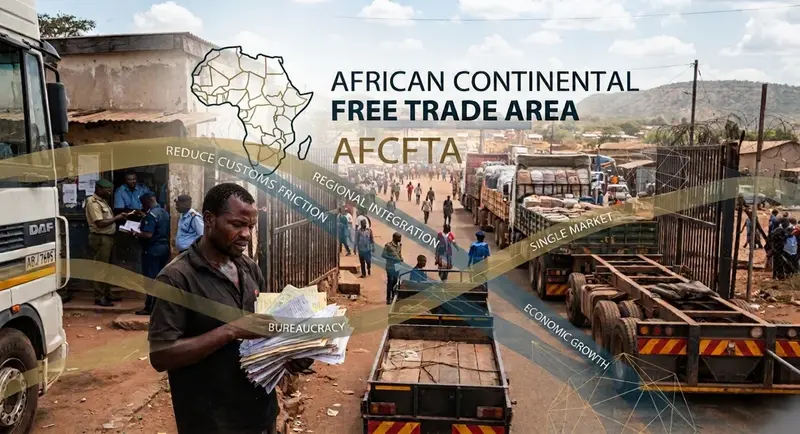
African Continental Free Trade Area (AfCFTA) visual showing trucks and customs officers at an African border crossing symbolizing trade integration, reduced bureaucracy, and economic growth. Image Credits: Kencrave
Africa
Intra-African trade hit $213.8B in 2025 but remains just 15-16% of total trade. This analysis explains why AfCFTA's binding constraint is sovereignty, not tariffs and what must change.
Executive Summary
Intra-African trade reached about $213.8 billion in 2025, up 5.47% from $202.7 billion in 2024. However, it still accounts for only 16% of total African exports or roughly 15% of total trade. The gap between this growth and the AfCFTA's ambition is not about lack of agreements but of execution failure. This is rooted in three connected constraints:
Executive Summary
Intra-African trade reached about $213.8 billion in 2025, up 5.47% from $202.7 billion in 2024. However, it still accounts for only 16% of total African exports or roughly 15% of total trade. The gap between this growth and the AfCFTA's ambition is not about lack of agreements but of execution failure. This is rooted in three connected constraints:
- A sovereignty trap that keeps tariff schedules off the books and borders closed to people.
- A financing system that penalizes the SMEs and trade flows the AfCFTA depends on.
- AfCFTA’s institutions remain purely intergovernmental, even though other regional blocs show that stronger, central enforcement is needed for deep integration of regional trade.
The binding constraint is not tariffs but the political economy of a country
As of 2026, 50 countries have submitted tariff schedules, but only 25 have gazetted them. This makes them legally unenforceable domestically and just 16 cover all product categories. Only 4 of 15 required ratifications for the AU Free Movement Protocol exist, while 51.1% of intra-African travel now requires a pre-arranged visa, up from 47.1%. The continent is liberalizing goods while restricting people.
Trade finance has failed to materialize fully. Global banks are retreating, Basel III/IV rules discourage SME lending, and FX shortages trap capital. Africa faces an estimated $100 billion annual trade finance gap, falling hardest on SMEs that provide about 80–90% of employment. Roughly $1.4 trillion sits idle, and 36% of African banks cite FX liquidity as their primary constraint double the previous period.
Structurally, close to half of African countries rely on oil, gas, or minerals for 60%+ of export earnings, while a $68–108 billion annual infrastructure gap makes trade 50% more expensive than the global average. Africa invests only 4% of GDP in infrastructure versus China's 14%.
The comparative evidence between AfCFTA and other bodies shows differences and similarities.The EU achieves about 60% intra-regional trade through enforcement, redistribution, and free movement. ASEAN has held at roughly 20% for two decades (since early 2000s) despite near-zero tariffs. Mercosur stagnates at around 15%. The AfCFTA, at 15–16%, most closely resembles Mercosur.
Until these constraints are addressed simultaneously through gazetting and enforcing tariff schedules, ratifying the Free Movement Protocol, expanding SME trade finance, closing the infrastructure gap, and moving toward central enforcement, the AfCFTA will remain widely endorsed but fail to meet expectations. The $3.4 trillion market opportunity will remain unrealized, and Africa risks a Mercosur-style stagnation at 15% intra-regional trade.
The Development of the AfCFTA
AfCFTA as an Agenda 2063 Flagship Project
The African Continental Free Trade Area (AfCFTA) is a flagship project of Agenda 2063, Africa's development framework. It aims to accelerate intra-African trade and strengthen Africa's common voice and policy space in global trade negotiations.
Origins and Approval of AfCFTA
The AfCFTA was approved by the 18th Ordinary Session of the Assembly of Heads of State and Government in Addis Ababa, Ethiopia, in January 2012, alongside the Action Plan for Boosting Intra-African Trade. On 21 March 2018 in Kigali, Rwanda, 44 heads of state signed the Agreement establishing the AfCFTA. More countries have since signed, with Eritrea remaining the only AU member state yet to sign.
Ratification, Entry into Force, and Operational Launch
Under Article 23, the agreement required ratification by 22 countries to enter into force. It achieved this threshold in a record one year and ten days and entered into force on 30 May 2019. The Operational Instruments governing trade under the AfCFTA regime were launched in Niamey, Niger, in July 2019.
Nigeria, one of Africa's largest economies, delayed signing due to concerns about dumping and its early-stage manufacturing and farming sectors. With Nigeria finally signed up, the operational phase was launched at the 12th Extraordinary Session of the Assembly in Niger on 7 July 2019. Trading under the AfCFTA regime officially commenced on 1 January 2021.
Nigeria, one of Africa's largest economies, delayed signing due to concerns about dumping and its early-stage manufacturing and farming sectors. With Nigeria finally signed up, the operational phase was launched at the 12th Extraordinary Session of the Assembly in Niger on 7 July 2019. Trading under the AfCFTA regime officially commenced on 1 January 2021.
Market Overview: Growth Without Transformation
Intra-African Trade Growth
According to the African Trade Report 2026 released by the African Export-Import Bank (Afreximbank, 2026), intra-African trade rose by 5.47 percent in 2025 to US$213.8 billion, up from US$202.7 billion the previous year. The report attributed this improvement to robust growth in several countries, including Ethiopia, Uganda, the Democratic Republic of Congo, and Zambia, as well as to improved implementation of the AfCFTA, rising regional demand, and enhanced trade facilitation.
African governments are opening their markets for goods but tightening controls on the movement of people. This is a contradiction that undermines the continent’s integration and hinders efforts such as those from AFCFTA,
Leading Contributors to Intra-African Trade in 2025
Top 10 countries account for approximately 53% of intra-African trade
The distribution of intra-African trade remains heavily skewed, though less concentrated than commonly cited figures suggest. South Africa alone accounts for 19.2% of intra-African trade. This is more than the bottom 40 countries combined. This concentration matters because it shapes how countries make trade deals. The largest traders benefit most from liberalization, while smaller economies fear being outcompeted.
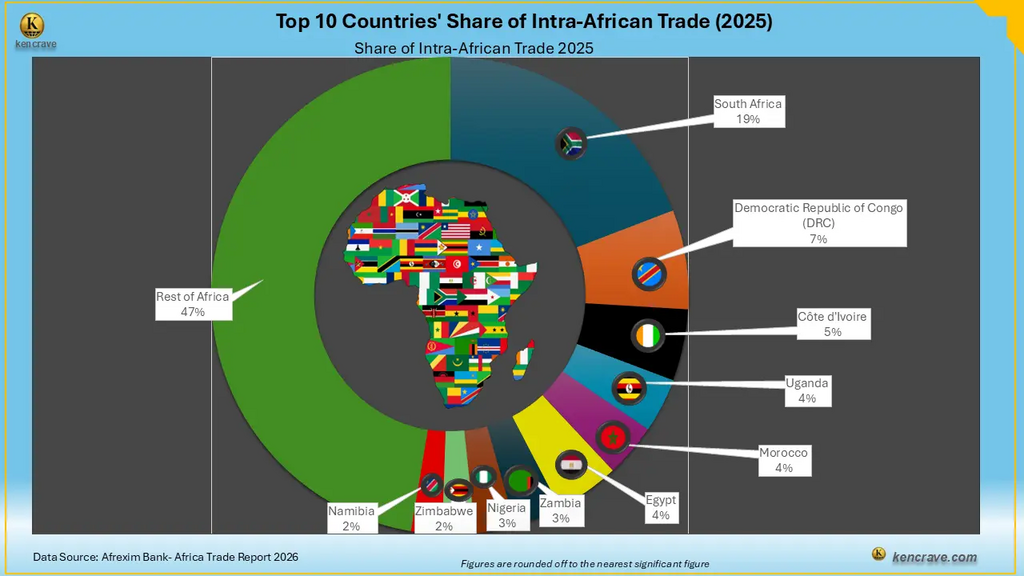
South Africa: The Dominant Trader in the Region
South Africa accounted for about 19.2% of total intra-African trade in 2025, down from 20.8% in 2024. The country imported goods worth roughly US$10.04 billion from other African nations during the year, while its exports to African markets remained steady at US$31.1 billion (Afreximbank, 2026).
South Africa's trade with other African countries was driven by:
- Imports: mineral products, precious metals, textiles, food products, crude oil, coal, petroleum products, electricity, sugar, and confectionery (from Eswatini, Zambia, and Mozambique).
- Exports: fuel and fuel products, machinery, electrical equipment, vehicles, plastics, iron and steel, and agricultural goods including cereals (Afreximbank, 2026).
Afreximbank in its report noted that South Africa's exports to African markets were more diversified than its imports from the continent. This is a pattern consistent with a regional industrial power exporting manufactured goods while importing commodities. This is both an opportunity (South Africa can anchor regional value chains) and a risk (smaller economies may experience it as dominance rather than partnership).
South Africa expanded its participation in the AfCFTA Guided Trade Initiative in 2025, shifting from pilot shipments to more consistent preferential trade and pushing forward negotiations on rules of origin for automotive and textile products.
Preferential trade means trade that takes place under special, more favourable terms than normal trade because countries have signed an agreement that gives each other benefits not available to outsiders.
Côte d'Ivoire Represents the Agro-Industrial Hub in Africa
Côte d'Ivoire represented 4.83% of intra-African trade in 2025, underscoring its continued importance as a regional trade hub. Its position was strengthened by its membership in the West African Economic and Monetary Union (WAEMU) and the Economic Community of West African States (ECOWAS).
The country remains a major exporter of cocoa, cashew nuts, rubber, and palm oil and is increasingly focusing on domestic processing and value addition in the cocoa and cashew sectors. As of 2026, its major regional trading partners include Mali, Burkina Faso, Ghana, and Nigeria.
The shift towards domestic processing is gradually strengthening Côte d'Ivoire's position as an agro-industrial base in West Africa. This is a rare example of structural transformation linked to regional trade.
Regional Trade Gateways
South Africa and Morocco continue to serve as major gateways to Southern and North African markets respectively. But gateway status can be double-edged. This is because it can concentrate logistics and financial flows in few zones deepening existing regional imbalances which AfCFTA is meant to correct.
Nigeria Share relative to its economic size
Nigeria represented approximately 2.75% of intra-African trade in 2025. This is a minor share relative to its economic size. Crude oil remained the country's largest export to African markets during the period.
However, the report observed an increase in exports of refined petroleum products following the operational launch of the Dangote Refinery, which is operating at near-full capacity and supplying petroleum products directly to Cameroon, Ghana, and Togo. This indicates a potential shift from raw commodity exporter to regional supplier of processed goods.
Nigeria's delayed ratification was driven by concerns about dumping and its emerging manufacturing sector. This illustrates that the political economy concern that even the largest economies fear liberalization when their domestic industries are uncompetitive.
Intra-African Trade Share of Total Exports
According to the European Business Council for Africa, intra-African trade remains one of the continent's greatest opportunities, but it currently accounts for just 16% of total exports, with most trade still directed outside the continent. The European Business Council for Africa notes that the full implementation of the AfCFTA could create a $3.4 trillion market. However, unlocking this potential requires:
- Investing in infrastructure by expanding transport, energy, and ICT networks.
- Streamlining trade policies and processes such as customs.
- Supporting industrialization through incentive tax breaks and affordable interest loans that can boost manufacturing and regional production.
UNCTAD Secretary-General Rebeca Grynspan stated: "Africa faces serious challenges, from volatile global markets and high debt costs to infrastructure gaps. But these challenges are also a chance to reshape the continent's economic future. With bold reforms, investment and full implementation of the AfCFTA, Africa can emerge stronger, more resilient and more competitive" (UNCTAD 2025).
.webp)
The Visa Challenge in Africa, Liberalizing Goods and Restricting People
The 2025 Africa Visa Openness Index reveals the following:
- 51.1% of intra-African travel now (based on 2025 data) requires a pre-arranged visa. This is up from 47.1% the previous year.
- Visa-on-arrival dropped to 20.4%.
- Four countries moved backward: Guinea-Bissau, Mauritania, Nigeria, and Somalia shifted from visa-on-arrival to requiring visas before travel (Africa Visa Openness Index, 2025).
This shows while the continent is much focused on AfCFTA’s objectives, the region is becoming less open to its own people even as it liberalizes trade in goods.

The Free Movement Protocol in Africa
As of the period 2025-2026, only four countries that is Rwanda, Niger, Mali, and São Tomé and Príncipe have ratified the AU's Protocol on Free Movement of Persons. Fifteen are needed for it to take effect.
AfCFTA Secretary-General Wamkele Mene notes: "It is a matter of regret that Africans cannot travel up to 90 percent of Africa without a visa. Such restrictions undermine the very goals of the AfCFTA."
Why Are Governments Restricting Movement Even as They Liberalize Trade?
This analysis identifies four drivers which have resulted in African Governments restricting movement in the region:
- Security fears. Open borders may facilitate terrorism, crime, irregular migration resulting in Africa’s security agencies resisting liberalization.
- Loss of revenue. Visa fees generate income. As a result, Africa’s Finance ministries resist losing revenue due to enactment of free movement within the continent.
- Border systems. Africa’s border systems are not harmonized. Entry rights cannot be accounted for. This means that administrators resist unverifiable openness.
- Political Reasons. Migration evokes fears about social integration. This becomes an enabler for politicians responding to voter anxiety on integration of individuals from other demographics who may influence electoral systems in a country.
Takeaway: Governments feel the costs of opening borders immediately, while the gains from free movement arrive slowly and are hard to measure. Since short‑term risks are visible and politically costly, states cling to border control even when they’ve committed to continental free‑movement goals. This clears shows the sovereignty trap
Structural Challenges for AFCFTA
AfCFTA set goals face key structural challenges. The challenges reveal a well‑organized cycle that keeps countries poor.
a. Commodity Dependence
Close to half of African countries rely on oil, gas, or minerals for at least 60% of their export earnings. This exposes African countries to price fluctuations. Through means such as diversifying exports to hedge their economies and boosting intra-African trade, the region would create more stable revenue streams.
Historically, African trade has been structurally funnelled outside the continent, exporting raw materials to partners like China, the EU, and the US, and in return import finished manufactured goods. Because many African nations export the same raw materials rather than processed goods, they have little to trade among themselves.
Intra-African trade requires diversified production structures that most African economies lack. African countries must transition from exporting raw materials to developing regional supply chains and manufacturing higher-value goods.
b. Infrastructure Deficits
Infrastructure gaps in key sectors such as transport, energy, and information and communications technology make trade 50% more expensive than the global average.
This limits Africa’s competitiveness especially for landlocked nations. Africa’s landlocked countries such as Botswana, Burkina Faso, Burundi, Central African Republic, Chad, Ethiopia, Lesotho, Malawi, Mali, Niger, Rwanda, South Sudan, Eswatini, Uganda, Zambia, and Zimbabwe are more exposed to such challenges than countries with a coastline (EBCAM, 2025).
Investing in logistics and digital connectivity is critical to unlocking growth.
Africa faces a significant shortfall in infrastructure, investing only about 4% of its GDP, far below China’s 14%. If the continent were able to close this infrastructure gap, its economic growth could rise by around 2 percentage points each year. African Development Bank, AfCFTA Secretariat, and Africa50 have united to unlock the $3.4 trillion continental market through strategic infrastructure development. This is a recent initiative, but the infrastructure gap still remains (AfDB, 2025).
SME Constraints
Small and medium-sized enterprises provide about 80% to 90% of employment across Africa but struggle with:
- Weak infrastructure
- Currency volatility
- Limited financial access
Expanding credit, risk-management tools, and regional supply chains could boost SMEs resilience (Trade Treasury Payments, 2026).
Connection to trade finance: SMEs are the intended beneficiaries of intra-African trade, but they are also the most credit constrained. Roughly, the $100 billion annual trade finance gap is not evenly distributed in the region. The financing gap falls hardest on the SMEs that need it most (Afreximbank, 2025).
The Trade Finance Gap and Why Financing Doesn't Materialize in Africa
It is estimated that Africa faces an annual trade finance gap of approximately $100 billion, a challenge that continues to hinder the continent from fully realizing the benefits of the AfCFTA.
Three factors explain why financing is not materializing as per expectations:
1. Global banks are retreating from Africa
International banks have been cutting correspondent relationships across Africa since 2008. Compliance costs make smaller markets expensive to serve, and one regulatory violation can trigger crippling fines.
This reflects a broader de‑risking trend where global banks are withdrawing from African markets not due to poor profitability, but because the regulatory risks outweigh the financial returns. A case of major global banks that have exited, sharply reduced African operations or restructuring their operations in Africa are Barclays, Standard Chartered, BNB Paribas, Société Générale, Deutsche Bank, HSBC and Atlas Mara.
2. Regulatory rules discourage lending
Basel III and IV impose punitive risk-weightings on SME exposures. Banks are opting for safe, high‑return government bonds instead of lending to businesses. This leaves roughly $1.4 trillion locked up as idle capital that isn’t fuelling economic activity in the continent.
3. Foreign currency shortages are worsening in Africa
Between 2020 and 2024, 36% of African banks cited FX liquidity as their primary constraint. This is double the previous period (2025-2019). This reflects a deteriorating situation for operations for African commercial banks. Many cannot access dollars or euros to underwrite imports (Afreximbank, 2025).
Comparative Analysis and Lessons from ASEAN, Mercosur, and the EU
According to Afreximbank's African Trade Heatmaps 2026, intra-African trade accounted for roughly 15% of total trade in 2025.
AMRO’s Director Yasuto Watanabe notes that ''ASEAN's intra-regional trade has remained at just over 20% for two decades'', remaining unchanged since unchanged since the early 2000s despite trade liberalization in the region (AMRO, 2025).
South America’s most important trade bloc, MERCOSUR, sits at approximately 15%, with Brazilian President Lula da Silva stating in December 2025 that intra-regional trade accounts for only 15% of the region's commercial flow.
Trade within the EU was about 1.6 times larger than trade with countries outside the bloc thus the intra‑EU commerce accounted for more than 60% of total EU trade (Euro Stat, 2024).
The Lessons for AFCFTA from EU, Mercosur and ASEAN
1. Institutions matter for a region to thrive
The EU created central institutions with real enforcement power, while ASEAN and Mercosur stayed intergovernmental, relying on consensus and non‑interference. The AfCFTA now has to choose which model to follow and whether its members are willing to give up enough sovereignty power for it to work.
2. Tariff cuts alone are not enough
ASEAN reduced tariffs to near zero, yet intra-regional trade barely moved (AMRO, 2025). Non-tariff barriers such as customs delays, regulatory hurdles, poor infrastructure matter just as much as a reduction in tariffs. The AfCFTA's focus on tariff schedules, while necessary, is not enough to elevate trade among African states.
3. Weak countries need support
The EU channeled investment to its poorer member states. Mercosur did not, and Brazil's dominance created resentment from other members. The AfCFTA must build mechanisms to help smaller economies benefit, not just the largest trade players. South Africa could provide a clearer way as it is the largest player contributing about 19.2% of Africa’s intra trade.
What This Means for AfCFTA
The comparative evidence suggests that the AfCFTA's current trajectory of intergovernmental, tariff-focused, without redistribution mechanisms is most similar to Mercosur. Mercosur has stagnated at around 15% intra-regional trade for decades (Geography Worlds, 2026). The EU's Intra trade of about 60% was achieved through:
- Central enforcement through bodies such as European Commission and the Court of Justice.
- Structural funds for poorer members.
- Deep regulatory harmonization.
- Free movement of people (Schengen).
- Proximity to industrial hubs in the region.
While long-term vision documents project a unified single market, the AfCFTA currently operates strictly as a Free Trade Agreement, representing the foundational stage of economic integration.
Unlike highly integrated blocs like the EU, it does not feature a common external tariff, a unified single market, or shared political institutions. Also, its initial tariff phase-out structures remain only partially implemented across the continent.
What Could Change for Intra-African Trade
It is projected that intra-African trade, estimated at $202.7 billion in 2024, could double within the next decade as African countries fully implement the continental trade agreement.
Some of key strategies to turn challenges into opportunities for doubling of Africa’s trade includes:
- Incentives for Industrialization: Tax breaks, lower capital costs, and affordable interest loans to firms investing in manufacturing and production for regional markets.
- Risk-Management Mechanisms: Establishing regional funds and early-warning systems for trade-related risks and pooling public and private resources for contingency planning and insurance.
- Crisis-Response Facilities: Creating trade finance mechanisms to support businesses affected by global shocks, helping them pivot to regional markets and maintain jobs
Doubling intra-African trade requires not just tariff liberalization but a full package of infrastructure investment, trade finance expansion, free movement, and institutional enforcement and research development focused on key sectors such as education, agriculture and education. Without these measures, the AfCFTA will continue to expand only slowly and will remain a relatively minor contributor to overall African trade.
Strategic Recommendations to Key Players
1. African Governments
Gazette and domestically enforce tariff schedules
Move from submission to legal domestication. Only 25 of 50 submitted schedules are gazetted. Link gazetting to access to AfCFTA’s Guided Trade Initiative benefits. Countries that gazette gain preferential access to pilot trade corridors while those that don't are excluded from new initiatives.
This can be achieved within a 1-year timeframe.
Ratify and implement the AU Free Movement Protocol
As of 2026, only 4 of 15 required ratifications exist. Free movement of people is essential to goods liberalization. Establish a visa Revenue Compensation Facility. This would be a pooled fund (from AfDB, Afreximbank, and development partners) to offset lost visa fee revenue for the first 3–5 years after ratification.
This could be ratified within 18 months and implementation within 3 years.
Shift from raw commodity exports to value-added processing
Provide tax breaks and affordable credit for domestic processing (e.g., Côte d'Ivoire's cocoa/cashew model). Condition incentives on regional sourcing such that firms must source a minimum share of inputs from other African countries to qualify for tax breaks. This builds intra-African trade rather than just domestic processing.
Rollout the policy within 24 months and a measurable shift within 5 years.
Invest in infrastructure and logistics
Close the $68–108 billion annual gap by prioritizing transport, energy, and ICT corridors, especially for landlocked states. Use regional infrastructure bonds guaranteed by AfDB and Afreximbank to attract private capital. Prioritise projects with clear trade facilitation impact.
Proposed timeframe 5-10 with annual milestones.
Protect SMEs from liberalization shocks
Establish adjustment funds and transitional support for sectors vulnerable to competition (e.g., Nigeria's manufacturing concerns). Fund these through a small levy on intra-African trade proceeds, pooled regionally and disbursed to affected sectors. This creates a redistribution mechanism
This can be designed within 12 months and operational within 24 months.
2. AfCFTA Secretariat
Enforce a public tracker for tariff schedule gazetting
Name and shame laggards; publish quarterly progress reports to create accountability. Introduce a tiered compliance system. Countries that gazette all product categories are given priority in dispute resolution and access to trade finance facilities while those that don’t are excluded from new AfCFTA initiatives.
This can be launched within 6 months and have quarterly reporting ongoing.
Build a central enforcement mechanism
Move beyond intergovernmental agreements. Propose a dispute settlement body with binding authority, modeled on the EU Court of Justice but focused on Africa’s operations. Start with voluntary opt-in for willing states to demonstrate effectiveness, then expand. This avoids the sovereignty issue that would arise from a continent-wide binding body imposed on unwilling members.
This proposal could be done within 12 months and negotiation to take place within 3 years.
Establish a redistribution fund for smaller economies
Channel resources to less competitive states to enable a more balanced trade approach between the African countries. Fund through a combination of AU assessed contributions, AfDB capital, and a small levy on intra-African trade. Disburse based on trade adjustment needs, not political allocation.
For this to happen, a feasibility study to be done within 12 months with a fund launch within 3 years taking place.
Harmonize border systems and digital customs
Standardize entry rights and electronic documentation to reduce trade costs. This can be piloted within 18 months and a full rollout within 5 years.
Link AfCFTA implementation to free movement
Make visa openness a formal indicator of AfCFTA compliance. As of 2026, more than 50% of intra-African travel requires pre-arranged visas. Publish an annual AfCFTA Implementation Scorecard combining tariff gazetting, free movement ratification, visa openness, and trade finance access. This creates a single accountability tool.
This could be integrated into monitoring a framework within a span of 12 months.
3. Development Partners
Fund trade finance gaps for SMEs
The estimated $100 billion annual trade finance gap falls hardest on SMEs.
Create a Trade Finance Guarantee Facility that is pooled from AfDB, Afreximbank, IFC, and bilateral donors to underwrite SME trade finance in high-risk markets. This directly addresses the Basel III/IV risk issue.
Commitments to be done within 12 months and a disbursement within 24 months.
Support infrastructure bankability
Provide blended finance and de-risking instruments to make transport, energy, and ICT projects attractive to private investors. The pipeline development could be done within 18 months and first closings within 3 years.
Finance free movement implementation
Fund border modernization, biometric systems, and training for immigration officials to address security and revenue concerns. Pilot programs to be carried out within 12 months and picked projects to be scaled within 3 years.
Support research and data systems
Fund trade statistics, impact evaluations, and policy research to track AfCFTA outcomes and guide course correction. Review to be done within 3 years.
4. Financial Institutions
Expand correspondent banking relationships
Global banks have retreated since 2008. Use regional banks such as Afreximbank and AfDB as intermediaries to restore cross-border payment channels. The financial institutions can pilot corridors within 12 months with expansion taking place within 3-5 years.
Develop SME-friendly credit products
Basel III/IV risk-weightings discourage SME lending. Financial institutions could focus on creating risk-sharing pools and collateral registries to unlock the $1.4 trillion in idle capital.
They institutions could product design within 12 months and scaling taking effect within 24 months.
Address FX liquidity shortages
By 2026, more than a third of African banks say their biggest problem is getting foreign currency. To fix this, Africa needs regional systems that make it easier to exchange currencies and settle payments in local money especially now that global trade is moving faster than ever. Africa can explore a regional currency swap facility among central banks to reduce dollar dependence.
These solutions could realistically be designed within a year and tested within two years.
Finance regional value chains
Focus lending on industries where African countries already have a strong edge such as in food processing and textiles.
This is a plan that can be developed within six months, and actual rollout can begin within eighteen months.
Invest in trade-related infrastructure
Close the $68–108 billion gap by funding logistics, energy, and digital connectivity projects with clear trade facilitation impact with first investment to be done within 3 years.
This could be done by use of public-private partnerships with guaranteed offtake agreements to reduce risk.
5. For Private Sector (Large Firms & Corporates)
Anchor regional value chains
Big companies like Dangote Refinery or major South African manufacturers should work with local small businesses and bring them into their supply chains instead of buying materials from outside Africa.
Training and support programs for these suppliers can be set up within a year, and real, measurable increases in local sourcing can be achieved within three years.
Invest in cross-border logistics and warehousing
Private investors should help close infrastructure gaps by building warehouses, cold‑storage facilities, and distribution hubs along key border routes.
Feasibility studies can be completed within a year, and the first facilities can be up and running within three years.
Lobby governments for free movement and AFCFTA’s Implementation
Business associations need to push for actual implementation, not just the signing of agreements. This could involve forming a Pan-African Business Council for AfCFTA implementation, a unified lobbying voice that crosses national boundaries and speaks for both large firms and SMEs.
Every delay ends up costing companies money. Advocacy campaigns can begin within six months, with ongoing engagement after that.
Adopt digital trade facilitation tools
Use digital tools like electronic documents, online payments, and tracking systems to cut down delays and lower costs. A pilot can start within a year, and full rollout can happen within 3 years.
Partner with SMEs as suppliers and distributors
Large firms should mentor, finance, and contract with SMEs to build inclusive regional value chains. Partnership frameworks can be created within a year and scaled up across the region within two years.
6. SMEs (Small & Medium Enterprises)
Form cooperatives and export consortia
Export consortia (this is a voluntary, formal alliance of two or more companies that work together to promote and sell their good or services in foreign markets).
Pool resources, share logistics costs, and negotiate collectively to overcome scale disadvantages. These groups can be formed within a year, with the first joint exports happening within 18 months.
Access AfCFTA-guided trade initiatives and trade finance
Apply for Afreximbank and AFDB facilities, government SME funds, and donor-backed credit lines. Do not wait for traditional banks. Applications can be submitted within six months, and financing can be secured within twelve months.
Digitize operations and use e-commerce platforms.
Adopt mobile money, online marketplaces, and digital invoicing to reach regional customers and build credit history. Businesses can get set up within six months and begin trading actively within twelve months.
Target niche regional markets, not global ones
Focus on supplying regional demand for processed food, textiles, construction materials, and services where proximity is an advantage. This can be realized through creating a formal SME Advisory Committee to the AfCFTA Secretariat, with rotating membership from national SME associations.
Market research can be completed within six months, and the first exports can begin within eighteen months.
Demand representation in AfCFTA negotiations
SMEs must push for representation at national trade ministries and the AfCFTA Secretariat. Advocacy can begin within six months, with formal SME representation in place within two years.
Bottomline: The Binding Constraint
The AfCFTA has moved from a legal framework to an operational regime, but the gap between political commitment and commercial reality remains wide. The binding constraint is not tariffs. It is the political economy of sovereignty.
Success now depends on execution through gazetting tariff schedules, modernizing customs systems, ratifying the Free Movement Protocol, expanding trade finance, and engaging the private sector.
Without these actions being taken, the AfCFTA risks remaining a vision widely endorsed but unable to meet its expectations. This would be a Mercosur for Africa, stagnating at 15% intra-regional trade while the continent's $3.4 trillion market opportunity remains unrealized.
Key Takeaways
1. Tariff Cuts Alone Don't Increase Trade as Proven by ASEAN case. ASEAN cut tariffs to near zero. Intra-regional trade stayed at roughly 20% for two decades. Non-tariff barriers matter just as much.
2. The EU Model Is Not Available to Africa. The EU's >60% intra-regional trade came through central enforcement, structural funds, and Schengen. No African state has shown the willingness to cede sovereignty at that scale.
3. South Africa's Dominance Is a Warning Sign. South Africa accounts for 19.2% of intra-African trade which is more than the bottom 40 combined. Mercosur's stagnation was partly driven by Brazil's similar dominance.
4.Four Drivers Block Free Movement, only One Is Addressed. Revenue loss, security fears, border systems, and political anxiety all drive visa restrictions. The Visa Revenue Compensation Facility addresses only the first.
5. The Informal Economy Is Invisible in AfCFTA Implementation. Informal cross-border traders with many of them being women and youths, are directly affected by visa restrictions and border delays. They have no voice in AFCFTA implementation.
FAQs on AfCFTA
1. Why is AfCFTA implementation lagging if 54 countries signed it?
Signing is not gazetting. As of 2026, only 25 of 50 submitted tariff schedules are legally enforceable domestically, and just 16 cover all product categories.
2. Why is intra-African trade only 15–16% despite AfCFTA?
Tariffs are not the binding constraint, countries’ rules are. Governments delay gazetting to preserve bargaining power and restrict movement even as they liberalize goods.
3. What is Africa's trade finance gap and who does it hurt most?
Africa faces a $100 billion annual trade finance gap. It falls hardest on SMEs, which provide 80–90% of employment but are the most credit-constrained.
4. Which regional bloc does AfCFTA most resemble?
Mercosur. The EU achieves >60% intra-regional trade through enforcement, redistribution, and free movement. ASEAN stagnates at around 20%; Mercosur and AfCFTA both sit at roughly 15%.
5. Why is free movement critical to AfCFTA's success?
As of 2026, only 4 of 15 required ratifications exist for the AU Free Movement Protocol, and 51.1% of intra-African travel requires a pre-arranged visa. Goods cannot move freely if people cannot.
Sources
- Afreximbank, "African Trade Report 2025: African Trade in a Changing Global Financial Architecture," 2025
- Afreximbank, "African Trade Report 2026: Leveraging Geopolitics for Trade and Industrialisation in Global Africa," 2026
- Africa Visa Openness Index, "2025: Visa Openness Remains a Work in Progress," 2025
- African Development Bank, "African Development Bank, AfCFTA Secretariat, and Africa50 Unite to Unlock $3.4 Trillion Continental Market Through Strategic Infrastructure Development," August 2025
- African Union, "The African Continental Free Trade Area," n.d.
- AMRO, "ASEAN Needs More Than Trade Deals to Deepen Integration," October 2025
- Bisong, A., & Byiers, B., "Africa's Economic Integration: How to Link Trade and Mobility Policies," ECDPM, November 2024
- CNZLECAF, "Africa: The World Bank Highlights the Benefits of the AfCFTA," August 2026
- European Business Council for Africa (EBCAM), "Africa's $3.4 Trillion Opportunity: Turning Vulnerabilities into Resilience," February 2025
- Geography Worlds, "Mercosur: South America's Trade Bloc," March 2026
- Hamoui, Z., "Africa's Invisible Walls: The Hidden Barriers to Continental Integration," The Borders Institute, January 2026
- The Africa Report, "Open Borders: Why Is Implementing the AfCFTA Stalling?" September 2026
- The Reporter Ethiopia, "Tariff Schedules Lag as Ethiopia Records USD 23mln in AfCFTA Trade," August 2026
- Trade Treasury Payments, "Unlocking Africa's SME Trade Potential: The FI Trade 3.0 Schema," January 2026