Kenyan Gen-Z during 2024 Finance Bill Protests, showing growing role of digital activism in governance. Image Credits: The Conversation
Africa
Kenya’s Gen-Z uprising is now a transnational movement. Inside the digital repression, ESG pressure, and youth-led accountability reshaping governance across the Global South.
What began as a digital protest against Kenya’s Finance Bill 2024 tax hike in Nairobi, has evolved into a transnational youth movement challenging corruption, dynastic politics, and digital repression. The Gen-Z revolution, born in Kenya and now echoing across continents, is reshaping governance, accountability, and ESG priorities in the Global South and beyond.
What Triggered the Gen-Z Protests in Kenya?
The Gen-Z uprising in Kenya erupted in June 2024, triggered by widespread opposition to the Finance Bill 2024, which proposed steep tax increases on essential goods and digital services. Mobilized under the hashtag #RejectFinanceBill, youth-led protests swept across Nairobi, Mombasa, Kisumu, and Eldoret.
The movement was leaderless and decentralized, coordinated via TikTok, X, and encrypted messaging apps (ACCORD).
Protesters cited youth unemployment, rising cost of living, police brutality, and elite impunity as core grievances.
The demonstrations disrupted economic activity, forced parliamenExpand on how digital repression techniques vary by regiontary revisions, and sparked a national reckoning on governance and generational equity.
Though not Kenya’s first protest wave, this was unprecedented in scale, coordination, and digital fluency, marking a new chapter in civic resistance.
How Gen-Z Uses Digital Tools for Civic Mobilization
Kenya’s Gen-Z activists mobilized nationwide protests against the Finance Bill, leveraging digital platforms to coordinate leaderless demonstrations. Their demands were clear: transparency, justice, and an end to elite impunity.
Youth unemployment in Kenya fueling frustration and mass mobilization.
The movement rejected traditional political structures, favoring decentralized, tech-driven activism.
Similar uprisings followed in Nigeria, Ghana, and South Africa, where Gen-Z networks amplified calls for reform.
This digital-first defiance has become a blueprint for civic resistance across Africa, Latin America, and South Asia.
Challenges, Risks, and Opportunities Across Borders
As Gen-Z movements spread, they face a mix of systemic pushback and strategic openings:
Challenges and Risks
Digital repression: Governments in Tanzania, Nepal, and Madagascar have intensified surveillance, internet shutdowns, and platform censorship.
Legal retaliation: Youth leaders in Morocco and Sri Lanka face arrests under vague national security laws.
Fragmentation risk: Leaderless structures can hinder long-term policy engagement and institutional reform.
Opportunities
Global solidarity: Transnational hashtags and encrypted networks foster cross-border learning and support.
Policy leverage: In Nepal, youth pressure led to the resignation of Prime Minister K.P. Sharma Oli.
Civic innovation: In Kenya and Ghana, youth-led civic tech platforms are tracking budgets and exposing corruption.
Digital Repression: How Governments Counter Youth-Led Movements
As youth activism spreads, governments are adopting more sophisticated forms of digital repression. Tactics vary significantly by region.
Africa: Shutdowns and Platform Throttling
Internet shutdowns during protests.
Throttling of social platforms. Government-compelled telecom compliance.
Use of state-aligned influencers to disrupt narratives.
These tactics aim to disrupt coordination during peak protest moments.
South Asia: Legal Suppression and Content Removal
Arrests under vague national-security laws.
Takedown requests to social media companies.
Restrictions on VPNs and encrypted platforms.
Monitoring of digital networks.
South Asian governments rely more onlegal tools than outright shutdowns.
Middle East & Authoritarian Regimes: High-Tech Digital Control
Deep packet inspection (DPI).
National firewalls blocking global platforms.
Forced migration to state-monitored apps.
Youth activists here focus heavily on circumvention technologies.
Latin America: Information Warfare and Digital Harassment
State-backed bot networks.
Disinformation campaigns.
Targeted online harassment.
Algorithmic manipulation.
The goal is to dilute, discredit, and divide activist communities.
ESG Implications of Youth Activism: Governance, Inclusion, and Accountability
Gen-Z’s demands align with core ESG principles, especially in governance and social equity:
Governance: Calls for transparency, anti-corruption, and institutional reform directly challenge ESG laggards.
Social: Youth-led movements highlight exclusion from labor markets, education, and digital rights.
Environmental: Gen-Z activism increasingly intersects with climate justice and sustainability.
Countries with stronger ESG frameworks such as Rwanda and Ghana, have seen more constructive youth engagement. In contrast, ESG-deficient states like Tanzania and Nepal face disruptive protests and reputational risk.
Comparative ESG Scores vs Gen-Z Protest Intensity (2025)
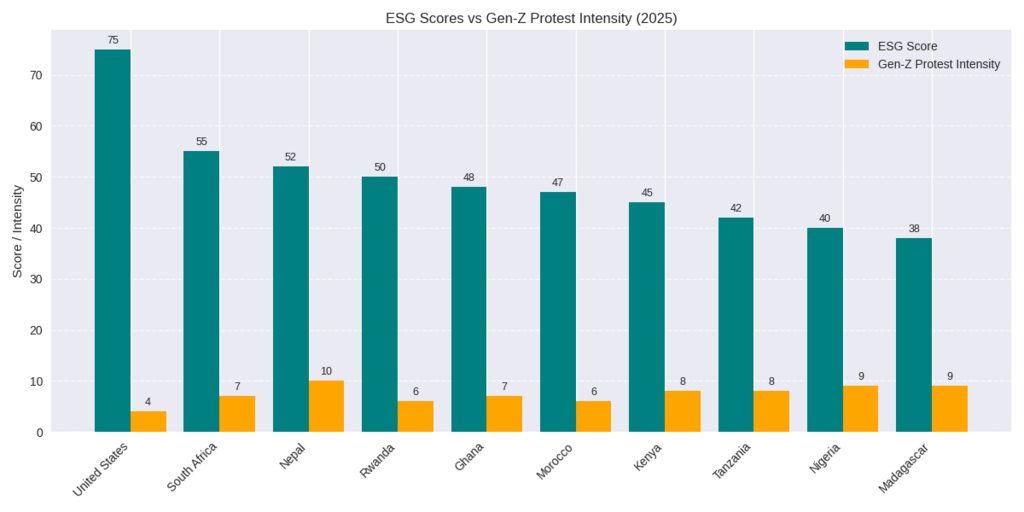
The bar chart below compares ESG scores with protest intensity across 10 countries. It reveals a clear pattern: lower ESG scores correlate with higher youth-led unrest.
ESG scores vs Gen-Z protest intensity 2025 bar chart comparing sustainability governance with youth activism across Kenya, Nigeria, South Africa, Rwanda, Ghana, Tanzania, Nepal, Madagascar, Morocco, and United States.
Key insights from the Graph “ESG Scores vs Gen-Z Protest Intensity (2025)
Inverse correlation: Countries with lower ESG scores tend to have higher Gen-Z protest intensity, suggesting youth are more vocal in demanding better environmental, social, and governance standards.
United States stands out with the highest ESG score (75) and lowest protest intensity (4), indicating stronger institutional frameworks and possibly more youth satisfaction.
Nepal and Nigeria show high protest intensity (10 and 9) despite moderate to low ESG scores (52 and 40), highlighting youth frustration with governance and sustainability efforts.
Regional Patterns
African countries like Kenya, Nigeria, Madagascar, and Tanzania generally have lower ESG scores (below 45) and high protest intensity (8–9), pointing to systemic governance challenges and active youth movements.
South Africa and Rwanda have moderate ESG scores (50–55) and slightly lower protest intensity (6–7), suggesting some progress in governance but still room for improvement.
Notable Outliers
Madagascar has one of the lowest ESG scores (38) and high protest intensity (9), making it a critical case for reform.
Morocco shows a moderate ESG score (47) and lower protest intensity (6), possibly indicating more stability or less youth mobilization.
Strategic Implications
Youth activism is a signal: High protest intensity may reflect unmet expectations in governance and sustainability, especially among Gen-Z.
Policy opportunity: Countries with high activism and low ESG scores could benefit from targeted reforms to address youth concerns and improve ESG metrics.
Strategic Trajectories: What Stakeholders Must Consider
For Governments: How to Invest in Youth Inclusion
Strengthen civic infrastructure: Fund youth-led platforms, protect digital rights, and ensure transparent institutions.
Integrate youth into policy: Create participatory budgeting, youth parliaments, and innovation grants tied to governance reform.
Studyreform models: Rwanda’s ESG-aligned governance and digital inclusion offer a blueprint for stability and engagement (OECD Rwanda Country Profile).
For Investors and ESG Analysts
Align ESG metrics with youth priorities: Include digital rights, civic participation, and generational equity in ESG scoring.
Monitor transnational activism: Track how digital movements influence policy, elections, and global norms.
For Civil Society and Media
Amplify youth voices: Support independent media and civic tech that elevate Gen-Z narratives.
Build cross-border coalitions: Facilitate regional forums and digital exchanges to sustain momentum.
Path Forward: A Movement, Not a Moment
From Nairobi to Kathmandu, Dar-es-Salaam to Bogotá, Gen-Z is rewriting the rules of engagement, demanding not just reform, but reinvention. Their digital fluency, civic urgency, and strategic coordination are reshaping governance and ESG priorities across continents.