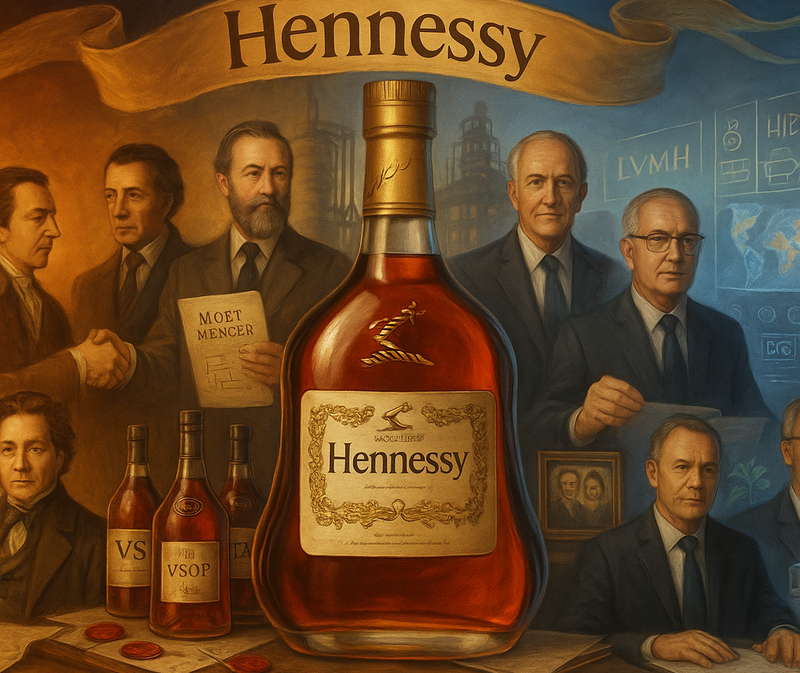
A representation of Hennessy's leaders over time. Hennessy a type of brandy made from grapes is a world-renowned French Cognac brand founded by Richard Hennessy in 1765. Image credits: Kencrave
7 min read
Business
Hennessy’s Sustainable Empire And How A 250 Years+ Cognac Brand Leads With Green Innovation, Heritage, And Global Strategy
Richard Hennessy, an Irish soldier in the French army, founded the company in 1765. His ambition was to produce fine cognac for an international audience. Richard’s descendants carried forward his vision, maintaining excellence in quality and expanding Hennessy’s global reach. Over centuries, the founding family embedded values of craftsmanship, integrity, and innovation into the brand’s DNA, which remain influential even after Hennessy became part of the LVMH group.
Hennessy exemplifies the concept of longevity in the business world. Founded in 1765, the brand has sustained its reputation for excellence in cognac production for centuries. Beyond product quality, Hennessy has adapted its operations to meet the evolving demands of sustainability, climate change, and consumer awareness.
From vineyard management to distillation, packaging, and logistics, Hennessy has integrated green initiatives that ensure responsible practices across its value chain. Its commitment to a sustainable future enables the company not only to preserve its heritage but also to evolve responsibly in a modern world.
Mission, Vision & Core Values
Mission: To craft and share the finest cognac in the world while protecting the environment, supporting communities, and honoring centuries of heritage.
Vision: To be the global leader in sustainable luxury spirits by combining tradition, craftsmanship, and innovation with a strong commitment to environmental and social responsibility.
Hennessy's Core Values:
Excellence: A continuous pursuit of perfection in every bottle.
Heritage: Preserving the legacy and savoir-faire of generations of master blenders.
Sustainability: Minimizing environmental impact through conscious innovation.
Integrity: Conducting business ethically and transparently.
Cultural Respect: Promoting inclusivity, diversity, and global appreciation.
Leadership Transition— From Family Legacy to Global Sustainability
Hennessy evolved from a family-run business to a globally managed luxury brand under LVMH (1987). With master blenders (cellar masters) passing down knowledge through apprenticeships, the brand maintains traditional craftsmanship. Simultaneously, LVMH introduced corporate governance and ESG frameworks, enabling Hennessy to scale while embracing green innovation.
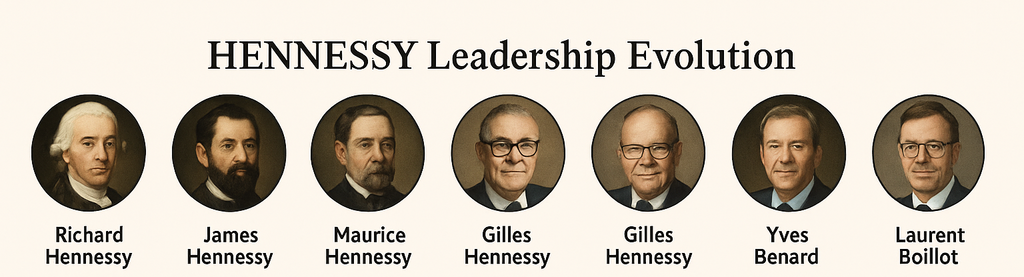
Hennessy's Leadership evolution since Richard Hennesssy
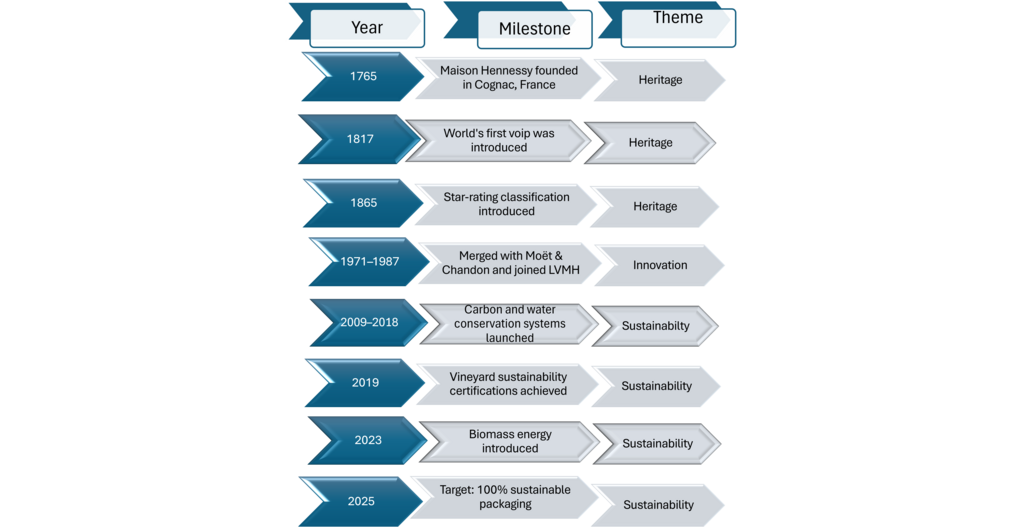
Timeline of Sustainability Impact
Over the years, Hennessy has had major sustainability impacts
Chart showing Hennessy's Timeline of Sustainability
Leadership Style — Participative & Transformational
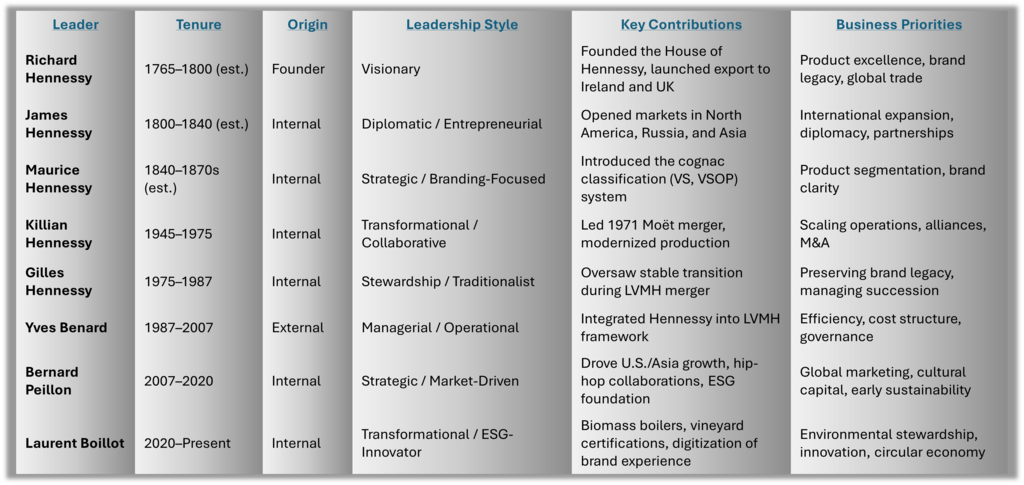
Hennessy has fostered different leadership styles over the years that embrace innovation and heritage. Under LVMH, it combines traditional savoir-faire with cross-functional sustainability strategies. This forward-thinking leadership empowers local teams and supports environmental and social responsibility.
Hennessy's Leaders over the years with their Leadership Syles and Key Business contributions
Company Culture — Heritage, Prestige & Global Identity
Hennessy’s brand culture is deeply emotional and rooted in loyalty, quality, and prestige. Internally, employees embrace the company's strong sense of tradition and innovation. Externally, the brand cultivates a ‘cult-like’ following by crafting narratives around heritage, exclusivity, and excellence. Its ambassador-led marketing strategy and collaborations with global artists and designers create strong consumer identity and aspirational value.
Hennessy isn’t just a drink, it’s astatus symbol and cultural icon:
Hip-Hop’s Favorite Cognac: Cognac mentioned in 3,000+ songs (Jay-Z, Tupac, Kendrick Lamar).
African Market Dominance: Seen as a wealth symbol (Nigeria consumes 40% of global VSOP).
Luxury Gifting: #1 cognac for Chinese New Year and Diwali
Green Leadership & Ethical Practices
Hennessy’s ethical commitment spans across production and community:
Works with 1,600+ winegrowers on sustainable viticulture
Biomass boilers and renewable energy in distillation
Closed-loop water systems
Recyclable packaging and lighter glass bottles
Fair labor and community investments
Beyond environmental ethics,Hennessy supports:
Education: Hennessy Fellowship for Black entrepreneurs
Art: Louvre sponsorship, Afropunk Festival
Community: Funding schools/hospitals in Cognac region
Strategic ESG Goals
Achieve carbon neutrality in production by 2030
100% recyclable/reusable packaging by 2026
Expand sustainable certificationsacross all suppliers
Reduce water usage by 30% in distillation (by 2027)
Strengthen community partnerships via innovation hubs
Financial Performance — The Revenue Engine
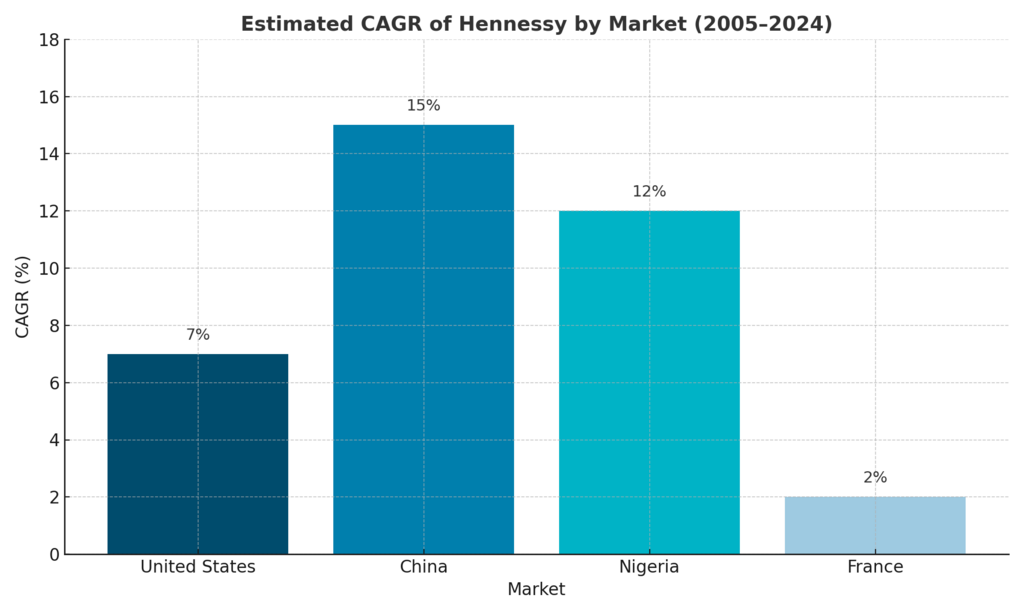
Hennessy generates its revenue primarily through the global sale of cognac. Key markets include:
United States – Hip-hop & mixology trends
China – Premium middle-class
Nigeria – Aspirational luxury
France – Mature market, brand loyalty, slower but steady premiumization
Visual showing Hennessy's estimated CAGR by market (2005–2024).
The company’s premium positioning and brand heritage allow it to command high prices.
Revenue is further supported by:
Strong distributor networks and retail partnerships.
Synergy with other LVMH brands in travel retail and luxury outlets.
Hennessy's revenue has grown significantly over the last 20 years:
Its revenue increased from €1.2 billion in 2005 to €3.4 billion in 2024, reflecting a 183% growth over the period.
On average, Hennessy has generated approximately €2.3 billion per year over the last two decades.
Diversification & Innovation in Spirits
Under Moët Hennessy, Hennessy benefits from LVMH's spirits portfolio:
Champagne: Moët & Chandon, Dom Pérignon
Whisky: Glenmorangie
Vodka: Belvedere
Hennessy's Innovation Areas:
Hennessy Black: Entry-level cognac
Paradis Imperial: $25K ultra-premium bottle
NFTs (e.g., Hennessy 8 series)
Digital tastings, virtual marketing
Resilience Through Crisis
Hennessy has survived major disruptions through agility and brand loyalty:
Prohibition (1920s): Shifted exports to Europe/Asia.
2008 Financial Crisis: Doubled down on emerging markets (China, Nigeria).
COVID-19: Pivoted to e-commerce (+40% DTC sales in 2020).
Supply Chain Shocks: Localized grape sourcing (95% from the Cognac region).
Challenges
Climate change has disrupted grape harvest cycles and quality
The energy-intensive distillation process challenges sustainability goals.
Maintaining a consistent global supply during economic uncertainty and logistic constraints.
Regulatory issues such as Alcohol advertising bans (e.g., Nigeria) and trade tariffs in key markets like the U.S. and China.
Increasing pressure from eco-conscious consumers demanding more transparency and action.
Gen Z Trends: Lower alcohol consumption vs. millennials.
Opportunities
RTD (Ready-to-Drink) Cocktails: Expanding into premixed luxury drinks.
AI & Precision Distillation: Using data to optimize blends.
Non-Alcoholic Cognac: Experimenting with dealcoholized versions.
Key Observations on Hennessy as a Global Brand
Internal succession dominated until 1987, reflecting the brand’s family heritage. Post-LVMH era shifted to performance-driven leadership, aligned with luxury market growth. Since 2020, ESG and sustainability have become the strategic north star of the brand, reflecting evolving consumer values and climate urgency.
Lessons For Businesses Aiming to Withstand Test of Times
Key lessons include:
Sustainability and profitability can co-exist with the right leadership and innovation.
Environmental action must be integrated into every department and supply chain level.
Brand legacy can be a powerful driver for ethical transformation.
Cultural storytelling and inclusive branding strengthen long-term customer loyalty.
Hennessy’s journey shows that heritage brands can successfully integrate sustainability without compromising tradition. By investing in green technologies, ethical leadership, and social responsibility, Hennessy not only meets regulatory demands but also builds long-term value and trust with consumers.