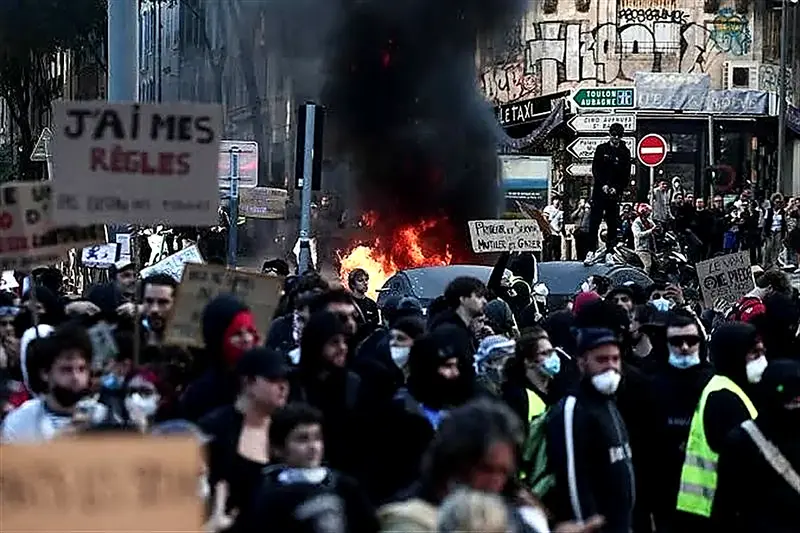
France protests 2026 with large street demonstration, burning vehicle, civil unrest, public disorder, and crowd gathering in Paris. Image Credit: Tasnim
Europe
France 2026 strikes and protests: what's driving the unrest and which sectors are disrupted. Potential scenarios for businesses and investors range from continued deadlock to a wider political crisis.
Key Takeaways
- France's 2026 unrest is driven by cumulative cost-of-living pressure, contested reform tactics, fears over the erosion of social protections and education reforms.
- Supply chain delays and security costs are the immediate exposure for companies.
- The most likely path is a prolonged deadlock, though the situation could also lead to government concessions or a wider political crisis. For investors, the watch items are political uncertainty, reform credibility, and Europe-wide spillover.
France is once again facing major protests, strikes, and public unrest that are affecting much of the country. What started as disputes between university students, labor unions and the government expanded into a wider movement involving several sectors of the economy.
On 17 October 2026, France witnessed significant public unrest, largely driven by rising living costs and growing concerns about the affordability of everyday expenses. Public transportation was heavily disrupted, with train services and Paris metro lines running at reduced capacity.
Major ports, including Marseille and Le Havre, have experienced delays and congestion, affecting the movement of goods. Some energy facilities were impacted by worker walkouts, leading to concerns about energy supply disruptions.
Major ports, including Marseille and Le Havre, have experienced delays and congestion, affecting the movement of goods. Some energy facilities were impacted by worker walkouts, leading to concerns about energy supply disruptions.
Large demonstrations have taken place in Paris, Lyon, Marseille, Nantes, and other cities as well. While protests started peaceful, they quickly aggravated to violence. Clashes between demonstrators and police led to vandalism, property damage, and the closure of businesses in several areas.
In addition to damaged storefronts, several looting incidents were reported in Paris and other French cities. Retail stores, including SFR telecommunications stores (one of the largest telecommunication companies in France), Etam clothing shops, and some McDonald's restaurants, were targeted during episodes of unrest. Authorities responded with increased security measures and a stronger police presence in affected neighborhoods.
What's Behind the French Protests in 2026?
The current unrest is being driven by several long-term issues that have been building for years and in recent times.
1. Disagreements Over Government Reforms
The French government has been pushing through economic and budget reforms aimed at reducing public spending and controlling the country's growing deficit. Labor unions argue that these measures unfairly affect workers and reduce social protections.
Many critics are also angry about how some of the policies have been passed. The government's use of constitutional procedures that allow legislation to move forward without a full parliamentary vote has fueled accusations that democratic debate is being bypassed.
2. Cost of Living Pressures
Although inflation in France has eased from the highs seen in recent years, many households continue to feel the lasting impact of higher prices. Inflation averaged around 1.6% in 2021, before surging to 5.2% in 2022 and 4.9% in 2023, driven largely by increases in energy, food, and other essential goods. While inflation slowed to 2.0% in 2024 and 0.9% in 2025, prices generally have not returned to previous levels, leaving many families facing significantly higher living costs than they did five years ago.
Food, energy, housing, and everyday consumer goods remain expensive for many households. Workers and labor unions argue that wage growth has not kept pace with the cumulative rise in living expenses, making it increasingly difficult for many people to maintain their standard of living. This gap between earnings and the cost of living has become a major source of public frustration and a key driver of recent protests.
3. Concerns About France's Social Model
Many French citizens are concerned that the government is moving away from the social protections that have historically been central to French society. For many demonstrators, the protests are about more than individual reforms; they are also about preserving the social support and public services they believe citizens should be able to rely on.
4. Education Conditions and systematic underfunding
University and college students across France have played a significant role in the protests, calling for reforms to the country's education system. Their concerns focus on several long-standing issues, including deteriorating school and university facilities, shortages of teachers and support staff, overcrowded classrooms, and what many see as a lack of transparency and fairness in the university admissions process.
Possible Outcomes for France due to 2026 Protests
Scenario 1: Continued Stalemate
The most likely outcome is a prolonged period of strikes and negotiations. The government may offer limited concessions, while unions continue disrupting key sectors such as transportation, logistics, and energy.
Potential impact: Slower economic growth, supply chain disruptions, and continued pressure on businesses across France and parts of Europe.
Scenario 2: Government Concessions
If public pressure becomes too strong, the government could delay or revise some of the controversial reforms. Political changes including a cabinet reshuffle or new elections could also be considered.
As a result, social tensions could ease but questions about France's economic position and long-term reform plans would remain.
Scenario 3: A Wider Political Crisis in France
If protests continue to grow and attract broader anti-government movements, France could face a deeper political crisis that extends beyond labor disputes to various sectors.
This is likely to result into Increased uncertainty for investors, greater political polarization, and wider concerns about stability in Europe.
Bottom Line
The situation in France highlights the challenges governments face when trying to balance economic reforms with public expectations. Rising living costs, concerns about democratic representation, and debates over social protections have combined to create a highly tense environment.
For businesses and investors, the main risks remain transportation disruptions, supply chain delays, political uncertainty, and the possibility of further unrest. The scenes in Paris and other French cities reflect deeper debates about the future direction of the French economy and society.