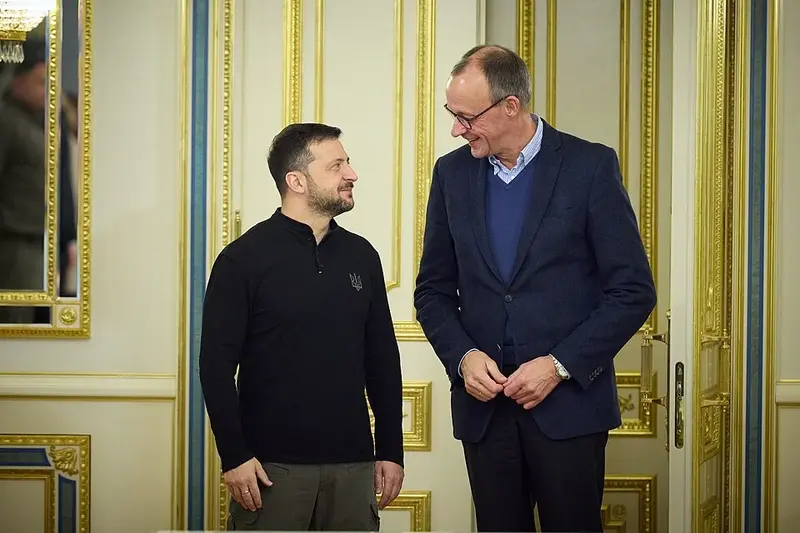
Volodymyr Zelenskyy and Friedrich Merz in a discussion on how to establish peace plans. Image Credits: Wikimedia
Europe
Germany accuses Russia of conducting the August 4 Leipzig/Halle Airport drone attack, closing Russia's Bonn consulate and Russian House. Berlin calls it hybrid warfare but stops short of calling it war.
Germany formally accused Russia of orchestrating the August 4th attempted drone attack at Leipzig/Halle Airport, with Interior Minister Alexander Dobrindt stating: "Taken together, police investigations, patterns of the crime and intelligence findings point to Russia for the attempted attack at Leipzig Airport," on September 1st.
Germany formally accused Russia of orchestrating the August 4th attempted drone attack at Leipzig/Halle Airport, with Interior Minister Alexander Dobrindt stating: "Taken together, police investigations, patterns of the crime and intelligence findings point to Russia for the attempted attack at Leipzig Airport," on September 1st.
Germany will take "proportionate and measured, yet resolute" action, closing Russia's Bonn consulate and the Russian House cultural center, while coordinating with NATO and EU partners. Wadephul's message to Moscow: “Russia must understand that Germany is a stabilizing force in Europe, always willing to negotiate, and will not be intimidated in any way.”
Key Insights Summary
- Germany formally blames Russia for the Leipzig drone attack representing its first public attribution of a hybrid attack on German soil.
- Target was a key NATO/Ukraine military logistics hub which resulted to Germany closing Russia's Bonn consulate and Russian House.
- Russia denies involvement and warns of escalation.
The Leipzig Drone Attack and Germany's Accusation of Russia
On August 4, 2026, an explosives-laden drone was discovered near Ukrainian cargo aircraft at Leipzig/Halle Airport in eastern Germany. The detonator was faulty and the drone did not explode, but a second drone struck a nearby cargo plane, and a third was found near the airport ten days later.
On September 1, 2026, German authorities formally blamed Russia for the attack. Interior Minister Alexander Dobrindt stated that "an examination of the drones proved they were Russian." He also stated that the attack followed the "well-established pattern of Russian hybrid operations in Europe," adding: "We are not at war, but we are a daily target of hybrid attacks." Dobrindt further noted that Germany assumes it will be the "target of further hybrid attacks by Russia."
Hybrid Warfare Is Europe's New Normal
Foreign Minister Johann Wadephul, speaking alongside Dobrindt, said the incident "fits into a broader pattern of Russian hybrid operations in Europe."
Chancellor Friedrich Merz reaffirmed the government's position, stating the attribution to Russia was "very clear, unassailable, and also legally sound." He also warned that "anyone who attacks us must know, we are firmly determined to defend our constitutional state, our democracy, our open society, and also the integrity of our territory."
Dobrindt made a critical distinction in his press conference, "we are not at war, but we are a daily target of hybrid warfare." Germany asserts it is under a persistent campaign of sub-war aggression that threatens its critical infrastructure.
According to Leipzig/Halle Airport's official website, the airport handles approximately 1.4 million tonnes of freight annually. The airport is used by Germany's military and NATO allies for military logistics and serves as a base for Ukraine's Antonov Airlines.
Given its strategic importance, federal prosecutors viewed the incident as an attack on Germany's transport and logistics infrastructure. This marks significant escalation from cyberattacks and espionage to direct physical attacks on infrastructure within the European space.
How Germany reacted to the Leipzig drone attack attempt
On September 1, 2026, Foreign Minister Johann Wadephul, joined by Interior Minister Alexander Dobrindt, announced a package of retaliatory measures against Russia following the Leipzig drone attack. This included:
- Closure of the Russian consulate in Bonn by September 18
- Terminating its agreement with the Russian House cultural centre in Berlin.
- Expanded entry restrictions for Russian nationals, with new blacklists to be drawn up.
- Increased pressure on Russia's shadow fleet of tankers, with the possibility of seizing ships.
Wadephul emphasized the government's approach: "We must not leave such an attack on our security unanswered." He also stated that Germany would defend itself against adversaries who seek to create insecurity.
He also expressed regret over bilateral relations noting that Russia shows no willingness to compromise and it was strained an already complicated relationship between the two countries.
NATO Secretary-General Mark Rutte stated that "NATO stands in full solidarity with Germany" and that "Russia's attempts to intimidate us, to undermine our unity and our willingness to support Ukraine are futile." EU Commission President Ursula von der Leyen indicated that attacks will not go without a clear response from the region.
Bottomline
The Leipzig drone attack marks a clear escalation in hybrid warfare, moving from cyber and disinformation campaigns to direct physical strikes on European critical infrastructure.
Germany has responded with a coordinated package of diplomatic and security measures, backed by NATO and EU solidarity, signaling that hybrid attacks will not go unanswered.
For businesses, the incident underscores the need for heightened supply chain security, close monitoring of evolving sanctions, and contingency planning. Businesses must be prepared for potential disruptions at European logistics hubs as the situation could change for the worst possible scenario.