Firefighter battling intense forest wildfire at night representing climate change, emergency response, and wildfire prevention depicting Europe heat wave crisis. Image Credits: Kencrave
Europe
The €55 Billion Adaptation Gap, 90% of UK Homes Overheating, and the Institutional Failure Behind Europe's Deadliest Climate Threat
Executive summary
Europe is warming faster than its institutions can adapt. In late June and early July 2025 climate change nearly tripled heat-related deaths across 12 European cities. According to European Environment Agency the extreme weather events (including heatwaves, droughts, and floods) €43 billion represents the total estimated economic losses in European Union. Heat is not a single weather event but a polycrisis that triggers chain reactions across sectors such as energy, health, and fiscal systems.
The adaptation gap is institutional, not technical. The EU needs roughly €70 billion annually through 2050 but funds allocated are about €15 billion. 85% of municipalities have plans but only 6% have dedicated finance strategies. Less than 20% of climate losses are privately insured, leaving governments to absorb over 80% of disaster costs.
Protection mechanisms make strong economic sense. Every euro not spent on adaptation turns into several euros in emergency response, with total costs projected to reach €126 billion by 2029. Phoenix in the U.S., Ahmedabad in India and Australia show that cooling centres, early warning systems, and passive design can dramatically reduce deaths and overheating. Europe has the tools to adapt. However, it lacks the urgency to treat heat as a systemic threat.
How deadly is extreme heat in Europe? The data behind the crisis
In July 2025, climate change nearly tripled heat related deaths across twelve European cities. The same summer inflicted 43 billion euros in immediate economic losses across the EU. Europe knows it is getting hotter. The harder question is whether its institutions can adapt when heat is no longer a single problem but a stress multiplier across energy, fiscal and governance systems.
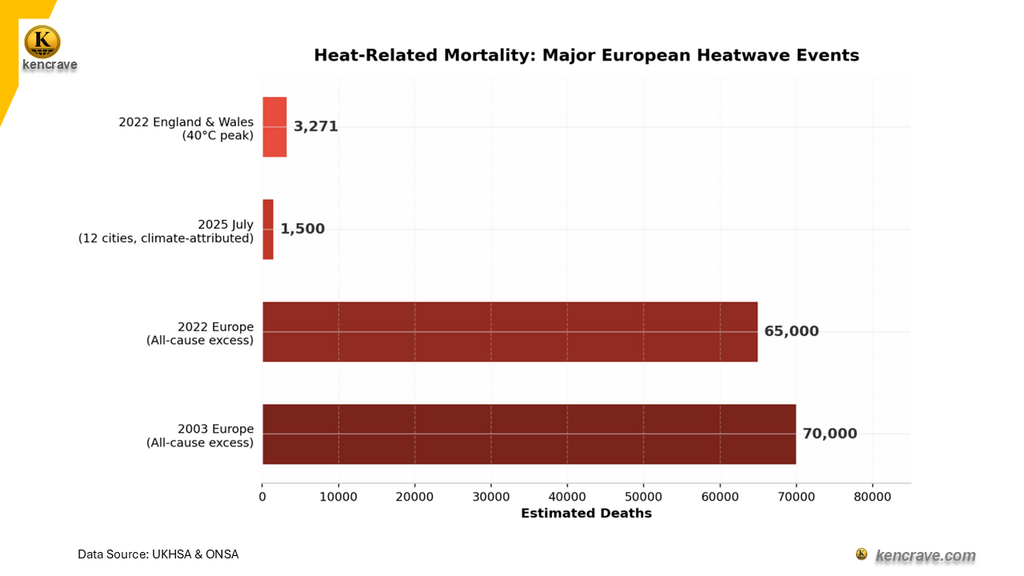
Between 1980 and 2023, 95% of weather-related fatalities in Europe were linked to heatwaves. The 2022 heatwave killed 60,000 to 70,000 people. Rapid assessments by the World Weather Attribution (WWA) network concluded that the intense July 2025 heatwave which broke prolonged records from Western Europe up through Fennoscandia, was made significantly more intense and far more likely due to human-induced global warming.
European heatwave mortality statistics showing deaths from major events in 2003, 2022, and 2025 - climate change impact on heat‑related deaths.
What is a polycrisis? How heat multiplies systemic risk
A polycrisis is when several major crises happen at the same time and interact with each other, making each one worse. Heatwaves don’t cause single and isolated problems. They instead trigger chain reactions in systems that are already stretched.
A heatwave drives electricity demand up. At the same time, drought cuts hydroelectric power and forces nuclear plants to slow down. The grid starts to fail. Hospitals lose cooling just as more patients arrive. Governments spend more on emergencies, so they cut adaptation budgets. The next heatwave hits a system that is poorer and even less prepared. That is how a polycrisis works.
Europe isn’t struggling because it misunderstands heat. It’s struggling because extreme heat now arrives while governments are already dealing with energy insecurity, post‑pandemic debt, and political division. In Italy’s 2025 summer, losses reached 25 billion euros which is about 1.2% of GDP and three million workers stopped working. Productivity drops sharply above 33°C, falling by about 50%.
Why is the UK so vulnerable to heat? A case study in fragmented governance
The United Kingdom exposes what happens when single problem institutions confront compounding crises. In summer 2022, a 40-degree Celsius heatwave killed 3,271 people in England and Wales (UK Office for National Statistics (ONS) 2022.
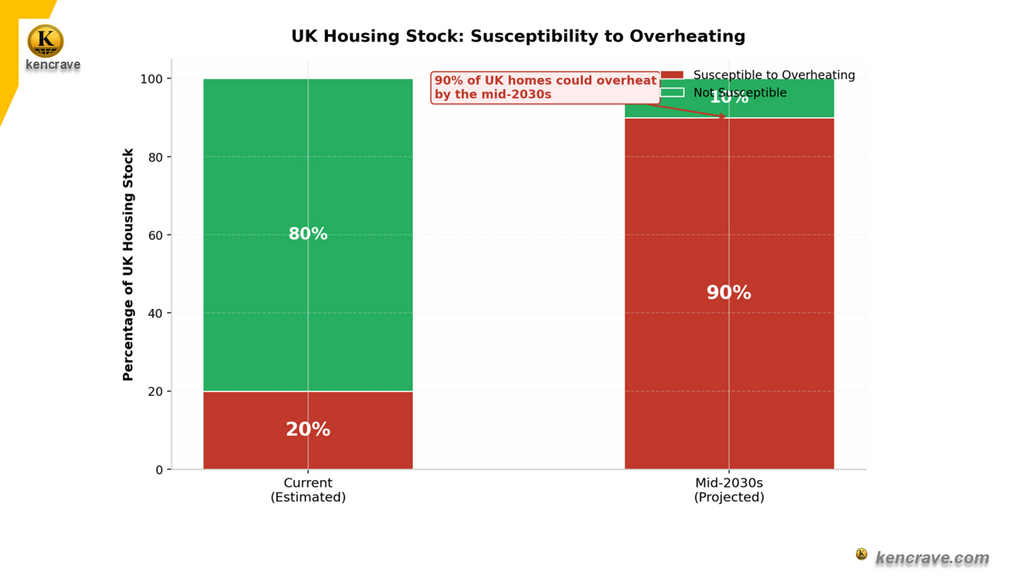
90% of UK homes could overheat by 2035
By the mid‑2030s, most UK homes estimated at around 90% could overheat. Yet Building Regulations still don’t require new buildings to meet overheating standards based on future climate conditions. By 2030, night‑time bedroom temperatures in English homes are expected to exceed safe limits for 14.3% of all hours.
UK housing overheating projection chart showing 90% of homes at risk by mid‑2030s
Additionally, an Independent Assessment of the Third National Adaptation Programme (NAP3), the Climate Change Committee's 2025 assessment found the UK's Third National Adaptation Programme falls far short of what is needed. Only three of 46 policy outcomes achieved a good score; 60% showed limited or insufficient progress.
The Department of Health can deal with medical impacts, but it cannot upgrade millions of homes that overheat. The Housing Ministry can change building rules, but it cannot set workplace protections or adjust labour laws for extreme heat. The Treasury controls funding, but if it doesn’t prioritise heat resilience, nothing gets financed.
The €55 billion gap and why europe isn't funding heat adaptation
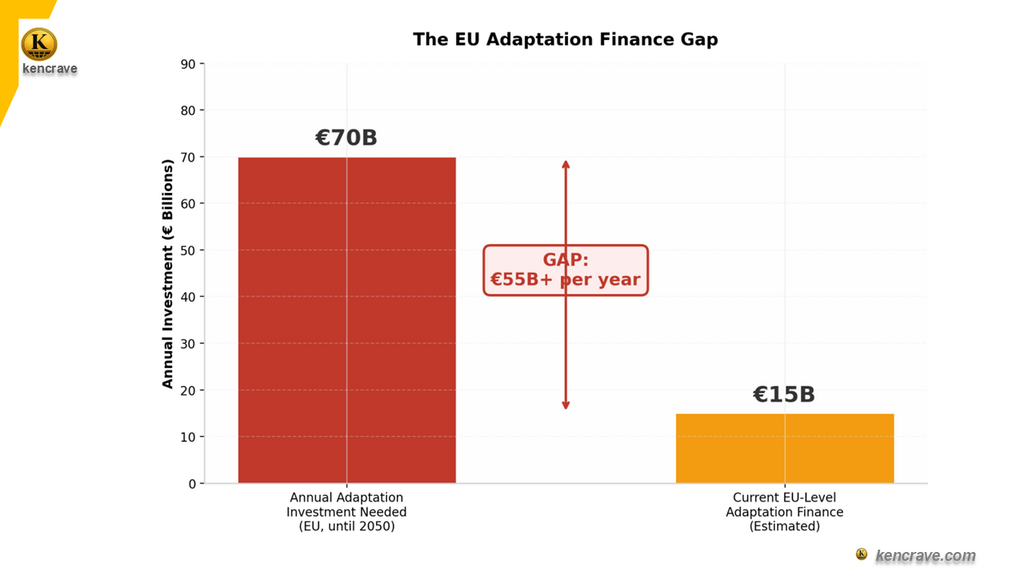
As of 2026, the EU’s climate risks are rising far faster than its financial capacity to handle them. A major assessment by European Commission's Directorate-General for Climate Action (DG CLIMA) notes that Europe needs about €70 billion every year for adaptation through 2050.
However, EEA tracking shows actual funding sits well below even the lowest estimates. This means that Europe’s adaptation needs are accelerating but its financing is not keeping pace. At the city level, 85% of municipalities have adaptation plans but only 6% have dedicated finance strategies.
Joint data from the European Central Bank (ECB) and EIOPA indicates that less than 20% of total climate-related economic losses in Europe are privately insured. This massive climate insurance protection gap leaves national governments to absorb more than 80% of disaster costs, shifting the long-term burden of climate breakdown onto public finances.
EU climate adaptation finance gap infographic comparing €70billion annual need vs €15billion current funding. Data Source: EEA
Municipal planning vs. Dedicated financing
While the majority of European municipalities have developed adaptation plans, the absence of dedicated finance strategies represents a critical implementation gap. Planning without financing creates a dangerous illusion of preparedness. When heatwaves strike, cities are left scrambling for emergency funds rather than drawing on pre-allocated resilience budgets.
Who pays when heat strikes? The insurance protection gap
Less than 20% of total climate-related losses are privately insured. This is primarily because:
Data limitations: Insurers don’t have detailed, forward‑looking models for heat losses, so they struggle to price coverage accurately.
Moral hazard and adverse selection: When coverage isn’t mandatory, only high‑risk properties buy it. Premiums rise, markets break, and insurance becomes unaffordable.
Systemic correlation: Heatwaves hit entire regions at once, creating highly correlated losses that private insurers can’t easily spread or pool.
Regulatory uncertainty: Regulators have been slow to require climate‑risk disclosure or promote parametric insurance that could cover heat‑specific damages.
As a result, governments end up carrying most disaster costs through emergency budgets and reconstruction funds. But these reactive expenses are only a short-term measure since they don’t build long‑term resilience.
Is cooling becoming a luxury? Heat, inequality, and survival
Adaptation is becoming a market transaction. Wealthy households install air conditioning and relocate. Low-income households remain trapped in thermally inefficient housing working outdoor jobs with no temperature protections and facing energy bills they cannot afford. If cooling becomes the main defence, survival depends on income: those who can afford it stay safe, those who can’t face higher illness and death.
The unequal impacts of extreme heat are structural, not accidental. Poorer communities often living in urban heat islands and badly insulated homes face the highest exposure and have the fewest resources to protect themselves. Outdoor and warehouse workers, many from low‑income backgrounds, are forced into dangerous conditions with no enforceable heat protections in much of Europe.
This isn’t just a social justice problem but an issue that threatens the credibility of climate governance itself.
The economics of inaction: is prevention really cheaper than disaster?
Heatwaves are becoming a structural economic risk, not a seasonal inconvenience. The question governments must answer is straightforward: is it cheaper to adapt before extreme heat occurs, or to pay for repeated losses afterwards? The evidence points toward prevention. The EU needs roughly 70 billion euros annually in adaptation until 2050.
That sounds large until set against the alternative. In summer 2025 alone, the EU suffered 43 billion euros in immediate losses. By 2029, cumulative heat-related costs are projected to reach 126 billion euros. A report from Allianz notes that Germany faces potential losses of up to 112.5 billion euros by 2030.
The fiscal trap is clear. Every euro not spent on prevention turns into several euros spent on emergency response, healthcare, infrastructure repairs, and lost productivity. Less than 20% of climate‑related losses are insured, largely because heat risk is hard to model, premiums are high, and many households and businesses opt out. As a result, governments shoulder most disaster costs through emergency budgets and reconstruction funds.
These reactive expenses don’t build resilience. However, they simply restore the system to its vulnerable state before the next heatwave hits. This creates a fiscal trap: governments underinvest in adaptation because budgets are tight, then face even larger bills when crises strike, making future adaptation harder to finance. Breaking this cycle means treating heat resilience as essential infrastructure, not an emergency afterthought
Comparative perspectives on global heat governance
What can Europe learn from Phoenix, Ahmedabad, and Australia?
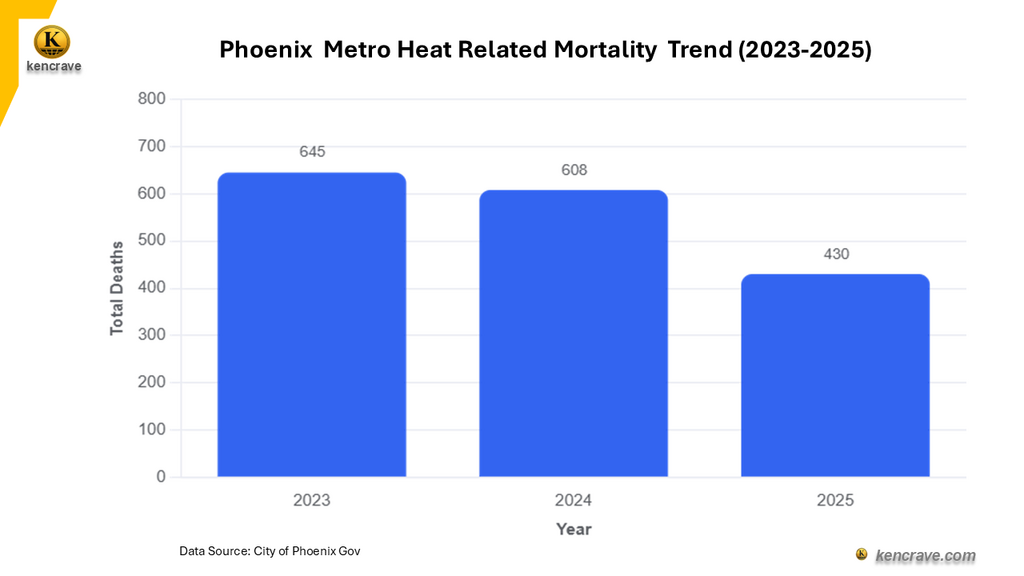
Europe's response speed lags behind other warming regions. In the southern United States, cities like Phoenix and Maricopa County, Arizonahave implemented mandatory cooling centre networks and occupational heat standards.
Phoenix heat‑related mortality trend chart 2023–2025 showing decline in total deaths
Key insight: Phoenix's two-year decline in heat deaths occurred despite rising nighttime temperatures. This suggests that expanded 24/7 services and targeted outreach to vulnerable populations (homeless, mobile home residents) are effective.
India: Ahmedabad's Heat Action Plan
In India, Ahmedabad pioneered a Heat Action Plan in 2013 that now serves as a global model, combining early warning systems, public awareness campaigns, and cool-roof requirements.
Ahmedabad Heat Action Plan impact assessment chart showing reduction in heat‑related deaths and estimated lives saved after 2010 heatwave
Key insight: Ahmedabad's plan demonstrates that low-cost interventions (cool roofs, early warning systems, community outreach) can produce measurable mortality reductions. Australia: Heat Resilience Building Codes Adoption
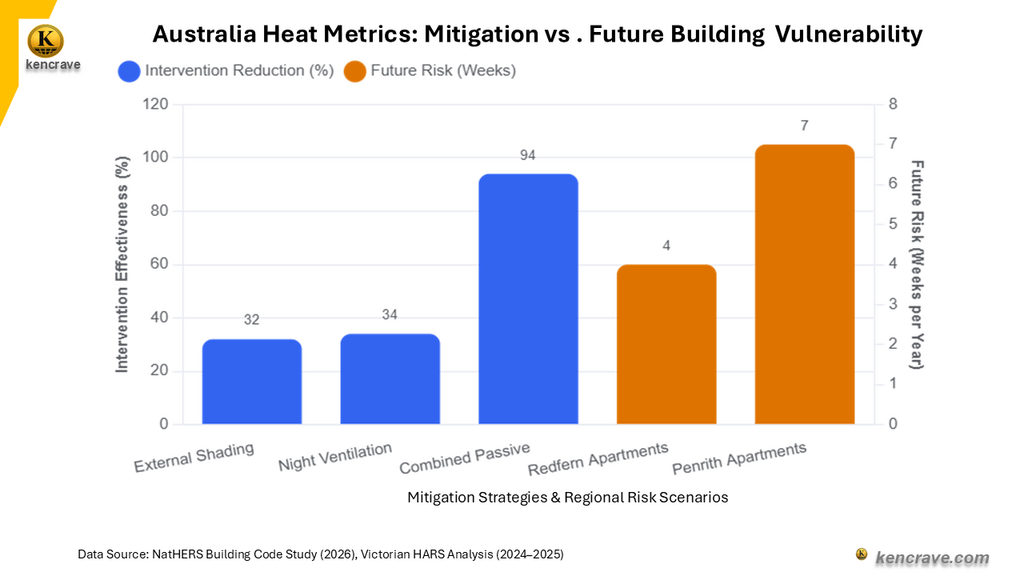
Australia has integrated heat resilience into building codes and urban planning frameworks for over a decade. The following chart shows this progress.
Australia heat mitigation metrics chart comparing intervention effectiveness and future building vulnerability to show climate resilience, passive cooling, and building code adaptation
Key insights
Passive Cooling: Combining passive design strategies yields a 94% reduction in structural overheating, nearly tripling the standalone efficacy of external shading (32%) or night ventilation (34%).
Future Building Vulnerability: Dwellings strictly compliant with current codes remain highly susceptible to climate shifts, resulting in multi-week annual overheating risks by the 2050s.
Regional Disparities: Geographic positioning heavily alters risk exposure within the same metropolitan territory, with inland Penrith apartments facing nearly double the annual overheating duration (7 weeks) of coastal Redfern apartments (4 weeks).
Australia's experience shows that heat-health action plans can reduce mortality. However, building codes still rely on historical climate data and fail to account for future warming. The University of Sydney study warns that apartments built to today's standards could become dangerously hot by 2050 with top-floor and west-facing units being highly vulnerable.
Europe's challenge is not due to absence of knowledge but a failure of institutional coordination and political will. The continent possesses the technical expertise, financial resources, and policy infrastructure to adapt. What’s missing is the urgency to treat extreme heat as the systemic threat it now is.
Stakeholder recommendations
How should governments, developers, and insurers respond?
The following recommendations are addressed to the key stakeholders responsible for building Europe's heat-resilient future. The recommendations focus on national and EU policymakers, property developers, and financial institutions. These recommendations are grounded on this analysis and are designed to break the cycle of reactive emergency spending by building anticipatory resilience into the fabric of European governance, infrastructure, and markets.
What national and EU policymakers must do
Mandate heat-resilient building standards tied to future climate projections, not historical averages.
Addressed to: National housing ministries, EU building standards bodies, and local planning authorities.
Current rules still use old temperature data that no longer matches the climate buildings will face. If new homes were built with passive cooling and enough thermal mass for 2050 conditions, the UK could avoid a future where 90% of its housing overheats by the mid‑2030s. If this doesn’t change, retrofitting later will cost far more than building correctly now. Governments also need legally enforceable workplace heat standards with clear limits for when work must stop.
Addressed to: National labour ministries, EU employment and social affairs bodies.
The UK currently has no legal maximum workplace temperature, leaving outdoor and warehouse workers exposed to dangerous conditions with no enforceable protection. France and Italy have a binding risk-prevention protocols. Adoption of a European‑wide rule requiring work to stop when wet‑bulb temperatures pass safe limits would prevent the productivity losses and avoidable deaths that happen every summer. Making employers legally responsible would ensure the rule is actually enforced.
Addressed to: National governments and EU institutions.
The fundamental failure exposed by the UK case study is not a shortage of policies but a fragmentation of responsibility. When no single institution owns the heat problem, each ministry focuses on its own narrow objectives while the systemic risk accumulates. A permanent coordination body with statutory authority and dedicated budget would ensure that building standards, health warnings, labour protections and infrastructure investments are designed as an integrated system rather than isolated systems.
What property developers must do: build for 2050, not 1990
Incorporate passive cooling, thermal mass, and nature-based solutions into new developments
Design buildings for the climate of 2050, not 1990. This includes:
Orientation and shading: Maximising natural ventilation and minimising solar gain through building orientation, window placement, and external shading devices.
Thermal mass: Using materials like concrete, brick, or stone to absorb heat during the day and release it at night, moderating internal temperatures.
Green infrastructure: Integrating green roofs, green walls, and tree planting to provide evaporative cooling and reduce urban heat island effects.
Smart glazing: Installing high-performance glass with solar control coatings and low-emissivity properties.
Night-flush ventilation: Designing buildings to enable natural cooling during cooler night hours.
Go beyond minimum regulatory requirements
Building regulations lag behind climate reality. Developers who voluntarily adopt future-proofed standards will protect their assets, reduce liability, and attract tenants and buyers increasingly concerned with comfort, health, and energy costs.
Retrofit existing stock with targeted interventions
For existing buildings, focus on:
Installing external blinds, awnings, or shutters.
Upgrading insulation and glazing.
Implementing smart ventilation controls.
Adding cool roofs and green roofs where structurally feasible.
What financial institutions (insurance companies, banks, and asset managers) must do
Develop parametric heat insurance products
Traditional indemnity-based insurance struggles with correlated systemic risks like heatwaves. Parametric insurance, which pays out based on predefined triggers such as temperature thresholds tends to offer a faster, more transparent solution. Insurers should:
Partner with meteorological agencies and climate scientists to develop reliable temperature indices.
Offer parametric policies to municipalities, businesses, and agricultural producers.
Bundle parametric heat insurance with broader climate resilience packages.
Integrate forward-looking climate risk into underwriting and investment decisions
Current underwriting models rely heavily on historical data.
Financial institutions must:
Incorporate climate projection models (e.g., 2°C and 4°C warming scenarios) into property and infrastructure risk assessments.
Require climate-risk disclosure from borrowers and policyholders.
Differentiate premiums and lending terms based on resilience measures implemented (e.g., cool roofs, passive cooling systems).
Create dedicated adaptation finance vehicles
Banks and asset managers have a critical role in closing the adaptation finance gap:
Establish green bonds and climate adaptation funds specifically earmarked for heat-resilient infrastructure.
Offer low-interest loans or mortgage products for energy efficiency and cooling retrofits.
Partner with municipalities to finance large-scale urban heat resilience projects.
Advocating for regulatory and data frameworks that enable climate-risk pricing
Financial institutions should collectively:
Push for mandatory climate-risk disclosure and standardised reporting frameworks.
Support the development of public climate-risk data platforms.
Engage with regulators to create enabling environments for climate-resilient investment.
The real test of European climate policy
Europe's heatwave crisis is not a story about record temperatures. It is a test of whether governments can convert climate knowledge into institutional capacity when heat is a stress multiplier across energy, fiscal, health and political systems simultaneously. The evidence suggests they are not adapting fast enough. Policies exist on paper but fail in implementation. Finance is pledged but not delivered. Responsibility is distributed but not coordinated. And the costs keep accumulating while the response lags.
Europe is getting hotter. The real question is whether its institutions can reform faster than its crises can compound.
Key takeaways: things you need to know about Europe’s heat crisis
Heat is a systemic threat multiplier. It is not an isolated weather event as it cuts across energy, health, fiscal, and political systems simultaneously.
Europe’s adaptation gap is institutional. The technical solutions exist, but policies are fragmented, standards aren’t enforced, and financing is insufficient.
The UK shows the risks of fragmented governance with 90% of homes facing overheating, yet building regulations still rely on outdated climate data.
The fiscal arithmetic is clear: every euro of prevention saves multiple euros of reactive emergency spending. However, governments remain trapped in a cycle of underinvestment and escalating losses.
Adaptation is becoming a market transaction thus creating a dangerous social divide where wealth determines survival, threatening both public health and political stability.
Key questions users often ask about the state of heatwaves in Europe
1. How many people died in Europe's heat waves?
Europe's 2022 heat wave killed 60,000 - 70,000 people. In July 2025, climate change nearly tripled heat-related deaths across 12 European cities.
2. What is the EU's heat adaptation finance gap?
The EU needs €70 billion annually for climate adaptation through 2050 but funds only €15 billion representing a €55 billion annual gap.
3. Why is the UK so vulnerable to extreme heat?
90% of UK homes could overheat by 2035, yet building regulations still rely on historical climate data. Governance is fragmented across health, housing, labour, and Treasury departments.
4. What is a polycrisis in climate adaptation?
A polycrisis is when heat triggers chain reactions across energy, health, and fiscal systems, grid strain, hospital cooling failures, emergency spending, and cut adaptation budgets.
5. What can Europe learn from Phoenix, Ahmedabad, and Australia?
Phoenix cut heat deaths from 645 to 430 (2023 - 2025). Ahmedabad's Heat Action Plan saved 1,190 lives. Australia's passive cooling cuts overheating by 94%.


-impact-assessment-across-india.webp)