A bundle of dollar bills and a Bitcoin coin lie on a map of South America, with a red financial graph line reflecting inflation, dollarization, or crypto adoption. Image Credits: Dennis Stima | Kencrave
10 min read
Business
Hyperinflation, Dollarization & Crypto In South America's Argentina, Venezuela & Beyond
Hyperinflation in Venezuela and Argentina is driving extreme monetary experiments through dollarization, crypto and CBDCs. Explore the risks, trade-offs & solutions.
South America has become a global laboratory for extreme monetary policies, driven by hyperinflation and eroding trust in local currencies. This distrust is often rooted in decades of political instability, populist policies, and past debt crises, which have systematically weakened institutions.
These domestic vulnerabilities are now being severely tested by a punishing global economic environment, including post-pandemic fiscal hangovers and a strong U.S. dollar, which makes dollarized debt and imports more expensive. The human cost is immense, with hyperinflation eroding life savings, pushing millions into poverty, and fueling waves of economic migration. Venezuela and Argentina exemplify the chaos, with historic inflation surges destabilizing economies:
Case Studies in Chaos
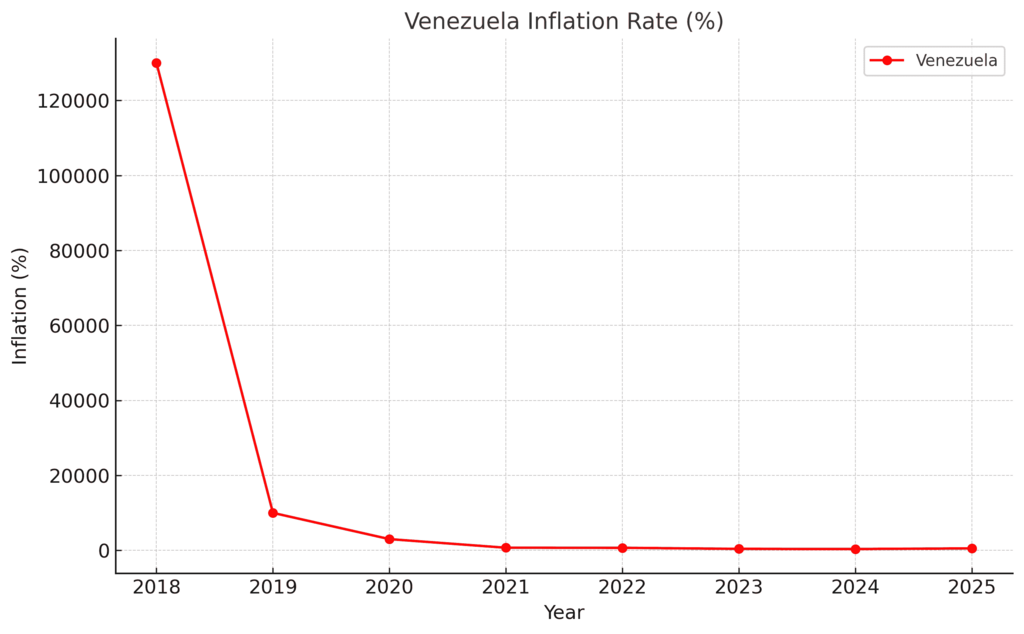
Venezuela: Rose to 130,060% in 2018, with hyperinflation persisting and remains among the highest in the world, with Inflation projected at 180% year end of 2025 (IMF). Despite attempts at redenominations, price controls, and even the launch of an oil-backed cryptocurrency (the Petro), the bolívar has become practically unusable in daily life.
World Bank and regional press estimates (2018 - 2025). Line graph showing Venezuela’s inflation from 2018 to 2025. The chart highlights a hyperinflation spike in 2018 (130,000%+) and a sharp decline in subsequent years, though inflation remains persistently high in the hundreds of percent
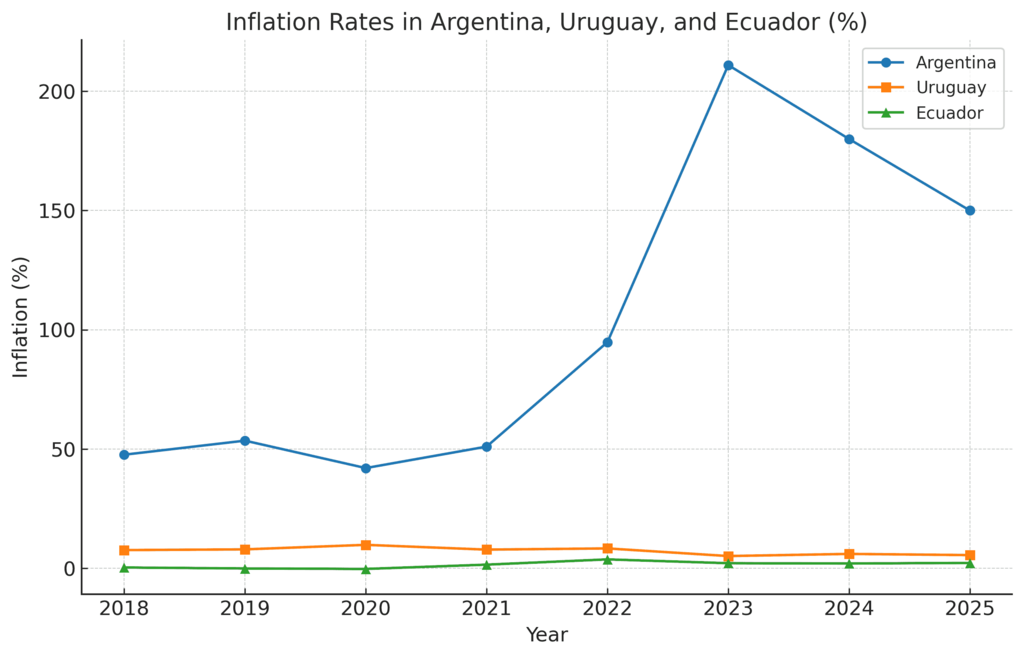
Argentina: Hit 211% in 2023, with estimates pointing to continued inflation through 2025. Argentines navigate a mix of multiple exchange rates, official, “blue dollar,” and crypto, while international creditors like the IMF remain central players, often resented for imposing austerity.
The Roots of Instability: A Historical Perspective
The region's monetary fragility isn't accidental; it's the result of specific historical cycles. In Argentina, the pendulum of Peronist populism and military dictatorships throughout the 20th century established a persistent pattern of large fiscal deficits, protectionism, and printing money to fund spending. This culminated in a catastrophic economic collapse in 2001-2002, which included a massive debt default and a brutal devaluation, permanently scarring the public's trust in the peso.
In Venezuela, the advent of "Chavismo" under Hugo Chávez in the early 2000s saw the state seize control of the oil industry and central bank, using petrodollars to fund vast social programs while dismantling institutional checks and balances. This left the economy wholly vulnerable to the eventual crash in oil prices, triggering the hyperinflation that continues today.
How Monetary Policy Works (Simply Explained)
Monetary policy is used by central banks to control the money supply and interest rates with the goal of managing inflation and stabilizing the economy. Central banks adjust key interest rates, conduct open market operations, and change reserve requirements to influence borrowing, spending, and overall economic activity. In more extreme circumstances, they may also deploy tools like quantitative easing (buying government bonds to inject liquidity) or use forward guidance to influence market expectations.
Printing money to cover budget deficits can lead to high inflation, especially when trust in these policies is low or political interference is present. Attempts to manage currency values through pegging or raising interest rates can fail if underlying economic and institutional trust issues are not addressed.
Structural causes of inflation and hyperinflation include:
• Fiscal deficits: Financing government spending by printing money increases the money supply, driving inflation.
• Weak institutions: Political influence over central banks reduces their credibility and effectiveness.
• Commodity dependence: Heavy reliance on volatile commodity prices creates economic instability. This often manifests as the "Resource Curse," where wealth from resources like oil leads to harming other exports and fuels corruption and fiscal mismanagement, as seen in Venezuela
• Currency distrust: When people prefer foreign currencies or alternatives like cryptocurrency over the local currency, demand for the local currency falls, worsening instability and inflation
Case Studies: Venezuela, Argentina, Bolivia, Ecuador, and Uruguay
Venezuela: The Petro Collapse
Launched in 2018 as an oil-backed cryptocurrency, the Petro was initially valued at US $60 per unit. However, poor governance, lack of transparency, and limited acceptance led to a collapse in credibility. By 2024, the project was officially discontinued, leaving no meaningful role in Venezuela’s monetary system.
Argentina: A Fragmented Peso System
Argentina’s peso operates under multiple exchange rates (official, informal “blue,” and crypto-linked). This fragmentation undermines transparency, distorts incentives, and weakens monetary control. In 2023, the peso lost more than half of its value, while informal market rates diverged sharply from the official exchange rate. Despite substantial IMF support, longstanding tensions over conditionality and austerity continue to complicate stabilization efforts.
Bolivia: Informal Dollarization
While Bolivia officially reported low inflation at 2.58% in 2023, trust in the boliviano remains fragile. For high-value transactions, U.S. dollars are often preferred, reflecting a de facto partial dollarization. This disconnect between official inflation data and household behavior illustrates the fragility of monetary confidence.
Ecuador: The Dollarization Trade-Off
Ecuador’s full adoption of the U.S. dollar in 2000 successfully stabilized prices and ended hyperinflationary pressures. However, it also removed monetary autonomy and constrained countercyclical policy options. Challenges such as reduced fiscal flexibility and social inequities remain prominent, underscoring the double-edged nature of dollarization (World Bank, 2003).
Uruguay: Institutional Stability
Uruguay demonstrates the benefits of credible institutions and prudent policy. With an independent central bank, no reliance on price controls, and consistent macroeconomic management, inflation has remained below 6% since 2023. This positions Uruguay as a regional benchmark for monetary stability.
Source: World Bank and national central bank statistics (2018 - 2025). Line graph comparing inflation rates of Argentina, Uruguay, and Ecuador between 2018 and 2025. Argentina shows steep volatility, Uruguay remains stable under 10%, and Ecuador, dollarized since 2000, stays near zero to low single digits.
Broader Regional Pressures: Chile, Colombia, and Peru
The specter of currency distrust extends beyond the most extreme cases. Middle-income nations like Chile, Colombia, and Peru have also faced significant inflationary pressures and currency depreciation since the pandemic. While their strong independent central banks have aggressively raised interest rates to combat inflation, a stark contrast to Argentina and Venezuela, public debt remains a concern. These countries are closely watched to see if they can maintain their hard-won institutional stability against global headwinds and domestic political pressures, or if they could face milder versions of their neighbors' crises.
Consequences of Dollarization
Dollarization stabilizes prices by anchoring economies to the U.S. dollar, reducing inflation. However, it eliminates monetary policy control, forcing reliance on U.S. Federal Reserve decisions, which may misalign with local needs. The only theoretical alternative to full dollarization, a shared regional currency akin to the Euro, remains politically unfeasible due to a lack of fiscal integration and political will (World Bank).
Long-Term Risks and Policy Trade-Offs of Dollarization
Risks • Loss of Autonomy: No control over interest rates or money supply limits crisis response. • U.S. Dependence: U.S. rate hikes can harm local economies. • Exclusion: Unbanked populations may struggle with dollar-based systems. • Capital Flight: High dollar demand drains reserves.
Trade-Offs • Stability vs. Flexibility: Dollarization curbs inflation but restricts growth tools. • Sovereignty vs. Trust: Adopting the dollar restores confidence but sacrifices control. • Short-Term vs. Long-Term: Immediate stability risks long-term rigidity.
How Cryptocurrencies Are Being Used in South America’s Inflation Crisis
As trust in local currencies evaporates, many turn to crypto. The results are mixed:
El Salvador: Bitcoin was made legal tender in 2021 to reduce remittance costs. By 2023, 90% of Bitcoin firms had shut down, and only 5% of Salvadorans used Bitcoin in daily payments. Full adoption would have led to risks in financial stability, consumer protection, and fiscal transparency (IMF, 2025).
Argentina: Informal “blue dollar” exchanges and crypto transfers surged in 2023, often giving buyers 40% better rates than official exchanges.
Venezuela: Some use crypto, but the majority rely on physical U.S. dollars for survival.
Everyday Survival Hacks: Adoption of Other Currencies
When the national currency collapses, people adapt in creative ways:
Trading pesos for dollars at illegal but widely tolerated “blue markets” (Argentina)
Conducting everyday purchases in dollars instead of bolivars (Venezuela)
Using remittances and stablecoins to bypass banking restrictions (region-wide)
Survival isn’t about policy; it’s about pragmatism.
Argentina’s Radical Proposals: Closing the Central Bank & Adopting the Dollar
Argentina’s president proposes:
• Full Dollarization: Eliminating the peso. • Closing the Central Bank: Ending domestic monetary policy. • Currency Competition: Allowing dollars and crypto.
This would make Argentina the second-largest dollarized economy, but critics warn of lost flexibility.
Brazil’s Digital Real (CBDC): A Safer Alternative to Dollarization?
Brazil’s Central Bank Digital Currency (CBDC), piloted in 2024, aims to track transactions and may replace cash by 2026. Its stated goals also include improving financial inclusion and payment system efficiency, though privacy concerns remain paramount.
Recommended Strategic Actions for Stakeholders
For Investors & Businesses
Hedge in USD: Immediately convert local earnings to U.S. dollars or USD-backed stablecoins to preserve value. Use parallel market rates for real financial planning.
Bet on Stability: Prioritize investments in institutionally stable countries like Uruguay to mitigate regional risk.
Prepare for Dollarization: Monitor Argentina's potential dollarization closely. If enacted, expect short-term pain but long-term stability for business planning.
Focus on Essentials: Target investments in export-oriented businesses and sectors that meet basic needs, which are more resilient to crisis.
For Policymakers & Governments
Copy Uruguay: The top priority is to guarantee central bank independence and enforce fiscal discipline to rebuild trust.
See Dollarization as a Last Resort: Understand it solves inflation but sacrifices all future monetary tools and requires extreme fiscal responsibility.
Design CBDCs for Trust, Not Control: If pursuing a digital currency (like Brazil's Digital Real), prioritize privacy and inclusion to avoid public rejection.
Legalize Pragmatism: Consider officially permitting dollar-based accounts and contracts to align policy with what citizens are already doing.
For Citizens
Minimize savings in pesos or bolivars. Convert savings to physical dollars or stablecoins (e.g., USDT, USDC) via any available means.
Use Crypto Wisely: Use stablecoins for savings and transfers, but avoid volatile cryptocurrencies for essential funds.
Develop Valuable Skills: Focus on skills that are valuable in a stable, dollarized, or global economy (tech, exports, skilled trades).
Vote for Institutions: Support political movements that prioritize independent central banks and fiscal rules, following Uruguay's model.
Key Takeaways
• Hyperinflation and distrust drive South America’s monetary experiments. • Fiscal mismanagement and weak institutions fuel currency collapse. • Dollarization stabilizes but sacrifices policy control.
South America’s monetary experiments, however desperate, demonstrate humanity’s capacity to innovate when traditional systems fail. The question isn’t whether these solutions are elegant, but whether they work well enough to keep commerce alive, and on that count, the evidence is clear.
Frequently Asked Questions: Dollarization, Inflation, and Crypto in South America
Q: What is dollarization and how does it affect South America?
A: Dollarization replaces local currency with the U.S. dollar. It reduces inflation but limits monetary flexibility.
Q: Why is Argentina considering full dollarization? A: To stabilize its economy after years of hyperinflation and currency collapse.
Q: How do cryptocurrencies impact hyperinflation in Venezuela? A: Crypto adoption is small compared to U.S. dollar use, but it provides limited alternatives when bolivars collapse.
Q: Which South American country has the most stable currency? A: Uruguay, thanks to its independent central bank and low inflation rates.