
SouthAmerica
Paraguay's Ueno Bank collapse froze funds for 3M people and toppled a president. What cashless economies must learn about concentration risk.
Key Takeaways
Key Takeaways
- Concentration is the core vulnerability. Tying public funds, pensions, and banking for about 60% of adults to Ueno Digital Bank meant a single failure that cut roughly 3 million people off from their money overnight.
- Weak oversight turned innovation into systemic risk. Conflicts of interest and $150M in insider loans went unchecked while $850M in public deposits flowed in, ending in impeachment and national financial damage for Paraguay.
- Cashless systems need fallbacks and security. Cash reserves, diversified infrastructure, scaled deposit insurance, and cybersecurity as national security are essential complements to digital finance.
The resignation of Paraguayan President Santiago Peña on November 5, 2026, took Latin America by surprise. It raised the concerns about the risks of an economy relying too heavily on digital banking. Peña stepped down after nationwide protests and an impeachment vote following the collapse and government takeover of Ueno Bank, Paraguay's largest digital-first bank.
The failure left nearly three million people, about 60% of the country's adults, unable to access their money overnight. As a result, the crisis is a major example of what can happen when a society depends heavily on digital financial systems.
Why Santiago Peña Resigned as Paraguay’s President
Peña's downfall was driven by allegations of conflicts of interest and weak oversight. Before becoming president in 2023, Peña worked as an economist for the International Monetary Fund (IMF). During his presidency, he promoted Ueno Bank as a key part of Paraguay's economic modernization strategy. However, questions arose because he had previously been a business partner of Grupo Vázquez, the conglomerate that owns Ueno Bank, and held shares in its parent company until early 2025.
Concerns grew after Peña appointed Carlos Carvallo to lead Paraguay's central bank. Carvallo had previously worked at Ueno's predecessor institution, even though the central bank was responsible for regulating Ueno Bank.
Under Peña's administration, Ueno Bank received strong government support. An estimated $850 million in public funds, including money from pension and healthcare reserves, was deposited with the bank. After industry regulators uncovered serious financial misconduct, opposition lawmakers accused the government of failing to carry out its oversight responsibilities.
As support for Peña collapsed, including within his own Colorado Party, he announced his resignation. He said he was stepping down to protect social stability and democratic institutions. However, Congress proceeded with impeachment and unanimously voted to remove him from office on November 6, 2026, one day after he offered to resign.
The impeachment stripped him of his lifetime senatorial immunity which allowed prosecutors to place him in pretrial detention. Vice President Pedro Alliana was then sworn in as president on November 6, 2026.
How Ueno Bank Collapsed
Ueno Bank grew rapidly from a small financial company into one of Paraguay's most recognizable brands. Its simple mobile banking platform attracted millions of customers, especially people who had never before used formal banking services.
That growth came to an abrupt end on November 3, 2026, when the central bank seized control of the institution. Regulators discovered that Ueno had issued approximately $150 million in high-risk loans to companies linked to its own executives and insiders, violating banking rules. Once those losses were accounted for, the bank no longer met legal capital requirements and lacked enough reserves to cover its risks.
The government began liquidation proceedings, and prosecutors moved to arrest several senior executives, including CEO Miguel Vázquez, as well as former Central Bank President Carlos Carvallo, who resigned immediately following the seizure.
Ueno Bank Crash: Key Data
- Affected Customers: roughly 3 million
- Share of adult population: about 60%
- Public funds frozen: $850 million
- Insider-linked loans: $150 million
- Solvency status: Below legal minimum requirements
- Political Outcome: Presidential impeachment, removal, and arrest of Santiago Peña. Vice President Pedro Alliana takes over as Paraguay’s President.
To quell street protests and restore liquidity, Paraguay’s Central Bank activated the state deposit guarantee fund. As of November 10, an estimated $340 million had been disbursed to roughly 1.7 million people, representing partial reimbursements for about 93% of eligible retail depositors.
What the Crisis Revealed About a Cashless Economy
The collapse highlighted the risks of relying on a single digital system to carry out financial transactions and related activities for an economy.
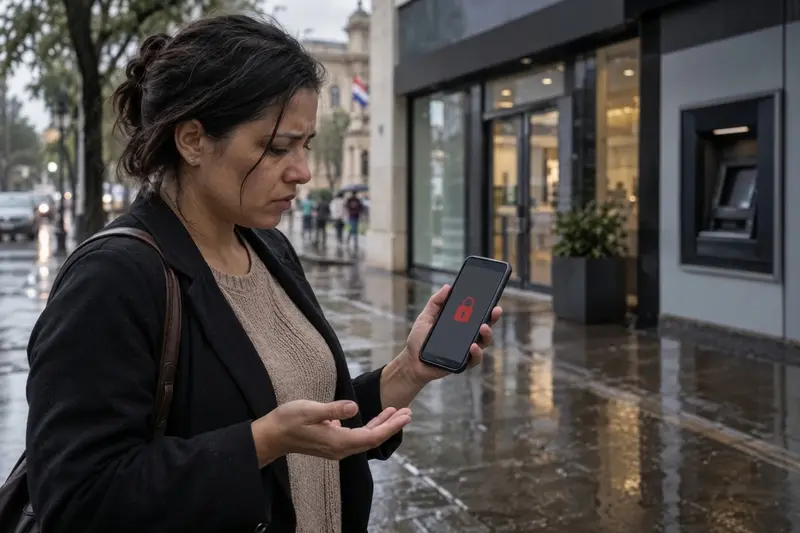
When Ueno's app, cards, and payment services ceased operating, a large percentage of people in Paraguay immediately lost access to their money. Unlike traditional banking crises where cash remains available, the disruption affected daily commerce almost instantly.
Key consequences from the crisis included:
- People couldn't access basic necessities. Many households were unable to buy food, medicine, or other essentials because their funds were trapped in frozen bank accounts.
- Public unrest increased. People gathered outside bank branches across the country, and protests escalated into clashes that required police intervention.
- Government payments were disrupted. Pension payments and other public benefits that relied on Ueno's digital infrastructure were delayed and frozen in some cases.
Cross-Border Fallout: Luxembourg Probe, Global Banks Under Fire, and Rising Borrowing Costs
The collapse of the bank resulted into some major developments:
- Luxemborg legal partnership with Paraguay. The crisis spread to Europe. Since the bonds were listed on the Luxembourg Stock Exchange via a shell company named U Holdings, Paraguayan prosecutors partnered with Luxembourg authorities to trace assets and uncover how international funds were channeled into insider companies.
- Major financial entities facing criticism. Weeks before the collapse, JPMorgan and Bank of America promoted Paraguay to investors alongside President Peña, despite serious accounting issues already existing at Ueno.
- Wider Market Damage to Paraguay: The bond suspension has negatively impacted Paraguay's reputation with investors. Investors are now demanding higher returns to lend money to Paraguay, making it more expensive for both the government and local companies to borrow.
Cybersecurity and Infrastructure Risks for Latin America
The fall of Ueno Digital Bank also highlighted the risks of concentrating financial and personal data within a single digital ecosystem.
Before the collapse, cybersecurity groups had already warned about increasing cyberattacks targeting financial technology companies across Latin America. Ueno's rapid growth reportedly outpaced its security controls.
Its affiliate company, Itti, managed several government contracts involving sensitive citizen information and public records. Combining banking data, pension information, and personal identification records in one system creates an attractive target for cybercriminals and state-sponsored hackers with the after results resulting in heavy losses.
Had a major cyberattack occurred during the crisis, recovering financial records could have become even more difficult. The incident underscored that digital financial infrastructure is not just an economic issue but also a national security concern.
What Other Countries Can Learn from Paraguay’s Digital Bank Collapse
The events in Paraguay offer several lessons for countries moving toward cashless systems.
1. Financial innovation must be matched by strong oversight
Expanding access to digital banking can help bring more people into the financial system. However, rapid growth without effective regulation creates new vulnerabilities. Regulators need the authority, independence, and resources to identify problems early, especially when a single institution becomes systemically important. Where oversight fails, millions of people can end up paying the price for the actions of a few executives.
2. Governments should avoid concentrating critical services within a single financial institution/system
In Paraguay's case, public funds, pension payments, and everyday consumer banking became heavily tied to one entity. When Ueno Bank collapsed, the disruption spread far beyond the banking sector. Diversifying financial infrastructure can reduce the risk that a single corporate failure triggers a wider economic crisis.
3. Cash reserves remain an important backup during emergencies
Digital payments are convenient and efficient, but they depend on functioning technology, communications networks, and financial institutions. When those systems fail, cash can provide households and businesses with a way to continue performing basic transactions. Paraguay's experience demonstrates the value of maintaining alternative payment options rather than relying exclusively on digital channels.
4. Cybersecurity should be treated as a national security issue
As more financial activity moves online, digital infrastructure becomes increasingly attractive to cyberattacks. Banking systems, payment networks, and government databases require continuous investment in security, resilience, and disaster recovery. A major cyberattack can be just as disruptive as financial mismanagement trickling down into the wider economy.
5. Deposit protection schemes must keep pace with financial concentration
Deposit insurance is designed to maintain public confidence, but it may be insufficient if a dominant institution serving a large share of the population fails simultaneously. Policymakers should regularly assess whether existing safeguards can handle a large-scale banking crisis.
6. Public trust is as important as technology
Digital financial systems depend on confidence that institutions are transparent, accountable, and properly regulated. When trust breaks down, citizens may become reluctant to use digital banking services, slowing financial inclusion efforts and making economic recovery more difficult.
Summary
Paraguay now faces the challenge of restoring public trust in its banking system, strengthening financial oversight, and replacing the services once provided by its largest digital bank. The crisis shows how vulnerable an economy can become when public funds, pensions, and everyday banking are concentrated in a single institution. When that institution fails, the disruption can quickly spread across the entire country and, if severe enough, threaten broader economic stability.