
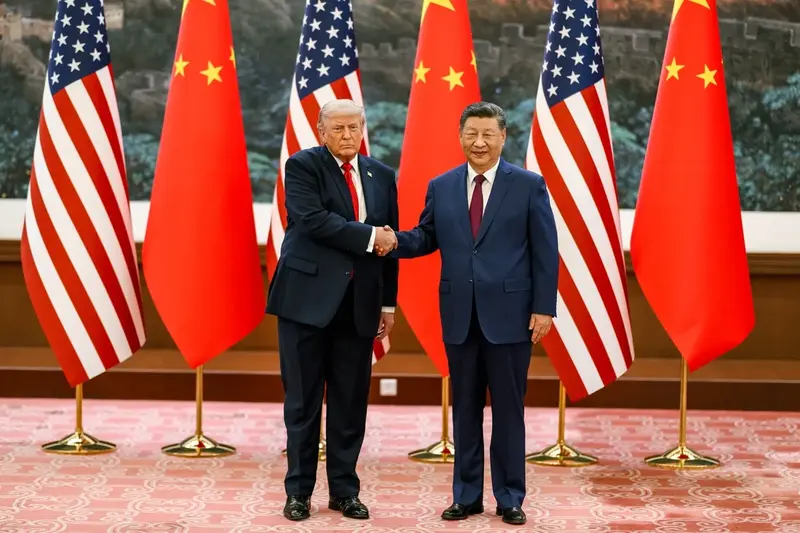
Xi Jinping and Donald Trump hold a handshake after a diplomatic meeting symbolizing the diplomatic relations between China and the U.S. Image Credits: Raw pixel under public domain.
NorthAmerica
Chinese President Xi Jinping visited the United States for a three‑day state visit from September 23 to 25, 2026. He held talks with U.S. President Donald Trump on bilateral relations and international and regional issues at the White House in Washington, D.C.
Key Takeaways
- The tariff relief covers $30 billion of non-sensitive goods in each direction. The arrangement covers U.S. exports including agricultural products, wood products and cosmetics. Chinese goods receiving favorable treatment include small appliances, toys and decorations.
- The AI outcome was procedural rather than binding. No formal agreement to slow AI development was reached. The US maintained its position of restricting China's access to advanced AI technology.
- The economic truce is time limited. It was extended by only two months to January 10, 2027. Both sides are playing a wait game rather than resolving structural issues.
The Eight-Point Consensus Between China and the United States
The Eight-Point Consensus is a set of agreements between Chinese President Xi Jinping and U.S. President Donald Trump covering the direction of bilateral ties, summit coordination, regional security, trade, law enforcement, technology, and cultural exchange. Together, they point toward a more stable, predictable relationship while keeping cooperation going in shared areas.
- Building a constructive strategic stability relationship. The two leaders agreed to build a constructive China-U.S. relationship of strategic stability based on respect, fairness and reciprocity.
- Mutual support for hosting APEC and G20 summits. They also agreed to support each other as hosts. China will host the 2026 Asia-Pacific Economic Cooperation (APEC) Leaders' Meeting in November, while the United States will host the G20 Leaders' Summit in December. Both expressed the intention to attend each other's event.
- Iran’s non-nuclear commitment. According to Whitehouse Fact Sheet, Iran was a key issue of discussion. Xi and Trump agreed that Iran should honor its commitment not to develop nuclear weapons. They also agreed that no country or institution should impose transit fees on international waterways.
- Recalling World War II alliance. The two heads of state recalled that China and the U.S. were allies in World War II and fought side by side to win the war.
- $30 billion reciprocal tariff reduction and economic mechanisms. The two heads of state acknowledged the positive role of the China-U.S. trade consultation mechanism. They further acknowledged the results of consultations between the two trade teams. Those results include three elements. First, the establishment and advancement of mechanisms such as the Trade Council. Second, the reaching of a $30 billion reciprocal tariff reduction arrangement. Third, the extension of the Kuala Lumpur trade consultation outcomes.
- Counternarcotics and Law Enforcement Cooperation. Both sides noted that counternarcotics and law enforcement cooperation has produced visible results. The two countries worked closely together to jointly crack multiple cases involving new psychoactive substances and precursor chemicals, apprehending dozens of suspects in both countries. The U.S. also welcomed China's decision to impose export controls on two additional precursor chemicals used to produce fentanyl.
- AI Dialogue and AI incident communication channel. Both sides agreed to establish a China-U.S. AI Dialogue to exchange views on the risks and benefits related to artificial intelligence. The next dialogue will be held in November 2026. Both sides agreed to establish a communication channel for AI-related incidents.
- Giant Panda Lease to Zoo Atlanta. The United States welcomed the arrival of a pair of giant pandas leased by China to Zoo Atlanta.
In addition, the Chinese and U.S. militaries agreed to sign a memorandum of understanding as soon as possible to strengthen crisis communication and prevention, and to continue cooperation in searching for the remains of U.S. military personnel in China.
What Do the Summit Outcomes Actually Tell Us?
The reset is procedural, not meaningful. Most of the outcomes establish channels, dialogues, or symbolic statements. Only a small number carry measurable content, and even those are narrow in scope. The $30 billion tariff reduction covers roughly 90% of covered products at most-favored-nation rates.
The amount of goods covers roughly 21% of U.S. exports to China and 7% of Chinese exports to the U.S. based on 2024 trade values. Neither side was willing to make comprises that a real settlement would require. They opted instead to buy time and institutionalize communication.
Both sides want to manage the rivalry, not escalate it. It has been a year of tariff threats, export controls, and rare earth restrictions. Then 2026 brought two summits back-to-back. Beijing hosted one in May 2026. Washington hosted the other in September 2026. The signal from both was the same. Both governments chose structured dialogue over unilateral pressure. At least for now.
AI has moved from a side issue to a formal agenda item. The two sides agreed to hold a dialogue on AI's risks and benefits. The first round is set for November. They also agreed to establish a channel for AI-related incidents. That's a notable departure. AI safety and incident response are now treated as bilateral business. The two countries are racing hardest to build frontier systems.
This is no longer just a domestic U.S. or Chinese regulatory matter. It affects markets and supply chains beyond the two countries. Coal purchase commitments and agricultural access will influence global commodity pricing. Tariff relief on consumer goods will shape manufacturing planning. The AI dialogue's outcome, or lack of one, will shape how third countries calibrate their own AI governance relative to the two dominant players.
What Comes Next and What to Watch?
November 2026: APEC and the first AI dialogue session land together
China will host the 2026 APEC Economic Leaders' Meeting in November. Trump confirmed that the two leaders would meet again there in Shenzhen. Both events: APEC and the first round of the AI dialogue, with the next round of discussions also set for November. This is the first real test of whether the summit's commitments turn into working mechanisms or stay as talking points.
December 2026: a fourth Trump-Xi meeting at G20 Miami
The United States will host the G20 Leaders' Summit in December, 2026. Both presidents expressed intention to attend each other's events. The summit is scheduled for December 14–15, 2026 at Trump National Doral Miami in Doral, Florida. Four in-person meetings within a single year is unusual. This could point to both sides are betting on sustained, high-touch diplomacy rather than letting officials handle it at lower levels.
January 10, 2026: the truce's real deadline
The broader trade truce was extended from November 10, 2026 to January 10, 2026. This gives negotiators a few months to work toward something more durable before it lapses. Any larger deal would only be announced later in the year. That announcement is expected after Trump's visit to Shenzhen in November 2026 for the APEC leaders' meeting. This suggests January 2026 is the month to watch for key issue settlement between the U.S and China.
The military MOU still needs to be signed
The two militaries only agreed to sign a memorandum of understanding as soon as possible to strengthen crisis communication and prevention. The actual document, and the mechanisms it creates, are still pending. Whether it gets signed on schedule is a concrete marker of follow-through.
The unresolved issues don't go away
Semiconductors remain where the two sides are furthest apart, and no new issue on Taiwan came out of this summit. Beijing remains dissatisfied with U.S. embargoes on high-end semiconductor exports, while Washington remains dissatisfied with the flow control of rare earth exports to the United States from China. Both issues will keep pressuring the relationship regardless of what gets signed at APEC or G20.
Bottom Line
The 2026 U.S.–China reset isn’t a big breakthrough; it’s basically a way to keep things from getting worse. Both sides chose to calm things down instead of fixing their main fights. The eight “deliverables” are mostly about opening channels, talking more, and stretching the current truce a bit. They don’t touch the real pressure points like chips, Taiwan, or rare earths.
The real test starts now. Will China and the U.S. actually sign the military MOU, will rare earth shipments pick back up, will the AI talks lead to anything useful? If those key points progress, it will symbolize a clear shift. If they don’t, the summit was just a 'normal thing', not a real shift.