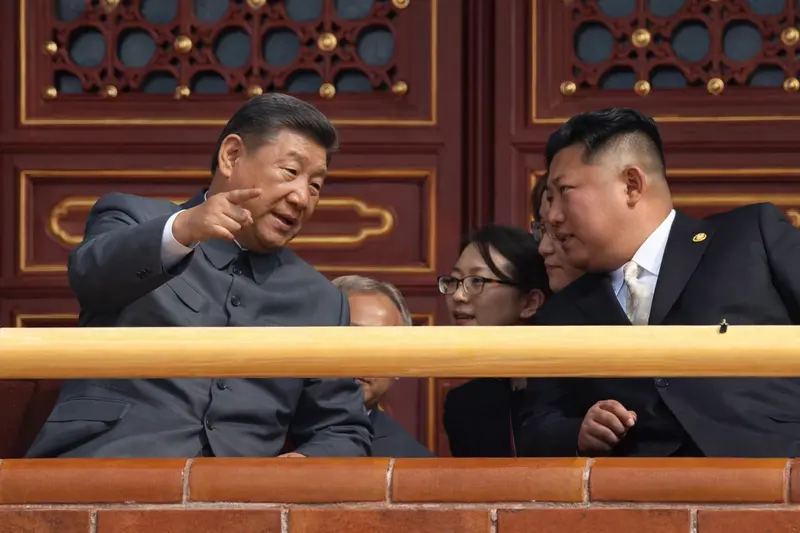
Xi Jinping and Kim Jong‑un in formal discussion during a diplomatic event in Beijing.
Asia
The relationship between China and North Korea is one of the most unique and strategically significant bilateral ties in East Asia. Historically, these ties have encompassed elements of alliance, reliance, competition, and mutual suspicion. Understanding the dynamics of the relationship requires distinguishing between public diplomatic gestures and the deeper strategic considerations at play.
China originally became involved in the Korean War to prevent the fall of North Korea, and it has since remained Pyongyang's most important economic and diplomatic partner.
Beijing provides trade, energy, food assistance, and political support; in return, North Korea functions as a strategic buffer, protecting China from U.S.-allied forces in South Korea.
Beijing provides trade, energy, food assistance, and political support; in return, North Korea functions as a strategic buffer, protecting China from U.S.-allied forces in South Korea.
Yet, the relationship has frequently seen moments of tension. Beijing has at times criticized North Korea’s nuclear tests and supported U.N. sanctions, while North Korea has grown frustrated by Chinese pressure and has continuously sought greater independence. Under Kim Jong Un, North Korea has significantly strengthened its ties with Russia, particularly since 2022, effectively decreasing its strict reliance on China.
Why China Supports North Korea
China maintains its support for the regime due to several core strategic imperatives:
- To prevent a regime collapse that could send a destabilizing wave of refugees across its borders.
- To preserve North Korea as a physical buffer between China and U.S.-allied South Korea.
- To prevent a unified Korea from potentially aligning with the United States.
- To maintain regional influence and counter the strategic power of the United States in East Asia.
Why the Relationship is Strained
Beijing has often been troubled by North Korea’s nuclear tests, missile launches, and provocative brinkmanship. Conversely, North Korea resents Chinese pressure and demands the strategic autonomy to make its own decisions without heavy-handed interference from Beijing. As a result, a baseline of geopolitical tension always underlies the relationship.
The Significance of Leadership Summits
In June 2019, Xi Jinping made a historic state visit to Pyongyang—the first by a Chinese leader in 14 years—marking a return to normalized relations after a prolonged period of tension over North Korea’s nuclear program. On June 8, 2026, Xi again visited North Korea for another major summit, marking his first trip there in seven years. This 2026 visit took place against a backdrop of:
- Deepening military and political ties between North Korea and Russia.
- Growing security cooperation among the United States, Japan, and South Korea.
- The continued expansion of North Korea’s nuclear capabilities.
The Strategic Agendas of the 2026 Summit
The 2026 state visit was marked by full military honors, a grand public welcome, formal talks focused on bilateral ties, and a visit to the Sino-Korean Friendship Tower. Notably, there was a distinct lack of public discussion regarding North Korea’s rising nuclear capabilities.
While the entirety of the closed-door discussions was not made public, there were several clear objectives for both sides during the visit.
China’s Agenda:
- Reasserting influence over North Korea: Beijing was concerned that Pyongyang’s deepening alignment with Russia could diminish China's leverage in Northeast Asia.
- Preserving regional stability: Beijing’s primary concern remains preventing war, regime collapse, or refugee flows on its border. A stable North Korea, even an uncooperative one, is viewed as far better than instability.
- Countering U.S.-led alliances: Strengthening ties with North Korea helps China counter the growing security cooperation between the United States, Japan, and South Korea.
- Expanding economic cooperation: Both sides sought to discuss trade, infrastructure, agriculture, technology, and cross-border collaborations.
North Korea’s Agenda:
- Securing economic support: Severely constrained by international sanctions, North Korea looked to China to boost trade, tourism, investment, and the supply of essential goods.
- Gaining political legitimacy: Hosting Xi provided high-profile international recognition and reinforced Kim Jong Un’s image as a respected global leader.
- Reducing overdependence on Russia: By skillfully balancing its relations between Moscow and Beijing, Pyongyang gains more diplomatic leverage with both.
- Normalizing its nuclear status: North Korea aims for gradual international acceptance as a de facto nuclear power rather than pursuing denuclearization.
Key Revelations of the Visit
- China is prioritizing stability over denuclearization: While Beijing historically supported denuclearization, recent signals suggest it now treats North Korea’s nuclear status as a permanent reality rather than an immediate problem to resolve.
- The relationship remains asymmetric but leveraged: China is far more powerful economically and diplomatically. However, North Korea retains leverage because Beijing fears regional instability far more than Pyongyang fears isolation. This gives Kim the room to resist Chinese pressure.
- China fears losing its grip: A primary catalyst for Xi’s 2026 outreach was the worry that Russia's growing footprint in Pyongyang could crowd out Chinese influence.
- North Korea remains focused on legitimacy: For Kim Jong Un, receiving China’s top leader signaled to the world that North Korea is not isolated and that major global powers will engage with it on its own terms.
Future Implications of North Korea-China Relationship
- Stronger economic engagement: Expect increased cross-border trade, transportation links, tourism, and development programs as both sides seek mutual economic benefits.
- Heightened strategic coordination: China and North Korea are likely to align more closely on regional security, specifically to counter the U.S.-Japan-South Korea alliance.
- Reduced Chinese pressure on denuclearization: While China continues to oppose nuclear escalation, it appears less willing to push disarmament as a precondition for diplomatic engagement.
- A more multipolar Northeast Asia: The visit signaled that regional politics are increasingly shaped by a trilateral dynamic involving China, Russia, and North Korea, rather than Beijing acting as Pyongyang's sole patron.
However, critical questions linger as to whether North Korea’s growing military capabilities will eventually trigger a crisis that China cannot control. Beijing wants a resilient buffer state, but not one whose actions spark a major regional war or an accelerating East Asian arms race.
Summary
Xi Jinping’s 2026 visit was not primarily focused on resolving the North Korean nuclear issue, but rather on rebalancing the power dynamics of Northeast Asia. China aimed to reassert its influence over a partner that has drifted closer to Russia, while North Korea successfully secured economic advantages and political recognition without compromising its nuclear program.
The summit proved that while the China–North Korea relationship remains vital, it is no longer straightforward, and future regional stability will be heavily dictated by this complex geopolitical balancing act.
The summit proved that while the China–North Korea relationship remains vital, it is no longer straightforward, and future regional stability will be heavily dictated by this complex geopolitical balancing act.