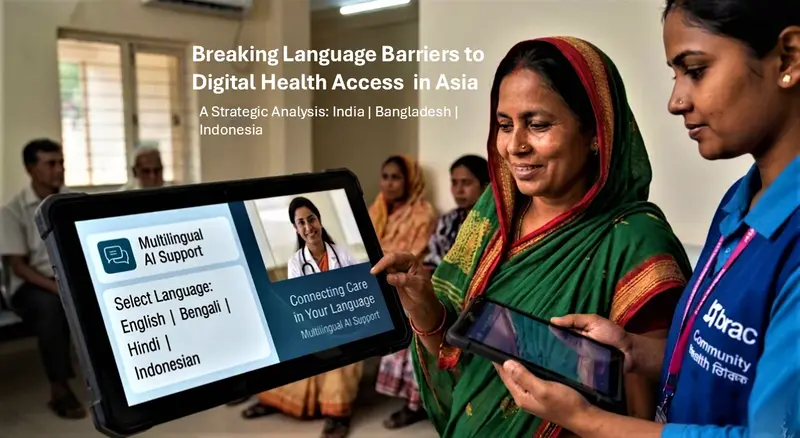
BRAC community health worker showing a multilingual AI digital health tablet interface to a woman in Asia. Image Credits: Kencrave
Asia
How India, Bangladesh, and Indonesia are using multilingual AI to break language barriers in digital healthcare. Key insights, challenges, and a strategic roadmap for health equity.
Executive Summary
The rapid digitization of healthcare services across South and Southeast Asia promises to revolutionize access to medical information and care. However, a pervasive language barrier threatens to widen, rather than bridge, the digital health divide. Globally, an estimated 4.5 billion people still lack access to essential health services, with health systems facing worker shortages, weak infrastructure, and financial barriers (World Bank Group, 2026).
With over 700 languages spoken across Indonesia, 22 scheduled languages in India, and significant regional dialects in Bangladesh, linguistic diversity presents one of the most formidable challenges to inclusive digital health.
This strategic analysis evaluates the role of multilingual artificial intelligence (AI) in reducing language barriers to digital healthcare access in three linguistically diverse nations: India, Bangladesh, and Indonesia.
Key Takeaways:
1. Language and Digital Literacy Remain Primary Barriers to Digital Health Adoption
Across India, Bangladesh, and Indonesia, linguistic diversity and low digital literacy significantly limit patient engagement with digital healthcare platforms. Many users cannot access or benefit from digital health services due to language incompatibility and limited technological familiarity.
2. Multilingual AI Solutions Are Emerging Across the Region
India's BHASHINI, Bangladesh's AmarDoctor, and Indonesia's SATUSEHAT represent a growing ecosystem of multilingual AI tools. These technologies are advancing beyond translation toward voice-enabled, conversational healthcare support that enables direct patient interaction in local languages and dialects.
3. Evidence of Real-World Impact Remains Scarce
While technical performance is promising, there is insufficient evidence that these tools are measurably improving healthcare access or patient outcomes at population level. Rigorous real-world evaluation is essential to determine whether multilingual AI can translate its potential into tangible health benefits.
Multilingual AI holds transformative potential to democratize digital healthcare in Asia. However, its success depends on a deliberate, evidence-driven transition from technological promise to proven, patient-centered impact. The organizations that bridge this gap will likely lead the next wave of health equity innovation.
Why Language Is the Hidden Barrier to Digital Healthcare Access in Asia
The Rapid Expansion of Digital Healthcare in Emerging Economies
Governments and healthcare providers across the globe are accelerating investments in digital health to improve service delivery, lower costs, and reach underserved populations. In India, Bangladesh, and Indonesia, national strategies such as the Ayushman Bharat Digital Mission (ABDM) and Indonesia’s SATUSEHAT are laying the groundwork for a connected, data-driven healthcare ecosystem.
The Unaddressed Language Frontier in Patient Engagement
Despite this progress, a critical success factor has been largely ignored that is linguistic accessibility. A patient’s ability to understand health information, navigate digital interfaces, and communicate symptoms is fundamentally dependent on their native language and dialect. For populations not fluent in dominant languages like English or Bahasa Indonesia, digital healthcare remains out of reach.
A systematic review of 34 studies found that cultural and linguistic factors affect all dimensions of digital health access and uptake, with language barriers, design components, and trustworthiness emerging as key factors (Lara Whitehead et al, 2023).
Comparative Landscape: Digital Health Maturity in India, Bangladesh, and Indonesia
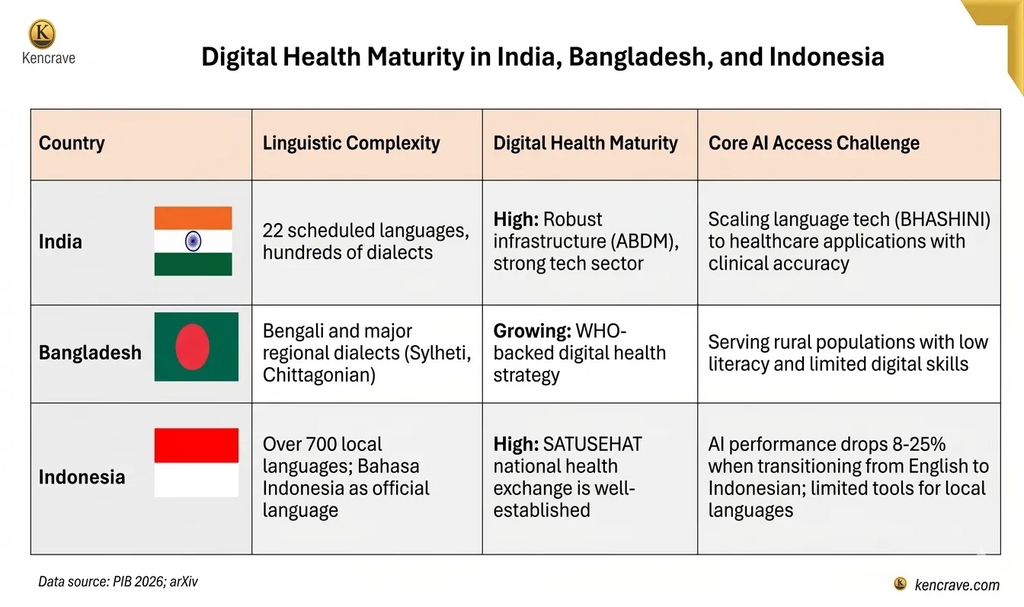
While all three countries face similar linguistic challenges, their digital health infrastructures and AI adoption trajectories differ markedly.
Linguistic complexity, digital health maturity, and AI access challenges in India, Bangladesh, and Indonesia, emphasizing language diversity and healthcare technology readiness.
Beyond Translation: The Multidimensional Nature of Language Barriers
Language barriers in digital health are not just about translation. They involve:
Health Literacy: Difficulty understanding medical jargons, terms and complex instructions.
Communication Gaps: Inability to describe symptoms, ask follow-up questions, or engage with providers.
Navigation Challenges: Struggles with text-heavy, non-voice interfaces.
Trust Deficits: Skepticism about AI-driven tools due to privacy concerns and lack of cultural resonance.
A nationwide survey of Indonesian language communities found that addressing language barriers, particularly through machine translation and information retrieval is the most critical priority. However, concerns around privacy, bias, and the use of public data for AI training highlight the need for greater transparency, (ACL Anthology, 2025).
Mapping the Multilingual AI Ecosystem for Healthcare
Case Studies from India, Bangladesh and Indonesia:
1. India’s BHASHINI: A National Blueprint for Language Technology in Health
India’s BHASHINI initiative is a flagship national language technology platform providing translation, speech-to-text, text-to-speech, and transliteration services across 22 languages. Its recent partnership with the Ministry of Ayush marks a strategic move to embed these tools directly into Ayush digital healthcare services, aiming to make traditional medicine systems accessible to multilingual populations (PIB, 2026).
Emerging Example: BandhuCare is a multilingual AI companion for cancer patients, developed by CMC Vellore and IIIT Hyderabad. It supports eight Indian languages and enables voice-based symptom reporting and patient-provider communication. This represents a clear step beyond normal translation.
2. Bangladesh’s AmarDoctor a Voice-Interactive AI for Primary Care Triage
AmarDoctor is a prime example of a voice-enabled, multilingual AI tool designed specifically for primary care. It supports Bengali and its major dialects (Sylheti, Chittagonian), allowing users to report symptoms via voice and receive triage and specialist recommendations.
Qualitative research exploring how Bengali-speaking users perceived AmarDoctor found that participants viewed the tool positively, particularly for its ability to capture symptoms in multiple Bengali dialects and support access to primary care. However, concerns were raised about potential translation inaccuracies and the risks associated with incorrect medical information (PMID 2025: 41342429).
3. Indonesia’s SATUSEHAT: Digital Health Infrastructure and the Local Language Gap
Indonesia’s SATUSEHAT provides a robust national health information exchange but lacks deep integration with multilingual AI tools.
Research on the IndoRad-VQA dataset found an 8–25 percentage-point gap between English and Indonesian settings when evaluating medical vision-language models, depending on the evaluation metric. This suggests that an AI system performing well in English cannot automatically be assumed to provide equally reliable results in Bahasa Indonesia (Pieter et al, 2025).
The Effectiveness Challenge: Technological Capability vs. Proven Patient Outcomes
Evidence of AI Performance: What the Data Shows
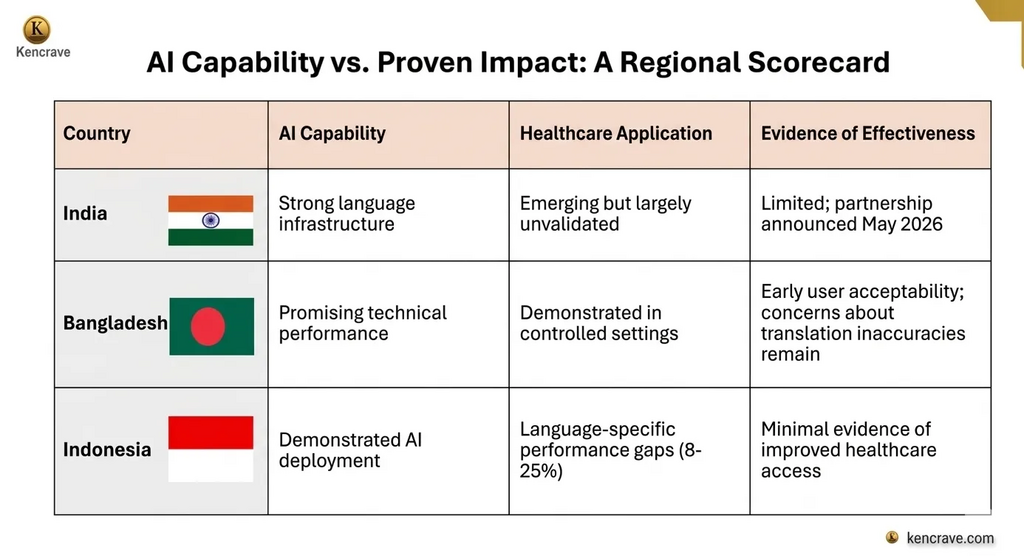
India: Strong capability in language infrastructure; healthcare applications are emerging but largely unvalidated.
Bangladesh: AmarDoctor shows promising technical performance (81% diagnostic precision) and early user acceptability, though limited to controlled settings.
Indonesia: Demonstrated AI deployment but with language-specific performance gaps and minimal evidence of improved healthcare access.
AI capability and healthcare effectiveness across India, Bangladesh, and Indonesia, highlighting language infrastructure, validation status, and regional performance gaps.
The Critical Disconnect: Where Multilingual AI Falls Short on Healthcare Access
Most of the current research focuses on whether the technology works and how well the models perform, not on whether it actually helps patients. There’s almost no evidence showing that these tools have achieved meaningful benefits for real patient outcomes.
Increased digital health platform usage among linguistically underserved populations.
Improved patient understanding of health information.
Reduced health disparities between linguistic groups.
Demonstrated measurable improvements in health outcomes.
This effectiveness gap represents the single greatest risk to the scalability and sustainability of multilingual AI in healthcare.
Navigating the Roadblocks and Strategic Opportunities
Key Challenges Limiting Multilingual AI in Digital Health:
Dialectal Underrepresentation: Major languages are prioritized while regional dialects remain underserved.
Digital Literacy & Infrastructure: Even well-translated content is inaccessible without basic digital skills and reliable connectivity.
Data Privacy & Bias: Concerns about data misuse and algorithmic bias undermines patient trust.
Lack of Real-World Evidence: Most studies are technical pilots, not population-level impact assessments.
Key actions that can speed up the use of AI to improve fairness in healthcare
Voice-First AI Interfaces: Prioritize voice interaction to overcome literacy and navigation barriers. India's BHASHINI initiative has demonstrated voice-enabled doctor-patient prescription generation systems.
Integration with National Health Infrastructures: Embed multilingual AI into existing platforms like ABDM and SATUSEHAT rather than creating siloed solutions. The Ministry of Ayush-BHASHINI partnership exemplifies this approach.
Invest in Local Language Healthcare Data: Build high-quality, de-identified datasets in local languages and dialects. The BHASHINI initiative includes focused efforts to develop domain-specific multilingual terminology systems and strengthen Ayush language datasets
Community-Co-Creation: Involve patients, healthcare workers, and linguists in the design and evaluation process. The AmarDoctor co-production pathway included Bangladeshi communities in Birmingham, UK, to understand contextual acceptability.
Mandate Real-World Impact Studies: Investors and governments must demand and fund research that measures the actual, population-level impact of these tools. This will separate hype from proven efficacy and guide future investment.
Risks and Mitigations in Multilingual AI Deployment in Healthcare
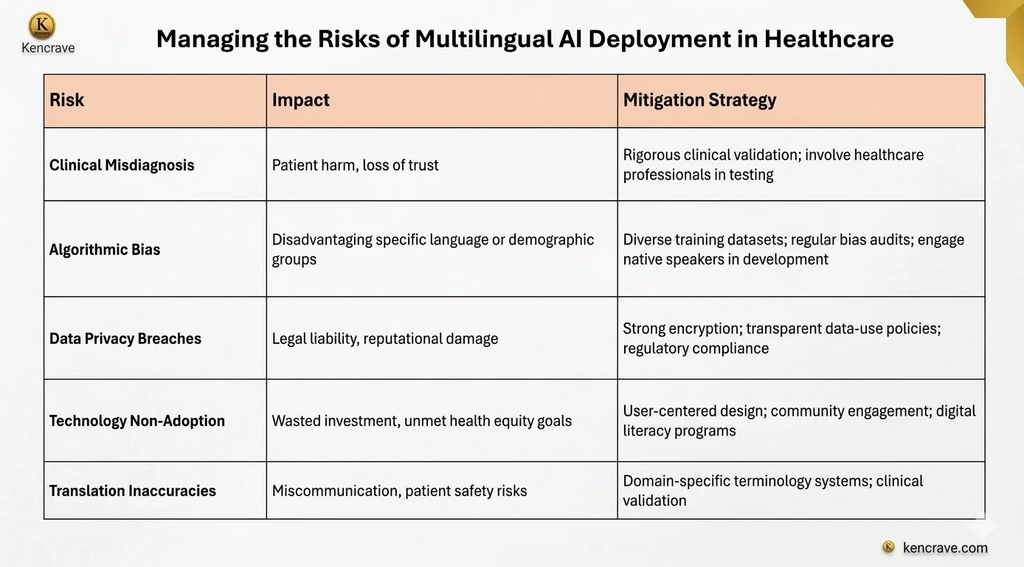
Multilingual AI could help more people access digital healthcare. But when these tools are used in real medical settings, they come with real risks. For example, they could give wrong medical advice, expose private patient data, treat some groups unfairly, or be ignored by users.
These problems can destroy trust, make health inequalities worse, and stop these technologies from doing what they were built to do. That's why it's critical to manage these risks carefully, openly, and systematically. Only then can multilingual AI be safe, fair, and trusted by the communities it's meant to help.
Key risks, impacts, and mitigation strategies for multilingual AI in healthcare in covering clinical misdiagnosis, algorithmic bias, data privacy, technology adoption, and translation accuracy.
The Bottom Line: From AI Potential to Population-Level Impact
AI that works across many languages isn’t just about having cool features. It’s essential if we want digital healthcare to include everyone.
India, Bangladesh, and Indonesia are making significant strides, but the industry stands at a crossroads. The choice is between continuing to develop impressive but unproven technologies and committing to a rigorous, human-centered path that demonstrates real, measurable improvements in healthcare access and equity.
As the World Bank Group emphasizes, the real promise of AI lies not in algorithms, but in healthier people, stronger systems, and more equitable care (World Bank Group, 2026).
Strategic Roadmap for Governments, Healthcare Providers and Tech Developers, and Investors
For Governments and Policymakers:
Fund outcome-based pilot programs with clear health equity metrics.
Create standards for collecting and sharing local-language healthcare data.
Support dialectal AI development through targeted grants and public-private partnerships.
For Healthcare Providers and Tech Developers:
Adopt a voice-first, multilingual approach as a core design principle.
Co-create solutions with end-users that includes patients, nurses, and community health workers.
Prioritize integration with national digital health infrastructures to maximize reach.
For Investors:
Shift due diligence from technical metrics (BERTScore) to patient-centered outcomes.
Choose tools that work well with others and can scale, instead of isolated apps that can’t integrate or expand.
Invest in digital health companies with clear strategies for clinical validation, bias mitigation, and data privacy.
This strategic analysis is based on secondary research from World Bank, WHO publications, government sources, academic studies, and industry reports. Sources