A concept image of astronauts on Mars, planting China’s flag, where courage, technology, and cosmic wonder unite on the red frontier symbolizing Asia's growing dominance in Space Exploration. Image Credits: Kencrave
Asia
Asia’s space race is rapidly accelerating, ushering in a new chapter in the global contest for space leadership. Driven by a potent mix of technological ambition, geopolitical strategy, and economic incentives, China, India, and Japan are investing heavily in their space programs. This surge marks a pivotal phase in the global quest to explore and utilize space, with significant long-term implications.
Asia vs. the West: Who Leads the New Space Race?
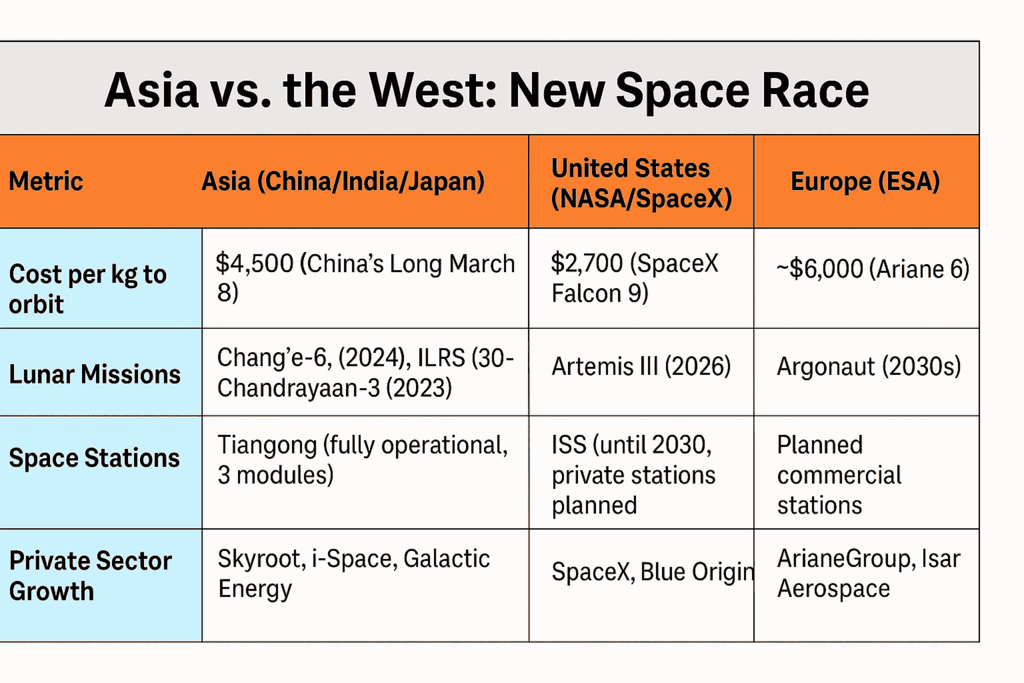
A comparative overview of key space capabilities reveals the growing competitiveness of Asia’s spacefaring nations.
A Comparative Table of Asia vs U.S.A and Europe in Space Exploration with Key Metrics
"While Asia is narrowing the gap in launch cadence and mission diversity, the United States still leads in reusability and deep-space exploration." Dr. Radhika Iyengar, Space Policy Fellow, Institute of Strategic Studies "India and Japan are playing pivotal roles in setting norms and collaborative frameworks, an often-understated dimension of space leadership." Kenji Tsubaki, Senior Analyst, Asia-Pacific Space Security Forum
China, India, Japan: The New Space Titans China
China continues to assertively expand its space program. The Tiangong space station, now fully operational, marks a significant milestone in long-duration human spaceflight. China is also advancing plans for a crewed lunar base by the 2030s in collaboration with Russia under the International Lunar Research Station (ILRS) initiative.
"China’s trajectory in space mirrors its terrestrial strategy, long-term investments with strong state backing," says Liu Zhen, Aerospace Analyst at the Beijing Institute for Space Policy.
India
India maintains a pragmatic yet ambitious posture. Its Chandrayaan-3 mission achieved the world’s first successful landing near the lunar south pole in 2023. India is simultaneously developing its Gaganyaan human spaceflightprogram and participating in NASA's Artemis Accords.
Japan
Japan offers a distinctive contribution focused on governance, robotics, and security. Its SLIM mission demonstrates precision lunar landing technology, while the H3 rocket is being refined to ensure greater cost-efficiency. Japan also plays a central role in debris mitigation through projects like ADRAS-J, aimed at removing orbital debris.
Comparative Timeline Visual of Key Mission Milestones in Space Race (2023–2040)
Technological Breakthroughs & Practical Impact
Across the region, a series of space technology achievements underscore growing capabilities:
China: Tiangong enables extended human presence in orbit; launch infrastructure supports high mission frequency.
India: Chandrayaan-3 success on a limited budget enhances its reputation for cost-effective innovation.
Japan: SLIM and the H3 rocket reflect advances in precision landing and cost-efficient access to space.
Technologies such as reusable launch vehicles, AI-based spacecraft operations, and next-gen satellite constellationsare already delivering real-world benefits:
High-speed internet access in rural India and Indonesia.
AI-powered disaster prediction for regions like the Mekong Delta.
Reduced cost to orbit through partial reuse of launch components.
The Orbital Economy: Asia’s $1 Trillion Opportunity, Market Trends and Projections
Asia’s space economy is expanding rapidly. Government space agencies now coexist with a growing cadre of startups and commercial ventures:
Key Trends & Metrics:
India’s NSIL reported ₹2,940 crore (~$350 million) in revenue for 2022–23, operating 15 communication satellites and overseeing over 120 international satellite launches, New Space India Limited (NSIL) 2023 Report.
China boasts over 430 commercial space firms, with its space economy forecast to reach $900 billion by 2029, (China Briefing).
The Asia-Pacific small satellite market is projected to reach$17.8 billion by end of 2025 and USD 34.11 billion by 2030, growing at a CAGR of 13.89% during this period, Space & Satellite Professional International (SSPI).
Japan’s space industry was valued at $8.6 billion in 2024, with rising private and public investment.
Space tourism in Asia, while nascent, is growing at 20% CAGR and may evolve into a multibillion-dollar segment by the 2030s.
"Asia’s space economy is transitioning from government dominance to a hybrid model where public-private synergy drives innovation," notes Shreya Mehta, Investment Strategist at Orbit Ventures, Singapore.
Challenges: Can Asia Sustain Its Momentum?
Despite notable progress, key challenges could limit Asia’s trajectory:
Geopolitical Tensions: U.S.–China competition may restrict access to critical technologies and collaborative frameworks.
Orbital Debris: Asia contributes approximately 40% of new orbital debris; mitigation efforts like Japan’s ADRAS-J are essential but nascent.
Budget Limitations: India’s space budget remains about 7% of NASA’s, limiting mission scope and frequency.
Lack of Unified Policy: Unlike the European Space Agency or U.S. FAA, Asia lacks a regional regulatory body or policy framework.
Strategic Roadmap: How Asia Can Lead the Next Space Era
Governments
Establish comprehensive, transparent regulatory frameworks to promote investment and innovation.
Invest in education and STEM workforce development tailored to space industry needs.
Encourage regional cooperation via data-sharing, mission coordination, and standards harmonization.
Private Sector
Develop dual-use technologies that serve both civil and defense applications.
Collaborate across national boundaries on shared challenges like debris mitigation and rural connectivity.
Focus on commercially viable downstream services such as precision agriculture, logistics tracking, and environmental monitoring.
Investors
Target high-growth sectors such as reusable launch systems, Earth observation, and in-orbit servicing.
Leverage public co-investment schemes to mitigate risk and catalyze innovation.
Monitor regulatory shifts that may impact long-term ROI and cross-border expansion.
Can Asia Redefine the Future of Space Exploration?
Asia is reshaping the global space race with a pragmatic, technologically advanced, and economically grounded approach. From China’s lunar ambitions to India’s cost-effective missions and Japan’s governance leadership, the region is carving out a multifaceted role in space.
If current trends hold, and challenges are proactively addressed, Asia could not only match but lead in several strategic space domains, redefining how humanity explores, exploits, and governs the final frontier.


.jpg)