
Asia
How Myanmar SMEs can cut waste without capital: a low‑cost lean guide for a conflict economy built on 5S, visual management, and self‑reliant kaizen.
EXECUTIVE SUMMARY
Lean manufacturing, born from Toyota's response to post-war resource scarcity, offers Myanmar's SMEs a proven roadmap to competitiveness without heavy capital investment. Yet lean awareness has spread faster than implementation capacity.
Japanese-linked programs (JICA, MPC, AOTS, MJC) trained thousands, but only nine MPC model companies received the hands-on coaching that actually changes factory floors. As of 2018, MJC alone reached nearly 15,000 participants, with about 20% of content on kaizen, yet no follow-up mechanisms existed.
Japanese-linked programs (JICA, MPC, AOTS, MJC) trained thousands, but only nine MPC model companies received the hands-on coaching that actually changes factory floors. As of 2018, MJC alone reached nearly 15,000 participants, with about 20% of content on kaizen, yet no follow-up mechanisms existed.
The regional comparison makes the argument even clearer. Among CLMV economies, Myanmar's manufacturing contributes just 0.11% globally, with GDP contracting 2.0% in 2025 and an infrastructure reliability score of 41.
Cambodia (0.03%, 5.3% growth, score 45) and Laos (0.01%, 4.5%, score 39) share similar constraints. In contrast, Vietnam (0.64%, 8.0%, score 77) demonstrates the mature trajectory Myanmar could pursue. Myanmar's manufacturing remains 22.5–25.1% of GDP, concentrated in CMP garments.
Cambodia (0.03%, 5.3% growth, score 45) and Laos (0.01%, 4.5%, score 39) share similar constraints. In contrast, Vietnam (0.64%, 8.0%, score 77) demonstrates the mature trajectory Myanmar could pursue. Myanmar's manufacturing remains 22.5–25.1% of GDP, concentrated in CMP garments.
SMEs should sequence adoption: begin with 5S, visual management, and hand-drawn value stream maps. These are minimal-capital tools. Target overproduction from weak buyer leverage, waiting from power instability, and defects from inconsistent inputs. Conduct financial analysis to determine cash buffers before cutting inventory, since stockpiles often serve as informal collateral.
Two human factors determine success: high power distance and post-2021 labor volatility. Thailand's evidence confirms waste minimization drives SME gains.
ORIGINS AND CORE PRINCIPLES OF LEAN MANUFACTURING
Lean manufacturing is a production philosophy and set of methods aimed at maximizing value for the customer while minimizing waste of time, materials, effort, and money. It originated primarily from the Toyota Production System (TPS), developed in Japan after World War II, and was later formalized and popularized in the West under the name "lean" in the 1990s.
The Five Core Principles of Lean
- Identify value from the customer's perspective.
- Map the value stream and trace every step a product goes through, separating value-adding steps from waste.
- Create flow for smoother processes without interruptions or bottlenecks.
- Establish pull; produce based on actual demand, not forecasts (the logic behind just-in-time production; JIT).
- Pursue perfection; lean is not a one-time project, it is a commitment to continuous improvement (Kaizen).
Why Lean Fits Resource-Constrained Economies
Lean is often associated with large automotive plants, but its core ideas of eliminating waste, respecting people, improving continuously, scale down well. Lean was born as a response to extreme resource scarcity in post-war Japan. For Myanmar's small and medium enterprises (SMEs) working with tight budgets, limited technical staff, and inconsistent infrastructure, the key is picking low-cost, high-impact tools first and building capability gradually rather than attempting a full Toyota Production System overnight.
LEAN MANUFACTURING IN MYANMAR: INSTITUTIONAL ENTRY AND EARLY DEVELOPMENT
A Springer volume published on kaizen dissemination in Southeast Asia (2020) describes Myanmar as a genuinely early-stage industrial economy rather than a maturing manufacturing base. Lean's entry into Myanmar was institutional and Japan-led, particularly after the country's 2011 political opening.
A Donor-Led, Japan-Linked Introduction
Lean/kaizen presence in Myanmar is not one program but at least four separate channels, mostly linked to Japanese government cooperation.
The Four Main Channels of Lean/Kaizen Dissemination
- MPC - Myanmar Productivity Center (2016). Three certified kaizen consultants, three candidate consultants, and nine "model companies" each received three factory consultations from the Japan Productivity Center. This program eventually expanded.
- MJC - Myanmar-Japan Center for Human Resource Development (2013). Backed by JICA-RI (Japan International Cooperation Agency–Research Institute), MJC delivered roughly 400 training courses and seminars to nearly 15,000 participants over five years, mostly from Myanmar SMEs. About 20% of that content specifically covered Japanese-style management and kaizen.
- JICA - Ministry of Industry 5S Seminars (2018). A targeted push on the most foundational lean tool, run directly with the government.
- AOTS - Association for Overseas Technical Cooperation and Sustainable Partnerships. Operating since 1959, AOTS has sent about 2,000 Myanmar trainees to Japan and trained roughly 6,000 inside Myanmar. A major share focused on kaizen and 5S. This predates the 2011 opening entirely, meaning some kaizen exposure existed even during the market isolation period (1996–2013), though at a much smaller and likely elite/state-enterprise scale.
The Implementation Gap: Awareness Without Adoption
Overall, lean/kaizen presence in Myanmar is institutionally driven and donor-dependent, concentrated almost entirely around Japanese cooperation agencies (JPC, JICA, AOTS) rather than organic market demand or private consulting markets.
- MPC created a few model companies with deep engagement in lean practices.
- MJC expanded lean manufacturing efforts through broad management training. However, because there were no follow-up visits, factory engagement, or mechanisms to track whether participants applied what they learned, the impact remained limited.
This gap is well documented in the training and development literature: large seminar-style training is excellent for introducing ideas but almost never leads to real change on the factory floor.
Awareness is easy and cheap to create; implementation is hard and requires hands-on coaching, repeated visits, and time. Precisely, these are elements that only the nine MPC companies actually received.
Absence of a Commercial Lean-Consulting Market
At present, everything documented is either NGO/academic (LEANGO), bilateral government cooperation (JICA, JPC, AOTS), or isolated private pioneers. There is no sign of a commercial lean-consulting industry serving Myanmar SMEs the way more mature Southeast Asian markets such as Thailand and Vietnam have.
MYANMAR IN THE REGIONAL MANUFACTURING LANDSCAPE
Why Compare Myanmar with Cambodia, Laos, and Vietnam?
Myanmar can be compared to its immediate neighbors in the CLMV group: Cambodia, Laos, and Vietnam. These are developing nations in Southeast Asia with similar economies and are relevant benchmarks for a low-cost lean manufacturing strategy.
The CLMV countries are transitioning from agrarian to manufacturing-based economies with heavy reliance on labor-intensive sectors. They face challenges attracting foreign direct investment (FDI) and integrating into global supply chains, often starting from a position of low-cost labor. SMEs are key pillars of these economies.
Cambodia: Shared Garment-Sector Challenges
Cambodia and Myanmar are both concentrated in garments and textiles, sharing most operational challenges and opportunities.
- Competitive positioning: Cambodia and Myanmar have the lowest operating costs among Asian manufacturing hubs but lag in competitiveness.
- Weak financial ecosystem: A 2025 study in the international Journal of Economics and Finance evidenced that collateral requirements hinder SME access to capital—a similar situation for SMEs in Cambodia.
Laos: A More Rural, Necessity-Driven Economy
Laos, though in the same CLMV category, has a far more rural, production-for-personal-use economy and a larger share of necessity-based entrepreneurs, making it quite different from Myanmar's more urban, garment-centered industrial structure.
Vietnam: The More Mature Industrial Trajectory
Vietnam offers a clear picture of a more mature industrial trajectory. It has moved much further along the path of industrialization, maintaining the third-lowest operating costs among nine countries in Asia, just behind Cambodia and Myanmar. Vietnam is now positioned in a more advanced manufacturing tier as it strengthens its supply chains and begins adopting automation.
Myanmar, Cambodia, Laos and Vietnam Economic Indicators at a Glance
The following table benchmarks Myanmar against its CLMV peers across four indicators that directly shape lean feasibility: manufacturing contribution, GDP growth, quality infrastructure, global contribution, labor cost, labor capability and political risk.
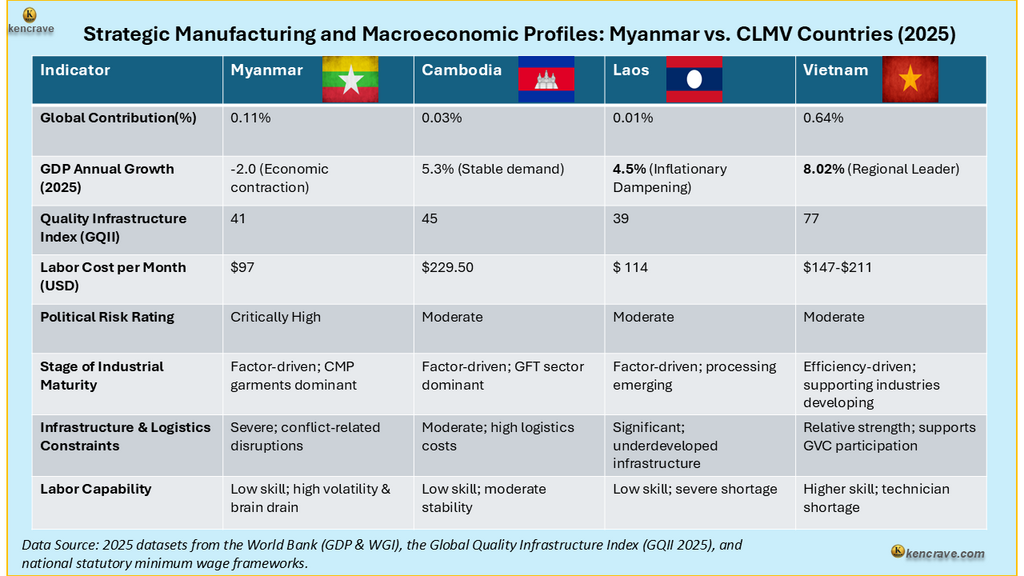
Key Insight: The comparative landscape confirms that Myanmar's SMEs don’t simply lag their neighbours. They operate in a distinct environment of higher risk and greater resource scarcity.
Myanmar's Structural Position: Labor-Intensive, CMP-Dominated Manufacturing
While Myanmar's total industry sector grew to contribute 36.2%–37.8% of gross value added by 2024–2025, the manufacturing component (roughly 22.5%–25.1% of GDP) remains heavily concentrated in labor-intensive garments under the Cut-Make-Pack (CMP) system. It has structurally struggled to transition toward advanced manufacturing ecosystems with deep, established local supply chains like automotive component production.
Typical Constraints Facing Myanmar's Manufacturing SMEs
Most manufacturing SMEs in Myanmar operate with:
- Limited capital for machinery or automation.
- Thin management layers, often owner-operated.
- Low bargaining power with international buyers, leading to defensive overproduction and excess inventory.
- Inconsistent infrastructure (power reliability, logistics).
- Minimal exposure to formal lean/kaizen training outside of donor-dependent programs (JICA, Japan Productivity Center, AOTS, academic-NGO pilots) rather than commercially self-sustaining ones.
Lean manufacturing is highly relevant to Myanmar because its core philosophy, shaped by Toyota in post-war Japan, was built as a response to extreme resource scarcity. The challenge, however, is not whether lean fits Myanmar's case, but how a typical SME can realistically adopt it when it has no consulting budget, no quality department, and an owner who also serves as general manager.
The question becomes: what does credible, sustainable lean adoption look like under these constraints?
A REALISTIC LEAN ADOPTION PATHWAY FOR MYANMAR SMES
The following principles are derived directly from what has and has not worked in Myanmar's documented pilots (LEANGO 2016, MPC model-company program).
Guiding Principle: Sequence Before Scope
Adoption must be staged, starting with tools that require little to no capital. Simple check sheets, Pareto charts, and root-cause "5 Whys" sessions can be run on a whiteboard as there is no software needed and catch recurring defects early.
Start with Paper-Based Value Stream Mapping
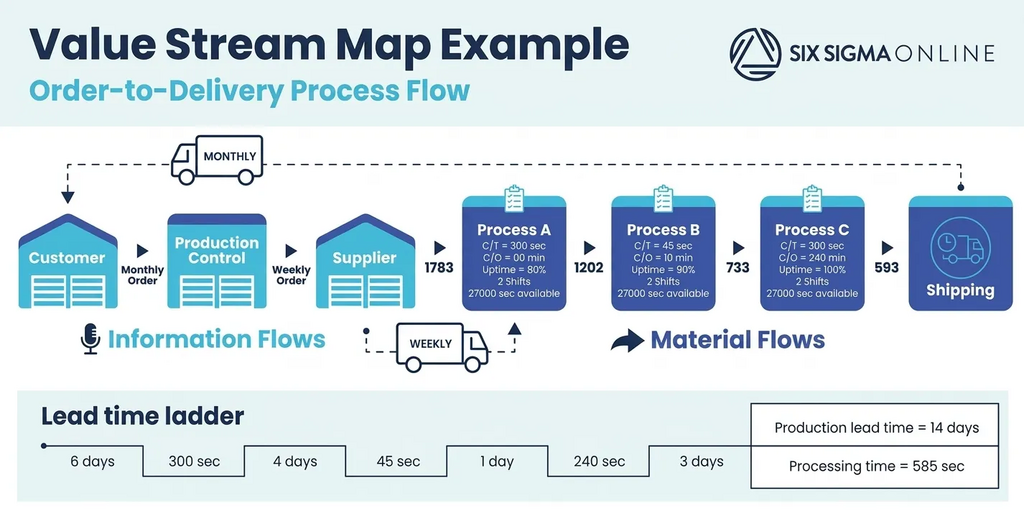
A simple hand-drawn value stream map of one product line shows where materials sit, how long each step takes, and where bottlenecks are. This step often reveals major process time waste (waiting, transport, overproduction) and costs just a day of observation.
Use Visual Management Instead of Digital Systems
Kanban cards, color-coded bins, and whiteboards for production tracking work well where ERP software or barcode scanners are not affordable or reliable. This is a real constraint given Myanmar's infrastructure and connectivity issues in many regions.
Target the Locally Dominant Wastes
Myanmar's SMEs face a distinctive pattern of waste:
- Overproduction and excess inventory, largely driven by weak buyer leverage
- Waiting time, often caused by power outages or delayed inputs
- Defects and rework, frequently stemming from inconsistent raw material quality
The Inventory–Cash Flow Trap: Why Financial Analysis Must Come First
In Myanmar's inflationary, credit-starved economy, finished goods inventory often doubles as informal collateral or a fallback payroll fund. Cutting inventory without first building a dedicated cash reserve of roughly one to two months of operating expenses can turn lean management into a potential insolvency trigger.
Therefore, the first kaizen step for tackling overproduction is not physical reduction but financial analysis that enable in distinguishing strategic buffer stock (needed because of forex and import volatility) from defensive fear-driven stock (accumulated due to buyer uncertainty). Cut overproduction only after confirming that cash flow is stable.
Implement 5S as the Foundation
5S is nearly free and builds discipline: Sort, Set in Order, Shine, Standardize, Sustain. It requires only labels, paint, and a few hours of shop-floor time. It typically surfaces the most obvious waste (searching for tools, wasted motion, unsafe clutter) and gets workers used to continuous improvement without capital investment.
Substitute People-Time for Machine Investment
Myanmar is a developing country with a low labor cost and labor-intensive base. The highest-leverage moves are therefore procedural and behavioral, not capital. SMEs should prioritize interventions that use people time creatively to compensate for limited machinery, automation, and technical departments. The following actions illustrate what this looks like:
- SMED-Lite Changeover Improvements: Pre-staging tools and materials before a changeover, and separating tasks that can be done while the machine is still running from those that require stopping it, can meaningfully cut downtime.
- Workstation Layout Redesign: Re-arranging a workstation layout reduces worker transportation time and movement per cycle. Evidence from LEANGO suggests that the biggest wins available to a cash-constrained SME come from how people work, not what equipment they use.
- Manual Material Risk Board: Since raw material imports from China and Thailand are subject to border closures, forex shortages, and customs delays, flow-based production is often impossible. SMEs should dedicate a physical whiteboard to tracking Critical Imported Materials, enabling them to manage the supply chain and protect against import delays.
- Borrow Institutional Infrastructure: Given the near-total absence of a commercial lean-consulting market, SMEs should route through existing donor/government channels (MPC, JICA-linked programs) rather than trying to import expensive private consultants.
- In-House Employee Development: For sustainability, SMEs should train a few of their best employees rather than everyone at once for example by sending 2–3 supervisors to lean training. Having them practice their training in-house is cheaper and builds internal ownership.
HUMAN AND CULTURAL FOUNDATIONS FOR LEAN IN MYANMAR SMES
The tools above that are the 5S, VSM, and Kanban, are key structural items. Their effectiveness in Myanmar depends on addressing two specific human factors.
Hierarchy and High-Power Distance: The Challenge of Bottom-Up Kaizen
Myanmar's workplaces operate with high power distance, meaning junior staff rarely challenge or correct their supervisors. Without a safe way to surface problems, kaizen turns into a top-down directive instead of a bottom-up improvement engine.
Recommendation: SMEs could pair 5S with a mandatory weekly 15-minute circle meeting where supervisors are trained to use open-ended prompts (such as "What slowed you down today?") and are explicitly barred from punishing candid feedback. The aim is to decouple problem-finding from blame.
Post-2021 Labor Volatility and the Need for Visual Job Aids
Frequent turnover driven by emigration, conscription, and political instability causes 5S routines to break down within weeks.
Recommendation: SMEs could introduce a 5S One-Page Visual Job Aid that is a laminated, image-based guide placed at every workstation. This enables new employees to learn sorting, setting, and standardizing in under two hours, ensuring the system remains intact even when the original 5S practitioners leave.
RISKS AND LIMITATIONS OF LEAN MANUFACTURING IN SMES
Dependence on External Support vs. Internal Champions
Historically, only a handful of Myanmar firms have received deep, sustained lean coaching. An SME cannot assume ongoing external support will be available, so internal champion development is not optional, but it is the primary sustainability mechanism.
Pull Logic vs. Defensive Stockpiling
Lean's pull-based logic clashes with the defensive stockpiling habits common among Myanmar SMEs, who often hold excess inventory to protect against cancellation risk in low-leverage buyer relationships. Fixing this tension requires more than a lean tool; it may also demand changes in buyer contracts or relationship norms, because process improvements alone cannot fully overcome the underlying commercial risk.
Infrastructure Constraints: Power, Logistics, and Digital Limits
Power outages and logistics unpredictability constrain reliance on digital/visual systems that assume consistent operating conditions. Paper-based and physical visual management remain more robust choices in this context.
Lean as Mindset, Not Technology
Lean carries a collective risk: it is fundamentally a mindset and a set of disciplined habits, not a technology you can buy. The SMEs that succeed are typically those where leadership models the behavior early participating in 5S, joining problem-solving sessions, and showing that lean is worth the effort. When workers see leaders practicing lean themselves, they trust that the process matters and commit their time to it.
Evidence from Thailand: Waste Reduction as the SME Advantage
Rahman, Laosirihongthong, and Sohal (2010) compared the operational returns of lean practices across different organizational scales in Thailand's manufacturing sector. Just-in-time production was highly significant for large enterprises, while waste minimization delivered the most substantial performance gains for small and medium-sized firms.
The practical reading is that SMEs do not get their performance gains from the same place large firms do. Large enterprises can buy their way into reliable supplier networks, forecasting systems, and integrated scheduling software. For a resource-constrained SME, this is not easily purchasable.
SMEs, by contrast, tend to see the benefits of lean mainly in waste reduction. These gains come from low-cost, behavior-driven, shop-floor practices such as cutting overproduction, defects, and unnecessary motion. They rely far more on daily discipline and worker buy-in than on capital investment.
Leadership modeling lean habits early is not just good management practice. It is also the most reliable, evidence-based way for SMEs to capture the one lean benefit they are truly positioned to achieve: waste reduction. When leaders visibly participate, workers see lean as legitimate and worth their effort, which is what makes the discipline stick.
The Illusion of Donor-Funded Progress
Donor-funded training often creates an illusion of progress, since programs like JICA and AOTS measure attendance rather than real implementation. The danger is that an SME owner joins a free seminar, believes they have learned all about lean manufacturing, and returns to the factory with no follow-through.
Solution: Financial discipline by setting a small monthly budget (e.g., 50,000 MMK) as a performance bonus for an internal Kaizen Champion, tied directly to documented 5S audits. This keeps the SME's lean journey independent of donor cycles and forces the owner to treat lean as a paid business priority rather than a free extracurricular item.
RECOMMENDATIONS FOR KEY SME PLAYERS
For SME Owners and Managers
- Start with value-stream mapping and 5S independently within a short term, without waiting for external program selection. This improves both immediate performance and the odds of being selected for MPC-style deep engagement later.
- Designate one non-owner "Kaizen Champion" early, so process discipline does not collapse if the owner is unavailable or the firm loses access to donor support.
- Track and document overproduction/inventory costs. Since this is the most common high-leverage local waste category, use it as the first kaizen target rather than a generic checklist.
For International Buyers Sourcing from Myanmar SMEs
- Where feasible, offer longer-term order commitments or cancellation-penalty structures for suppliers demonstrating lean practices. This directly addresses the root cause of defensive overproduction, which is otherwise a rational response to buyer-side risk that no amount of internal kaizen fully solves.
CONCLUSION: SEQUENCING, DISCIPLINE, AND SELF-RELIANCE
The Consistent Pattern: Awareness Ahead of Capacity
Across LEANGO's 2016 pilot, MPC's small cohort of model firms, and MJC's broad-but-shallow seminar reach, the pattern is consistent: Myanmar has spread awareness of lean far faster than it has built the capacity to implement it.
A 12–18 Month Adoption Framework
Effective strategy therefore requires sequencing:
- Months 1–6: Start with 5S, visual management, and hand-drawn value stream maps.
- Months 6–12: Focus on the waste types that actually dominate Myanmar's context—overproduction from weak buyer leverage, waiting time from power instability, and defects from inconsistent inputs.
- Months 12–18: Substitute disciplined behavioral change for machinery investment, since lean was designed for labor-intensive, capital-scarce environments.
- Year 2: Add digital-lite adoption using free platforms like WhatsApp and Google Sheets.
The principle remains constant: build behavioral consistency first and only add the next tool once the current one runs smoothly without management oversight.
Evidence from Comparable Economies
Evidence from comparable Southeast Asian economies reinforces this direction. Rahman, Laosirihongthong, and Sohal's (2010) study of Thai manufacturers shows that waste minimization is the lean construct most strongly linked to SME performance, validating what Myanmar's constraints already imply. SMEs win by cutting waste on the floor, not by buying their way into advanced systems built for larger firms.
Bottom Line: Habits Before Tools, People Before Systems
Ultimately, lean is not a technology purchase but a mindset and a set of habits. Its success or failure in Myanmar SMEs will hinge on:
- Whether leadership is willing to model that discipline early.
- Whether internal champions are cultivated so progress does not depend on continued donor support.
- Whether buyers are willing to share responsibility for the very risk structures that drive defensive overproduction in the first place.
None of this requires large-scale resources. It requires sustained attention, realistic sequencing, and the willingness to treat small, repeatable wins as the foundation for a lean capability that can eventually stand on its own—independent of the institutional scaffolding that has, so far, been the only thing holding it up.
FAQs: Lean Manufacturing for Myanmar SMEs
1. Can lean manufacturing work in Myanmar without consultants or donor funding?
Yes. The core tools that are 5S, value stream mapping, and visual management, require no external expertise and no capital investment.
2. What is the single first step an SME should take?
Implement 5S at one workstation. It is nearly free, builds discipline, and surfaces the most obvious waste immediately.
3. How much does it cost to start lean in a Myanmar SME?
Typically under $100 for labels, paint, and a whiteboard. The real investment is 2–3 hours per week of shop-floor time.
4. Should I reduce inventory if my buyers might cancel orders?
Not immediately. Secure 1–2 months of operating cash reserves first, then separate strategic buffer stock from defensive panic stock.
5. How long before I see results?
Visible 5S improvements appear within 4–6 weeks. Full lean capability. where discipline persists without supervision, takes 12–18 months.
Key Terms with Definitions
- 5S: Sort, Set in Order, Shine, Standardize, Sustain, a foundational workplace organization method.
- AOTS: Association for Overseas Technical Cooperation and Sustainable Partnerships.
- CMP: Cut-Make-Pack, a garment production system where the buyer supplies materials and the manufacturer provides labor.
- JICA: Japan International Cooperation Agency.
- JIT: Just-in-Time, producing only what is needed, when it is needed.
- Kaizen: Continuous improvement.
- Kanban: A visual scheduling system that signals what to produce, when, and in what quantity.
- LEANGO: A lean manufacturing NGO pilot program referenced in the analysis.
- MJC: Myanmar-Japan Center for Human Resource Development.
- MPC: Myanmar Productivity Center.
- SMED: Single-Minute Exchange of Die, a method for reducing changeover times.
- SME: Small and Medium Enterprise.
- TPS: Toyota Production System.
- VSM: Value Stream Mapping.
References
This analysis is based on documented pilots, regional comparisons, and evidence from comparable Southeast Asian economies. It is intended as a practical guide for SME owners, managers, donors, and international buyers operating in Myanmar's manufacturing sector.
- Homma, T., "Kaizen Dissemination Through the Government and Private Sector in Southeast Asia: A Comparative Study of Malaysia, Indonesia, and Myanmar," Springer, 2020.
- Rossi, M., Luglietti, R., Donnici, G. & Aung, M.K., "Lean Project Boosts Sustainable Development in Myanmar," Planet Lean, September 2016.
- Rahman, S., Laosirihongthong, T. & Sohal, A.S., "Impact of Lean Strategy on Operational Performance: A Study of Thai Manufacturing Companies," Journal of Manufacturing Technology Management, Vol. 21 No. 7, pp. 839–852, 2010.
- World Bank, "Worldwide Governance Indicators (WGI) 2026," September 2026.
- Mesopartner, "Global Quality Infrastructure Index (GQII) 2025," December 2025.
- World Bank, "Myanmar Economic Monitor," 2025.
- JICA, "Myanmar-Japan Center for Human Resource Development: Project Completion Evaluation Report," February 2016.
- United Nations Development Programme (UNDP), "Stitches of Struggle and Hope: The Realities of Garment and Apparel Workers in Myanmar," June 2025.
- S&P Global, "Myanmar Manufacturing PMI," May 2026.
- Asian Development Bank, "Asian Development Outlook April 2026," April 2026.