
Asia
The Evergrande liquidation represents the largest corporate failure in Chinese history, with ripple down effects still unfolding across the property sector and global credit markets. Hui's life sentence, alongside the prosecution of over 50 executives, establishes a new enforcement precedent that prioritizes financial stability over individual wealth or political connections. For international investors, the case fundamentally rewrites the risk management for Chinese real estate, demanding enhanced scrutiny of regulatory alignment and social impact alongside traditional financial metrics.
Key Summary Insights:
- Hui Ka Yan received a life sentence for orchestrating an $80 billion fraud that concealed Evergrande's true debt, leading to the $300 billion collapse of China's largest property developer.
- Beijing's "Three Red Lines" policy deliberately forced Evergrande into insolvency, signaling that regulatory compliance now trumps the "too big to fail" doctrine in China.
- The Evergrande crisis marks a permanent shift away from real estate-led growth, with lasting economic fallout for millions of homeowners and new regulatory risks for global investors.
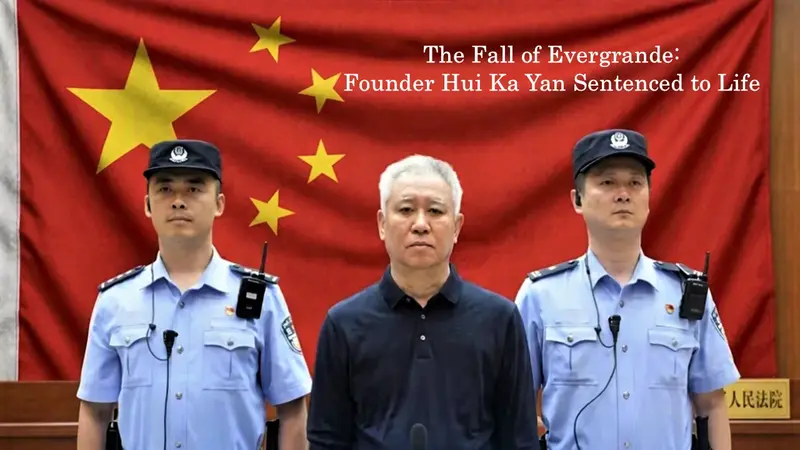
Once hailed as Asia’s richest man, Hui Ka Yan, the founder and former chairman of China Evergrande Group, was imprisoned for life on August 20, 2026, by the Shenzhen Intermediate People’s Court. The outcome marked one of the most shocking corporate collapses in modern economic history. The verdict closes the book on a debt-driven real estate empire whose staggering $300 billion meltdown shocked China’s economy, particularly its real estate sector, with ripple effects felt in global financial markets.
The $300 Billion Crash: What Triggered the Evergrande Collapse?
Founded by Hui Ka Yan in 1996, Evergrande capitalized on China's historic urbanization wave. The company built over 1,300 residential developments across hundreds of cities, rapidly transforming into the nation’s premier property developer. However, this relentless expansion was entirely funded by aggressive borrowing.
This borrowing spree stopped in 2020 when Beijing introduced the restrictive "Three Red Lines" policy to curb systemic risk and excessive debt in the real estate sector. Cut off from easy credit, Evergrande plunged into a catastrophic cash flow crisis. By 2021, the company officially defaulted on its massive liabilities. After years of failed restructuring attempts, a Hong Kong court on January 29, 2024, finally ordered the firm’s liquidation, resulting in its removal from the Hong Kong Stock Exchange.
Why Hui Ka Yan Was Imprisoned
Hui's legal troubles escalated sharply following his initial detention by Chinese authorities. He ultimately pleaded guilty to eight severe financial charges. The court found that between 2016 and 2021, Hui led an unprecedented, large-scale financial fraud designed to falsely inflate Evergrande's assets while deliberately hiding the company's true debt levels.
How Evergrande Inflated Assets by $80 Billion
According to investigations by regulators, Evergrande manipulated its financial records by prematurely booking revenues from uncompleted apartments, effectively overstating its earnings by roughly $80 billion over a period of two years. As cash reserves dried up, the company misappropriated millions of dollars in pre-sale deposits from everyday homebuyers. Most of these funds were diverted to cover up financial losses and rescue other failing projects. Consequently, hundreds of thousands of people were left with unfinished homes.
The court noted that Hui’s actions damaged the country’s market system and led to massive financial losses. As a result, he was sentenced to life in prison, permanently lost his political rights, and had all his remaining personal assets confiscated.
The crackdown didn’t stop with him; more than 50 Evergrande executives, including both of Hui’s sons, were also given prison sentences, some as long as 18 years. Corporate entities under the Evergrande umbrella were hit with fines amounting to roughly $2.3 billion (specifically 8.82 billion yuan for Evergrande Group and 7 billion yuan for Evergrande Real Estate).
The crackdown didn’t stop with him; more than 50 Evergrande executives, including both of Hui’s sons, were also given prison sentences, some as long as 18 years. Corporate entities under the Evergrande umbrella were hit with fines amounting to roughly $2.3 billion (specifically 8.82 billion yuan for Evergrande Group and 7 billion yuan for Evergrande Real Estate).
Pattern of Crackdowns: Comparing Hui Ka Yan to Wu Xiaohui, Xiao Jianhua, and Lai Xiaomin
Hui Ka Yan’s life sentence is part of a wider push by Beijing to tighten oversight on powerful business figures when their risky behavior threatens the country’s financial stability or fuels public anger. Over the past decade, several other major Chinese entrepreneurs have ended up in similar situations.
Wu Xiaohui (Anbang Insurance Group): In 2018, Wu, the founder and chairman of Anbang, was sentenced to 18 years in prison. He was found guilty of massive fundraising fraud and embezzlement. He led the company on a high-risk, debt-heavy buying spree around the world that eventually alarmed government regulators.
Xiao Jianhua (Tomorrow Group): Xiao, a billionaire financier, was sentenced by a Shanghai court to 13 years in prison. Both he and his company were found guilty of illegally taking public deposits, violating trust agreements, and committing bribery.
Lai Xiaomin (China Huarong Asset Management): One of the harshest examples of China’s crackdown on financial crimes, Lai, the former head of one of the country’s biggest state-run bad debt firms, was executed after being convicted of bribery and bigamy.
What the Evergrande Crisis Means for Global Investors
- Regulatory risk is now a dominant factor in Chinese real estate investing. The "Three Red Lines" policy demonstrated that Beijing is willing to force even the largest players into insolvency to achieve broader financial stability.
- Due diligence must extend beyond balance sheets. Investors must now assess political alignment, regulatory compliance, and social impact as core components of credit analysis.
- The era of "too big to fail" has ended. Despite Evergrande's importance, the Chinese government allowed liquidation to proceed, prioritizing long-term structural reform over short-term bailouts.
- There are still chances to profit amid the collapse. Investors who specialize in distressed assets and restructuring could focus on Evergrande’s remaining projects, though the legal and regulatory hurdles remain key factors to watch.
Bottom Line: Economic Fallout and the Future of China's Property Market
Hui Ka Yan’s life sentence sends a clear message to China’s business elite: no matter how wealthy or well connected they are, they can still be punished if their actions endanger the country’s financial system or social stability.
While Hui’s conviction closes the legal chapter of the Evergrande crisis, the economic fallout is far from over. Millions of everyday people and investors in China are still dealing with the effects of a collapsed housing market.
The broader property sector, which accounts for roughly a quarter of China's GDP when including related industries such as cement and steel manufacturers, construction equipment suppliers, interior design and furnishing companies, property management services, and plumbing, electrical, and HVAC services, remains in a prolonged downturn.
Looking ahead, the Evergrande collapse may ultimately accelerate China's transition away from real estate-led growth toward a more sustainable, innovation-driven economic model.