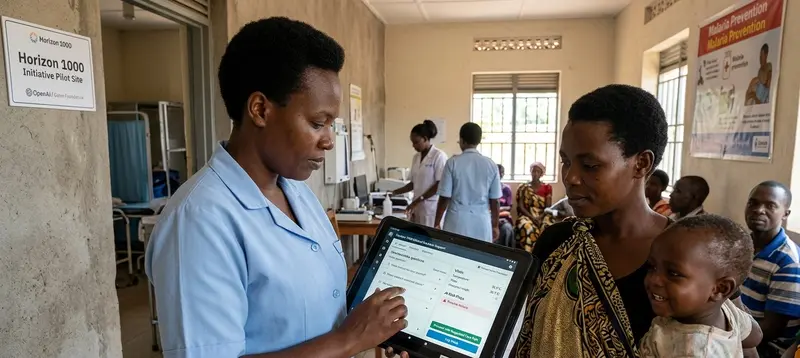
Healthcare worker using digital tablet for patient data entry at Horizon 1000 pilot clinic in Africa. Image Credits: Kencrave
Africa
Rwanda’s Horizon 1000 Initiative (2026), funded by the Gates Foundation and OpenAI, deploys AI-powered clinical decision-support tools in primary care clinics, starting with 50 sites and scaling to 1,000 clinics across Africa by 2028.
Facing a severe healthcare workforce shortage and high malaria burden (70% of CHW cases), Rwanda uses AI to guide patient intake, flag risks, suggest care steps, and reduce administrative workload, while keeping human clinicians in control.
The system combines, large language models with structured medical rules, aligns with national standards, and safeguards data privacy and health sovereignty.
Evidence shows AI can cut diagnostic errors by 12–30%, boosting efficiency and care quality. Rwanda’s strong digital infrastructure, political commitment, and localized, low-connectivity design make Horizon 1000 a model for ethical, scalable AI in African healthcare. The first phase of the horizon 1000 healthcare initiative
Rwanda is piloting artificial intelligence-powered technology in public health clinics as part of a new initiative aimed at strengthening primary healthcare, starting with more than 50 clinics this year.
The Gates Foundation and OpenAI on January 21st, 2026, launched a new initiative dubbed Horizons1000, with joint funding of $50 million over two years.
This is the first step of a broader, continent-wide plan to bring AI tools to around 1,000 primary healthcare clinics across Africa by 2028. The Horizon 1000 initiative is set to begin in Rwanda and expand further in Africa to Nigeria, South Africa, and Kenya.
Why Horizon 1000 Matters For Rwanda’s Healthcare System
Rwanda now has one health care worker for 1000 patients, which is far below workforce density levels associated with countries approaching universal health coverage (WHO, 2022).
Bar graph comparing Rwanda's physician-to-population ratio (1:1000) against the WHO-recommended standard (4:1000), highlighting a 75% deficit in healthcare human resources.
Key insight: There is a 75% shortage of healthcare human resources. This puts a strain on healthcare services.
Rwanda’s healthcare workforce gap and why AI is being deployed now
Rwanda is already exploring the use of AI to help health workers with disease diagnosis, relieve them of tedious administrative tasks, and model the trajectory of diseases.
As a start, the country has rolled out internet access to around 97% of its population a significant achievement in a country where most people live in rural areas.
It is currently building some of the foundational digital infrastructure that is enabling and powering the technological advancements.
One of Rwanda’s aims is to use AI to create decision-support tools for its 60,000-plus community health workers who provide primary healthcare to communities across the country. The country wants an AI tool to help them in the diagnosis of malaria.
It aims to make more accurate diagnosis and to predict when and where to expect malaria cases. Malaria accounts for approximately 70% of the cases that community health workers deal with yearly in Rwanda.
Pie chart showing Rwanda's disease burden: 70% Malaria cases versus 30% other medical cases, highlighting why malaria is the strategic priority for Rwanda's Vision in healthcare goals.
Why Rwanda was selected as the pilot country for ai-driven primary care
Rwanda was chosen as the pilot country because of:
Strong digital health leadership. The country has been building digital systems (like national health information platforms and community health worker support tools) for years.
Readiness to scale innovation. Officials see Rwanda as an ideal testing ground for ethical and practical AI integration before expanding to other African health systems.
Political commitment. Senior health leaders in Rwanda emphasize using AI in ways that support clinicians and improve care quality across local communities.
Inside the "Ai Co-Pilot": How it actually works
The system is best understood as a clinical decision-support assistant built on:
1. Large Language Models (LLMs). The model does pattern recognition and reasoning over text, not diagnosis in the legal sense. It is fine-tuned on medical guidelines (WHO protocols, Rwanda MoH standards) and restricted in scope (primary care, triage, maternal/child health, common infections). 2. Structured clinical rules layered on top-the AI is constrained by rule-based medical logic Inputs:
Patient symptoms (entered by nurse/community health worker).
Vitals (temperature, BP, weight, etc.).
Basic patient context (age, pregnancy status).
Past visit summaries (if available).
The AI does not:
Train itself on new patient data.
Store raw identifiable patient data long-term.
Replace national health records.
From patient arrival to clinical decision: How ai is integrated into daily care
Flowchart diagram illustrating the step-by-step clinical workflow from patient arrival to final diagnosis in Rwanda's Horizon 1000 AI-assisted primary healthcare clinics.
Flowchart diagram illustrating the step-by-step clinical workflow from patient arrival to final diagnosis in Rwanda's Horizon 1000 AI-assisted primary healthcare clinics.
Step 1: Patient arrives
A nurse or community health worker opens the clinic system (tablet/desktop).
Step 2: Guided intake The AI:
Prompts structured questions.
Flags missing critical info.
Adjusts questions based on answers (e.g. pregnancy → maternal pathway).
This reduces human error and inconsistency. Step 3: AI reasoning The system:
Converts inputs into structured tokens.
Runs them through: Clinical rules engine and language model for reasoning and explanation.
The AI produces: Risk level, suggested next steps and red-flag warnings.
The AI suggests, it does not decide.
Step 4: Human confirmation The clinician accepts, rejects, or modifies the AI’s suggestion. This human-in-the-loop setup is legally and ethically essential.
Data governance, privacy, and health sovereignty in Rwanda’s AI clinics
Rwanda’s Ministry of Health controls: Data access and deployment scope.
OpenAI does not own the health data, and the models are used as tools, not autonomous agents. This matters a lot for sovereignty of the country’s data.
What the AI System Cannot Do Safely
The model has less accuracy for:
Rare diseases.
Complex multi-condition cases.
Cultural nuance in symptom reporting.
Situations with poor or missing data.
That’s why it’s limited to primary care support, not hospitals or specialists yet.
Key benefits of AI-assisted primary healthcare in Rwanda
This initiative aims to be the transformative opportunity that will:
Improve citizens’ access to health care. AI can help stretch limited human resources more effectively especially in areas with severe staffing shortages.
Reduce administrative burden. Systems can help cut down paperwork and free up time so clinicians can spend more time with patients.
Assist in the realization of accurate and timely decisions by health care professionals. AI can assist frontline nurses and community health workers in triaging patients, suggesting care guidance, and flagging warning signs that may need urgent attention.
Technical, linguistic, and system integration challenges
Digital experts are worried about AI technology using the English language, which is not widely spoken in Rwanda. Efforts are underway to develop AI technologies in Kinyarwanda, the language spoken by about 75% of Rwanda’s population.
Integration with existing systems
Making sure that AI tools work smoothly with the existing Rwanda health infrastructure and workflows is essential for long-term success.
Lessons from AI trials and deployments
AI in clinical support isn’t entirely new. There have been Research trials with live clinicians.
According to the star newspaper, an AI tool called AI Consult was tested in 15 primary care clinics and results showed a reduction in medical errors in routine primary care by supporting clinicians without replacing them.
It offered real-time alerts and guidance to clinicians and was associated with:
Roughly. 16 % fewer diagnostic errors.
Approximately. 13 % fewer treatment errors.
Reductions in omissions during patient history taking.
AI’s impact on diagnostic accuracy across selected health systems in Rwanda, Kenya, India, China, the United Kingdom, and the United States.
AI’s impact on diagnostic accuracy across selected health systems in Rwanda, Kenya, India, China, the United Kingdom, and the United States.
Error bars represent observed or reported ranges in diagnostic error reduction following AI decision-support deployment. Kenya reflects real-world primary care trial data, while Rwanda represents a projected national target under Horizon 1000 (Science Direct).
Key insights: AI’s impact on diagnostic accuracy across selected health systems
Across global healthcare systems, AI decision support tools consistently reduce diagnostic errors by approximately 12–30%, depending on clinical setting and use case.
The strongest gains are observed in high-volume environments where clinicians face heavy workloads and time pressure.
United States, approximately 18–25% reduction in diagnostic errors in radiology and primary care decision support systems.
United Kingdom, an estimated 15–20% reduction in missed or delayed diagnoses using NHS AI triage and imaging tools.
China, about 20–30% improvement in diagnostic accuracy in AI-assisted imaging and clinical decision systems.
India, roughly 12–18% reduction in diagnostic errors in AI-supported primary care and telemedicine platforms.
Kenya (Nairobi trials), an estimated 15.8% reduction in diagnostic errors in AI-assisted primary care clinics.
Rwanda is estimated to reduce errors by 16%.
The AI decision support proves its value for initiatives like Rwanda's Horizon 1000. (O'Brien et al., 2024).
Key insights: Reduction in error after AI Trials in Nairobi
A 15.8% reduction in diagnostic errors directly translates to fewer missed or incorrect diagnoses, a leading cause of preventable harm in primary care, especially in high-volume, low-resource clinics.
The 12.9% reduction in treatment errors (incorrect medications or dosages) shows AI's utility beyond diagnosis, improving the entire care pathway and enhancing patient safety.
Real clinic deployments tested for safety and impact. The Perioperative AI Chatbot (PEACH) system was embedded in real perioperative clinical workflows and evaluated for accuracy and safety with actual clinicians.
Historical AI decision tools used in clinical practice. The HIV Treatment Response Prediction System (HIV-TRePS) is an AI-based system used from around 2010 by clinicians worldwide, enabling them to predict how individual patients would respond to combinations of HIV drugs based on very large treatment datasets. It was widely used in clinical practice to tailor therapies.
Rwanda’s current program (Horizon 1000) is one of the most ambitious attempts yet to scale AI assistance across a national primary care network in low-resource settings with a structured integration into the public health system.
What comes next: Scaling Ai in Rwanda without sacrificing safety or trust
1. Plan early for financial sustainability
Gradually integrate AI costs into National health budgets, insurance and reimbursement frameworks
Donor funding should support transition, not create dependency.
2. Scale cautiously and evidence-first
Expand only after: demonstrated outcome improvements, stable clinician adoption and clear governance structures.
Rwanda’s strength lies in credibility and discipline, not rapid expansion.
Policy and implementation recommendations for Rwanda’s Ai health strategy
1. Keep AI as clinical support and not decision-maker.AI should remain advisory, with all final decisions made by trained health workers. This preserves patient safety, legal clarity, and clinician trust.
2. Prioritize consistency and early risk detection. The goal is reliable care at scale, not superhuman performance.
3. Invest deeply in Kinyarwanda and local context. Ensure Kinyarwanda-first interfaces, locally validated symptom descriptions and alignment with Rwanda’s disease patterns and care pathways.
Localization is essential for accuracy and adoption.
4. Design for low-connectivity environments. AI tools must work offline with delayed syncing and never block care due to technical issues.
5. Establish frequent AI health oversight. Create a dedicated unit to monitor AI performance, review errors and adverse events, update clinical rules and models and audit bias and system drift.