Strategic comparison of Brazil and Chile startup ecosystems, analyzing fintech growth, AI startups, venture capital availability, ecosystem maturity, founder challenges, and long-term competitiveness in Latin America (2016–2026). Image Credits: Kencrave
SouthAmerica
Why do startups fail in Brazil and Chile? Fintech/AI concentration, 2016–2026 survival data, Chile's scale constraint, and market entry strategy for founders and investors.
Executive Summary
Brazil and Chile share a similar startup pattern with fintech and AI dominating. However, cloud infrastructure and climate tech remain underrepresented but differ in momentum. Brazil peaked in 2019 and has declined since while Chile has stayed flat at a lower level. This gap reflects market size, capital access, and interest rates more than entrepreneurial ambition.
Brazil's concentration is capital-driven as fintech and AI attract investor conviction. This is reinforced by high interest rates that favor core-business bets over speculative ones. Yet 8,258 startups ceased operations between 2015 and September 2024, averaging 58 months of life, with over half of the startups generating no revenue. Failure stems mainly from product–market mismatch (42%) and capital decline (70%), not technology.
Cloud and environmental technology remain structural gaps in the ecosystem. While AI adoption will continue to drive demand for cloud infrastructure, rising climate-related risks are creating a parallel need for environmental and climate-adaptation solutions, as underscored by the 2024 floods and increasing frequency of natural disasters.
Chile's constraint is scale, not survival. Startup Chile has supported more than 3,000+ startups with roughly 64% of them still active. This is far above the global estimate of 15% rate, but too few entrants limit output. Established mining companies raise barriers in energy and manufacturing entry while cloud services offer a more accessible opportunity.
Recommendations to Entrepreneurs and Investors
Entrepreneurs should validate whether low competition signals weak demand or high barriers, localize pricing by value rather than currency, prioritize B2B in Brazil and treat Chile as a validation springboard.
Investors should assume Brazil's high-rate environment will continue, use cloud as an indirect AI investment, favor Startup Chile-backed companies, maintain long-term climate-tech exposure, and make localization a non-negotiable screening criterion.
Latin America's Startup in Capital Concentration, Founder Density, and the Brazil–Chile Gap
Latin America's startup ecosystem has long faced a structural contradiction. The region has many founders, but a low proportion of ventures that survive and scale. World Bank research suggests that only about 10% of startups in emerging markets gain access to strong mentor networks, and the region's support organizations operate more as silos than as a coordinated ecosystem. The lack of coordination among incubators, accelerators, universities, and investors actively hinders the region from developing the density of high-tech entrepreneurs it needs to launch and sustain transformative ventures.
As of 2026, this seems to be changing with over 35% of Latin American startup founding teams now featuring at least one founder with international education or elite global work experience, drastically shifting the density of highly skilled leadership compared to 2016 (Endeavor's 2024 ecosystem report, as cited by LatinLeap).
Brazil and Chile occupy different positions within this landscape. São Paulo is Latin America's premier hub, ranking 23rd worldwide in StartupBlink's 2025 Global Startup Ecosystem Index and leading the region. Santiago ranks 75th globally in the same index and 4th in Latin America, third in South America behind São Paulo and Bogotá. Despite Chile's limited market size of about 20 million people, it continues to serve as an ideal institutional springboard into neighbouring markets due to a stable political environment and legal framework.
In 2023, Latin America attracted approximately 1.5% of global venture investment, totalling $4.0 billion. This capital was heavily concentrated. The region's leading hubs of Brazil and Mexico commanded nearly 80% of total regional funding, while Chile captured roughly 6%. This capital imbalance directly determines which sectors startups enter and how likely they are to survive.
According to the official LAVCA 2025 Trends in Tech Report, the Latin American venture capital ecosystem has stabilized following a prolonged period of global market adjustments. The region attracted approximately 1.4% to 1.6% of global venture investments. The annual regional tech funding held steady at $4.5 billion across 751 recorded transactions, driven primarily by a strong resurgence in early-stage and seed-level rounds.
Data tracking the 2025/2026 venture ecosystem indicates that funding remains highly concentrated in Brazil and Mexico. Brazil and Mexico together account for nearly 80% of all regional investment. Notably, Mexico has rapidly closed the gap, trailing Brazil's total deployment by just 14% . At the same time, Chile consistently captures roughly 5.9% to 6% of regional funding, reinforcing its position as Latin America's leading venture capital hub on a per-capita basis and one of the region's broadest startup ecosystems.
These 2023 and 2025/2026 figures measure different periods and different definitions of regional investment. This explains why Brazil and Mexico's combined share appears as nearly 80% in some datasets and closer to 70% in others once Colombia's 12% share is counted separately.
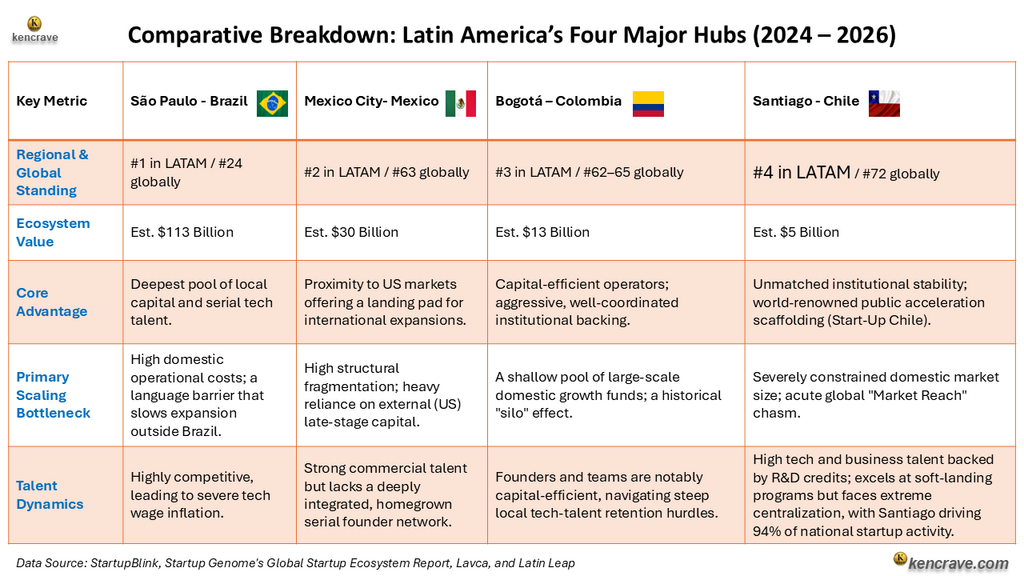
Latin America startup ecosystem comparison 2024-2026: São Paulo, Mexico City, Bogotá, and Santiago ranked by startup ecosystem value, venture capital access, talent, scaling challenges, and global startup hub competitiveness.
Key Insights on São Paulo, Mexico City, Bogota and Santiago as Major Hubs in Latin America
Based on the 2026 data, the comparison table highlights four key insights about how Latin America's top tech ecosystems operate:
São Paulo, Brazil (The Capital Giant): It dominates regional funding with over $55B in ecosystem value. Strong local capital and engineering talent but restricted by high domestic costs and a Portuguese language barrier.
Mexico City, Mexico (The US Gateway): Leverages physical proximity to the US to secure American venture capital and international remote workers. However, it lacks deep, homegrown serial founder networks.
Bogotá, Colombia (The Lean Operator): Scales efficiently using tight capital structures. Relies on aggressive institutional support and the dominant "Rappi Mafia" network to overcome a shallow pool of domestic growth funds.
Santiago, Chile (The State Sandbox): Uses top-tier public programs like Start-Up Chile and R&D credits to launch international ventures. It is however constrained by a small domestic market and extreme centralization, with 94% of tech activity trapped inside the capital.
These four Latin America hubs matter here because they are the benchmarks against which Santiago's scale constraint is measured.
Dominant Sectors in Latin America: Fintech and AI
Financial technology and artificial intelligence dominate the regional startup landscape over the past decade.
More than half of all fintech companies in Latin America and the Caribbean are based in Brazil. This leadership stems from what is known as the “Brazil Stack,” made up of Pix, Open Finance, Gov.br and Drex, which together form an advanced environment for fintech innovation. Fintech in the region has increasingly shifted toward embedded financial infrastructure, B2B banking-as-a-service, and AI-driven lending and operational scalability.
AI is the leading investment theme across the ecosystem. In the first half of 2026, AI startups made up 55% of all first-time VC-backed startups in Latin America, including both AI-native companies and those building foundational models or infrastructure-layer services.
Investments are growing in climate-tech, biotechnology, logistics, SaaS, foodtech and mobility. Deep tech, which covers biotechnology, medical devices, clean technologies and advanced manufacturing, is an emerging frontier. Brazil holds 952 of the 1,316 deeptechs mapped in Latin America (72.3%), while Chile leads the region in attracting deeptech investment relative to its size.
Brazil: Post-2019 Contraction, Fintech/AI Concentration, and the Revenue-Conversion Problem
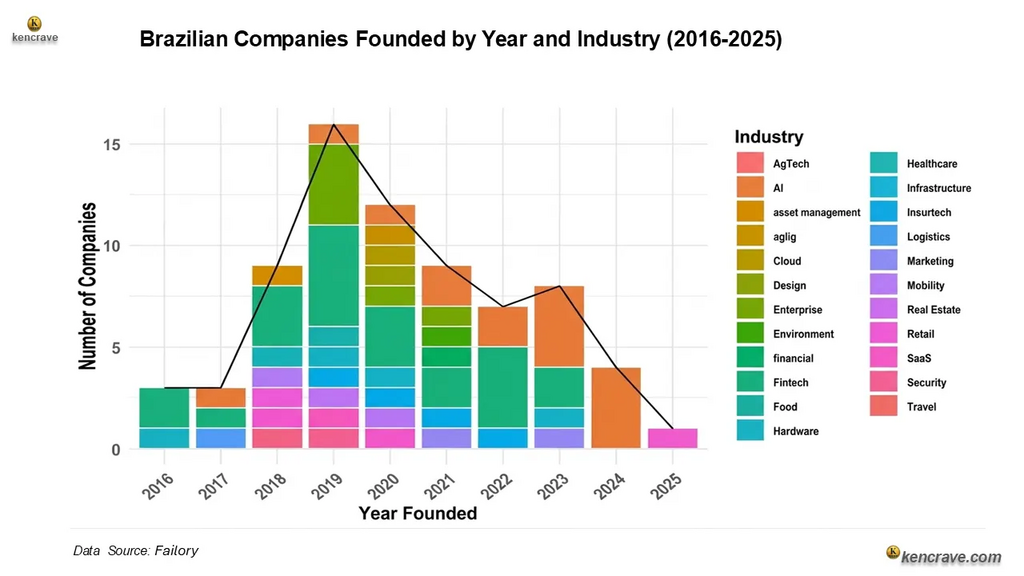
Brazil's startup ecosystem tells a story of concentration and contraction as represented by the visual below.
Brazil startup ecosystem growth chart showing companies founded by year (2016–2025) across fintech, AI, healthcare, logistics, retail, SaaS, enterprise, and infrastructure sectors, highlighting industry trends and startup formation in Brazil.
Failory data show that the number of successful Brazilian startups peaked markedly in 2019 and has declined steadily since. Sector distribution is highly concentrated with fintech accounting for 22 companies cumulatively and AI for 14, together making up a clear majority of the sample.
This concentration is driven by fundamentals. Fintech and AI attract the most capital because they benefit from stronger investor conviction and more developed knowledge ecosystems. Brazil's high interest-rate environment further reinforces this dynamic. Elevated risk-free returns push corporate venture investors to prioritize opportunities tied more closely to core business needs and away from speculative bets. But those same high rates also expose a deeper problem.
Distrito data show that between 2015 and September 2024, 8,258 Brazilian startups ceased operations, with an average lifespan of about 58 months. More than half of registered startups have no revenue at all, revealing that the central problem is not product creation but converting product into revenue.
A 2026 analysis by CB Insights of failed ventures found that 42% of the startups failed because the market did not need the product, not because of technology or incompetent team. The analysis revealed that 70% of the startups ceased operations due to a decline of capital to support business operations.
The absence of cloud services and environmental technology from Brazil's mainstream startup distribution stands out. The gap in domestic cloud infrastructure creation is largely structural. This is because AI companies rely heavily on data storage and computing infrastructure.
This means that demand for cloud services will expand naturally as AI adoption grows. Environmental technology reflects a similar mismatch. The 2024 Rio Grande do Sul floods created a clear demand signal for climate adaptation solutions, yet the supply of startups and deployable technologies still falls well short of that demand.
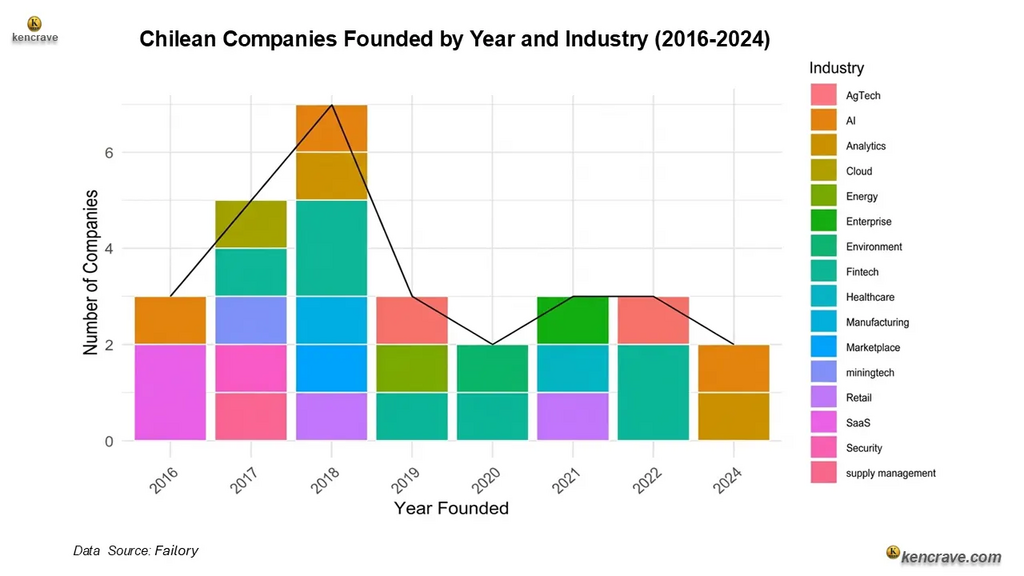
Chile's startup ecosystem has remained remarkably stable since 2016 to 2024.
chilean-companies-founded-by-year-and-industry-2016-2024.webp29.9 KB Chile's data present a very different case from Brazil. Between 2016 and 2024, the number of successful startups remained consistently low, showing little variation over time. Fintech and AI were the most prominent sectors, but their absolute numbers remained far below those observed in Brazil.
The immediate explanation is sample-selection effect as Failory's definition of "success" is itself highly selective thus the pool of Chilean startups meeting that standard is naturally small. Chile's domestic market is small, and its economy lacks the scale and diversification of larger regional peers. This forces founders of various startups to consider markets from other regions from day one.
Why Startups Fail in Latin America: Growth Drivers and Three Structural Causes
Drivers of Growth for Startups in Brazil and Chile
The sectoral concentration in Brazil and Chile is driven first by capital availability, not market demand. Fintech and AI dominate because they attract the most venture funding and corporate venture attention. Brazil relies on sheer market scale, capital abundance, and financial depth, while Chile leverages institutional quality and regulatory stability.
Brazil's Startup Drivers
Brazil's dominant position in the South American startup landscape roots from its ability to attract early-stage capital and its substantial financial infrastructure. In 2024, Brazil captured the majority of all startups in Latin America and the Caribbean that raised their first Venture Capital (VC) round, holding a 49% share. The capital influx is supported by a deep financial system within South America.
In 2020, Brazil recorded the highest financial development index (0.662) and the second-highest financial institutions depth index (0.514). Furthermore, Brazil possesses the highest international liquidity reserves in (4,041.65) as of 2025, providing a stable macroeconomic buffer.
This financial depth is matched by a strong commitment to innovation. Brazil spent the highest percentage of its GDP on Research and Development (1.19%) in 2023 and hosted the highest number of venture accelerators in the region (7) as early as 2015. While its general average of government effectiveness sits at a moderate 51.61/100 in 2025, the sheer scale of its market and capital availability continues to drive ecosystem growth.
Chile's Startup Drivers
Chile, despite its smaller market size, has cultivated a highly attractive ecosystem built on strong governance and institutional depth. In 2025, Chile ranked as the second country in South America for government effectiveness (73.68/100) and regulatory quality (66.44/100). It also secured third place in the region for rule of law and control of corruption, trailing only much smaller nations like French Guiana and Uruguay.
This institutional credibility is paired with a highly sophisticated; albeit concentrated, financial sector. In 2020, Chile boasted the highest financial institution depth index in the region (0.707) and the second-highest overall financial development index (0.524).
However, Chile's share of first-time VC rounds in 2024 was the lowest at just 7%, and its R&D expenditure sat at 0.39%, the fifth highest in Latin America. Chile's 3rd-place ranking in international liquidity (627.23) further underscores a stable but more conservative capital environment compared to Brazil's high-volume market.
In Chile, Startup Chile's public incubation system provides a critical survival buffer. However, the system is better at keeping companies alive than at generating large numbers of new entrants.
Together, these metrics reveal that Brazil acts as the region's high-volume engine for startup creation and VC deployment, whereas Chile functions as a highly stable, institutionally robust environment that prioritizes regulatory quality and financial soundness over sheer volume.
Structural Causes of Startup Failures in Latin America
Startup failure in Latin America can be grouped into three layers:
Product–market mismatch. CB Insights' analysis shows 43% of failures stem from the market not needing the product. This is particularly acute where founders copy product logic from the US or Europe without adapting to local payment habits, logistics, or price sensitivity. The region's fragmentation of more than twenty countries with different regulations, currency, and business culture makes cross-border expansion far costlier than within the EU.
Capital structure and interest-rate suppression. Brazil's elevated benchmark rate makes risk-free returns competitive with risk-adjusted early-stage returns, directly dampening risk-capital allocation. Latin American bank lending rates are high and collateral heavy. This makes debt financing without equity dilution nearly impossible for startups.
Gaps in founder capability and support systems. The World Bank notes that while Latin America has high levels of business churn and many low-skilled entrepreneurs, it lacks a sufficient concentration of individuals with the skills and education needed to build and sustain transformative companies. Brazil's data reinforce this trend with more than half of startups generating no revenue. This shows that many founders fall into the trap of over-engineering a product without establishing early product-market fit or a clear path to monetization.
Chile performs better, with Startup Chile's strong survival rates suggesting effective selection and support, but a limited pipeline of entrants constrains overall output.
Recommendations for Founders and Investors in Brazil and Chile
For Entrepreneurs in Brazil and Chile
Validate the nature of low competition before entering. The low presence of cloud services and environmental tech may signal opportunity or insufficient demand. Test willingness to pay with a minimum viable product before committing resources, rather than assuming that no one is doing it because no one has thought of it.
Localize pricing architecture rather than simply converting currency. Latin America's purchasing power varies widely. A USD-priced SaaS product that seems affordable elsewhere can take a substantial portion of a Brazilian worker's monthly income. Effective localization means adjusting pricing to local buying power, not just converting currencies.
In Brazil, prioritize B2B or B2B2C models whenever possible. The startup ecosystem is heavily B2B-driven, while B2C remains less common due to expensive customer acquisition and payment infrastructure hurdles.
In Chile, design diversification into other regions from day one. Chile's domestic market cannot support scaled growth, but its stable legal environment and free-trade network make it a suitable springboard into Peru, Colombia, and Mexico. Treat Chile as a validation market, not a destination market.
Avoid the technology in search of a problem trap. In Brazil, 43% of failures stem from the market not needing the product. Before investing in technology advancements, perform a market validation through an MVP. Don't over-engineer a product in its early stages.
For Investors in Brazil and Chile
Assume high interest rates will continue shaping Brazil's startup market. When safer fixed-income assets offer attractive yields, venture investments must deliver significantly higher expected returns to justify the added risk.
Cloud infrastructure is a simpler, lower-competition way to capitalize on AI growth. AI companies generate rising demand for storage and computing regardless of which AI applications ultimately win the market. In Brazil and Chile, cloud infrastructure remains significantly less crowded than the AI application layer, creating a larger opportunity for new entrants.
In Chile, focus on companies backed by Startup Chile. Their 64% survival rate is well above the regional average, making Startup Chile screening a useful quality signal. However, this may partly reflect selective admission criteria rather than consistently stronger companies.
Maintain a selective allocation to environmental technology. Demand for climate-adaptation solutions in Brazil has increased following the 2024 floods, but long sales cycles and policy reliance limit near-term upside. The sector is better suited to long-term growth investors.
Prioritize localization capability during due diligence. Companies with local product decision-making authority and integrated logistics and payment infrastructure consistently outperform businesses that simply replicate overseas models. Verify that the founding team includes a local product leader with the authority to reject headquarters-driven decisions when they do not fit market needs.
Bottom-line: Demand vs. Barriers, Not Crowding
The decisive variable for both markets is not which sectors look crowded but whether low competition reflects weak demand or high barriers to entry. The answer differs by market. In Brazil, the main challenge is monetization. Startups can build products, but turning products into a revenue generating engine is harder.
Customer validation and local pricing strategies should be prioritized before launch. In Chile, the challenge is market access. Mining leaders dominate demand and innovation budgets in energy and manufacturing, making industry connections critical. Startups without those relationships are better off focusing on cloud services or export-oriented businesses, proving traction locally before expanding into Peru, Colombia, or Mexico.
For investors, Brazil's high-interest-rate environment should be treated as a long-term factor in return models, not a temporary headwind. Startup Chile remains a useful quality signal, but its conservative selection process can overlook higher-risk opportunities. Across both markets, teams with deep local expertise are generally better positioned than founders simply adapting overseas business models in their operations.
Data Sources and Methodology
This analysis was developed by triangulating public startup databases, industry reports, government publications, and regional market data. It reconciles figures where sources measured different periods or employed differing definitions.
Clarke, Ben, et al. "Climate change and El Niño behind extreme precipitation leading to major floods in southern Brazil in 2024." npj Natural Hazards 3.1 (2026): 4.