

Advanced Australian health-tech laboratory with biomedical researcher inspecting medical device, showcasing biotechnology innovation, medical research, diagnostics development, and pharmaceutical manufacturing. Image Credits: Kencrave
Australia
Strategic analysis: Australia ranks 7th in health research but 20th in commercialization. It maps the barriers, proven accelerators, and actions to build sovereign HealthTech capability.
Executive Summary
Australia's health and medical research sector has doubled since 2017 and ranks 7th globally, yet it ranks 20th among OECD countries for new-to-market product innovation. Only three public hospitals have adopted Harrison.ai, a homegrown AI leader used by one in two private radiologists. This is the major challenge for Australia, world-class invention yet weak translation.
The barriers are structural. Public hospital procurement prioritizes cost minimization over value, with local content as low as 5% in some health services. Australia lacks patient, risk-tolerant venture capital. More than 150 funding programs span five federal portfolios, creating duplication and a 64-cent cost gap per research dollar.
86% of digital health SMEs cite capital as a top barrier, regulators have shifted to compliance on AI scribe tools, and Australia ranks 22nd on the Global Innovation Index
Medical products take roughly 10-17 years to develop, yet policy assumes shorter timelines, producing two "valleys of death", that is one between research and prototype, another between clinical evidence and procurement.
What works is already proven:
- ANDHealth returns $19.70 per $1 invested.
- AUScelerate turned $47 million into $220 million.
- CTCM turned $19.75 million into $64 million.
- CSL Seqirus's $1 billion facility shows sovereign manufacturing is achievable.
- The MRFF holds $25.4 billion and commits $6.5 billion through 2033-34.
- The National Reconstruction Fund provides $15 billion.
Two risks could foreclose the window. AI sovereignty: overseas hyperscalers becoming the de-facto front door to Australian healthcare. Capital flight: IP moving offshore before early-stage trials, making domestic production at scale nearly impossible to recover.
Recommendations are directed at the actors capable of removing each barrier. The next five years will determine whether Australia becomes a HealthTech leader or continues exporting its best ideas.
Australia's, A Global Leader in Health and Medical Research Sector
Australia's, A Global Leader in Health and Medical Research Sector
Australia possesses one of the world's most productive health and medical research sectors. According to a 2026 report by the Association of Australian Medical Research Institute, Australia ranks ranks 7th globally in the health research sector (AAMRI, 2026). It also ranks 9th of 32 high-income countries in the 2024 World Index of Healthcare Innovation (FREOPP, 2024).
The life sciences sector now encompasses approximately 2,900 organisations. It employs one in every 60 jobs in Australia (Austrade & AusBiotech, 2025). Health innovation spans five key technology categories. These include biologics and advanced therapies such as next-generation vaccines and mRNA platforms. They also include medical devices and implants, diagnostics and reagents, digital and AI-enabled health technologies, and manufacturing platforms.
These manufacturing platforms include good manufacturing practice facilities and sterile manufacturing lines (National Reconstruction Fund Corporation, 2025).
These manufacturing platforms include good manufacturing practice facilities and sterile manufacturing lines (National Reconstruction Fund Corporation, 2025).
The Translation Gap: Why Australia Struggles to Commercialise Medical Research
Despite this research excellence in health, Australia still lags in turning ideas into products the market actually adopts. According to the Australian Industry Group, Australia ranks 20th among OECD countries for firms introducing new-to-market product innovations (Australian Industry Group, 2025). This is a clear gap between invention and commercialisation. Australian MedTech and BioMedTech startups are exceptionally strong on invention and technical quality.
The real opportunity now sits in scaling capital, development pathways, and execution. Research translation means different things to different stakeholders. It ranges from embedding evidence into clinical practice to commercializing an idea into a marketable product. This creates a challenge in understanding how success is measured and funding allocated.
Building Sovereign HealthTech Capability: Resilience and Economic Case
The COVID-19 pandemic exposed Australia's reliance on imported vaccines, diagnostics, and critical medical supplies. According to the National Reconstruction Fund Corporation (NRFC), building sovereign capability is not just an industrial opportunity. It is a matter of national resilience and security. This ensures robust medical manufacturing, secure supply chains, and high-skilled jobs. The economic case is equally compelling (NRFC, 2025).
According to a 2026 report by IQVIA Institute global forecasts, the global medicines market is forecast to exceed US$2.3 trillion by 2030. The medical technology market is expected to grow with a CAGR of 6.99% between 2025 and 2030 to US$0.96 trillion (Mordor Intelligence, 2026).
Australia risks missing this opportunity if it continues to export its best ideas for commercialization overseas. The NRFC notes that too often, Australia's breakthroughs are commercialized overseas and re-imported as finished products (NRFC, 2025).
Australia's Medical Breakthroughs: From Pacemaker to Gardasil
Australia has a long history of medical breakthroughs. These include:
- 1926: The Electronic Pacemaker by Dr Mark Lidwill & Edgar Booth, World's first artificial cardiac revival.
- 1940s: Medical Application of Penicillin by Sir Howard Florey triggered the global antibiotic age.
- 1961: Ultrasound Scanner by George Kossoff & David Robinson led the greyscale prenatal and diagnostic imaging.
- 1978: Multi-channel Cochlear Implant by Prof. Graeme Clark led the world's first functional "bionic ear".
- 1999: Spray-on Skin by Prof. Fiona Wood revolutionized severe burn therapy and tissue culture.
- 2006: Gardasil HPV Vaccine by Prof. Ian Frazer & Dr Jian Zhou developed the world's first cancer-preventing vaccine.
The MRFF: Australia's $25.4 Billion Health Research Endowment
A pivotal moment came in 2011 with the McKeon Review. It laid the foundations for transformative change. On 26 August 2015, the Australian Government established the Medical Research Future Fund (MRFF). It was designed as an endowment fund to provide sustainable, long-term funding for priority-driven medical research and innovation.
As of 2026, the endowment fund is valued at about $25.4 billion (Australian Government Department of Finance, 2026). Unlike other funding, the MRFF focuses on commercialization and translation. The MRFF is agile enough to address emerging health issues and empowers consumers to contribute to research at every stage.
Australia's Commercialization Programs: BioMedTech, CTCM, and AUScelerate
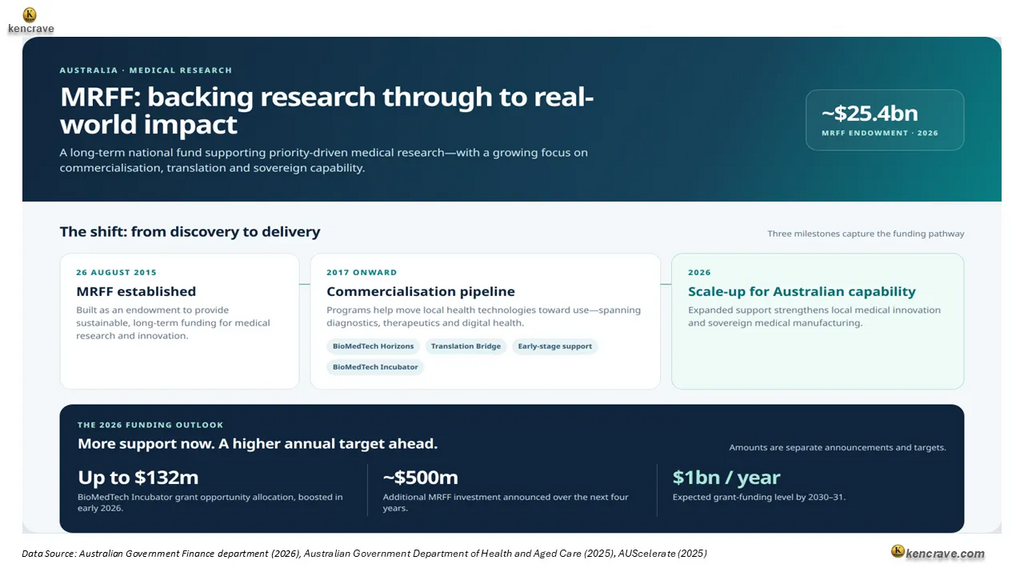
Following the MRFF's establishment, a suite of commercialization-focused programs emerged. The BioMedTech Horizons program provided $45 million from 2017 supporting collaborative health technologies. The Biomedical Translation Bridge provided $22.3 million from 2018 (AUScelerate, 2025).
Early-Stage Translation and Commercialization Support provided $79 million from 2020. The BioMedTech Incubator provided $50 million then $99 million from 2022.
It supported novel diagnostics, therapeutics, and digital health technologies. Industry-led accelerator programs also emerged. These include ANDHealth, MTPConnect's CTCM Program, and AUScelerate. They delivered end-to-end commercialization assistance paired with non-dilutive funding.
As part of the ongoing strategic scale-up of sovereign medical manufacturing in Australia, the Australian Government expanded this pipeline heavily. In early 2026, the official allocation for the BioMedTech Incubator grant opportunity was boosted up to $132 million to dramatically scale support for local medical startups (Australian Government Department of Health and Aged Care, 2026).
Additionally, in 2026 the Australian Government announced about $500 million over the next 4 years to increase investment in medical research through the MRFF. The grant funding is expected to hit $1 billion a year by 2030-31.
COVID-19 and the Shift to Sovereign Medical Manufacturing
The COVID-19 pandemic fundamentally reshaped the policy landscape. It drove a new focus on building sovereign manufacturing capability (NRFC, 2025). This shift was reflected in the establishment of the National Reconstruction Fund Corporation (NRFC). The NRFC identified medical science as a priority area for investment.
The draft of National Health and Medical Research Strategy was announced in August 2025. It represents the latest policy evolution in Australia's health innovation landscape. The strategy explicitly focuses on ensuring scientific excellence is translated, developed, and commercialised into global health innovations.
It also aims to strengthen sovereign manufacturing capability and incentivise local procurement (Australian Government Department of Health and Aged Care, 2025).
Australia's Translation Barriers: Procurement, Capital, and Funding Fragmentation
Despite significant policy effort and investment, Australia continues to face persistent translation barriers. Risk-averse procurement frameworks in public hospitals prioritizes cost minimisation over supporting local innovation. As a result, governments, providers, and consumers are deprived of the advantages of cutting-edge technologies, while local health tech start-ups face reduced opportunities to compete and expand (DHCRC, 2025).
Underdeveloped venture capital markets provide less patient, risk-tolerant capital than other OECD countries such as the United States, Israel, or the UK. Australia's private venture capital (VC) sector is highly conservative (Global Data, 2025).
Australia's research ecosystem spans over 150 individual funding programs scattered across five federal portfolios (Health, Education, Industry/Innovation, Defence, and Foreign Affairs) alongside separate state systems (Universities Australia, 2025).
This creates duplication and unmet needs. Data modelled by AAMRI indicates that research translation faces a 64-cent cost gap for every dollar of grant funding (AAMRI, 2026). Hospital procurement requirements are complex and challenging for local medtech manufacturers.
Australia's HealthTech Moment: Momentum vs. Structural Barriers
Australia stands at a critical space. According to the Australian Government Department of Health, Disability and Ageing (DHDA), the MRFF 3rd 10-year Investment Plan commits $6.5 billion to health and medical research through 2033-34. It has a target of $1 billion annually by 2030-31 (Australian Government Department of Health and Aged Care, 2024).
Accelerator programs have proven that targeted commercialisation support works. According to a 2026 report by L.E.K. Consulting, ANDHealth generates roughly $19.70 in capital raised for every $1 invested.
The AUScelerate final evaluation report shows the program leveraged $47 million into $220 million in follow-on funding (AUScelerate National, 2026). MTPConnect's report confirms the CTCM Program transformed $19.75 million into $64 million in sector investment (MTPConnect, 2025).
Major sovereign manufacturing investments demonstrate that onshore capability is achievable. This includes CSL Seqirus's $1 billion vaccine facility which is digitally and sustainably enabled (CSL Seqirus, 2025). The facility will provide supply of pandemic influenza vaccines, antivenoms and Q fever vaccine to Australia.
The challenge is whether Australia can convert this momentum into lasting sovereign capability, or if long-standing systemic barriers will continue to hinder the nation's ability to transform world-class research into innovations that deliver benefits for patients and the economy.
Australia's HealthTech Market Overview 2025–2030
The Australian life sciences sector has doubled in size since 2017. As of 2026, it consists of approximately 2,900 organizations and supporting around 350,000 jobs. The total ASX biotech market grew from roughly $32B in 2017 to well over $160B in 2026 (AusBiotech, 2025).
Key Growth Drivers: MRFF and NRFC Investment in Medical Innovation
Several key drivers underpin this growth:
- The MRFF, now valued at $25.4 billion as of March 2026, provides a sustainable, long-term funding source for priority-driven medical research.
- The NRFC has committed $15 billion to invest in priority areas including medical science, with a focus on ensuring Australian medical innovation completes the full onshore journey to commercial viability.
- Major sovereign manufacturing investments, including CSL Seqirus's $1 billion cell-based vaccine facility in Melbourne, AdvanCell's Thorium-228 manufacturing plant in Queensland, and Southern RNA's mRNA production facility, demonstrate that onshore capability is achievable with strategic investment.
Digital Health: Australia's Fastest-Growing HealthTech Segment
The digital health sector has emerged as a particularly dynamic segment. According to ANDHealth's State of the Industry report, the sector has grown at 52% year-on-year since 2019 (ANDHealth, 2025). Adoption of AI-enabled diagnostics, remote monitoring technologies, and digital therapeutics has been key drivers for digital health.
According to the NRFC 2025, the global medicines market is forecast to reach roughly $2.3 trillion by 2030. The medical technology market is expected to grow to US$0.96 trillion (Praxis Global Alliance, 2026).
These figures position Australian companies to capture significant market share if commercialisation barriers are addressed.
The Procurement Barrier: Why Local MedTech Innovations Struggle to Reach Public Hospitals
Public hospital procurement systems remain largely closed to local innovators, with fragmented decision-making across states and territories. A study by Australian Medtech Manufacturing Alliance (AMMAA) suggested that as little as 5% of procurement of procurement spent by some public health services is on locally manufactured products (DHCRC, 2025).
Homegrown AI leader such as Harrison ai used in medical diagnosis in CT scans and X-Rays using AI is accessible to one out of every two private radiologists nationwide but adopted by only three public hospitals in Australia (DHCRC, 2025).
"However, while Harrison ai is a positive demonstration of the local digital health technology sector, it is disappointing that it has had greater success scaling its business in overseas markets than in Australia," said Ms Schmiede, CEO of DHCRC
Accelerator Programs: Evidence from ANDHealth, AUScelerate, and CTCM
Accelerator programs have demonstrated what works:
- ANDHealth generates $19.70 in capital raised for every $1 invested while creating jobs at 14 times the IMF benchmark.
- The AUScelerate program leveraged $47 million in MRFF funding into $220 million in follow-on investment, supporting 80 innovations and creating 151 jobs.
- MTPConnect's CTCM Program transformed $19.75 million into $64 million in sector investment, with 75 percent of supported companies securing additional external funding and one technology achieving US FDA approval.
Australia’s MRFF 3rd Investment Plan: $6.5 Billion Committed Through 2033-34
The MRFF 3rd 10-year Investment Plan commits $6.5 billion to health and medical research through 2033-34. Annual disbursements are targeted to reach $1 billion by 2030-31. Current disbursements in 2025-26 are approximately $650 million (Australian Government Department of Health and Aged Care, 2024).
The pipeline of supported innovations continues to grow. 4DMedical secured FDA clearance for ventilation analysis software, the world’s first and only non-contrast, ventilation–perfusion (VQ) imaging solution (4DMedical, 2025). 4DMedical formed a partnership with Philips to bring the technology to North American hospital networks.
In 2025, Navi Medical Technologies, the Melbourne-based startup secured U.S. FDA clearance for its Neonav® ECG Tip Location System. It is the first device of its kind designed specifically to guide the accurate placement of central venous catheters in critically ill neonatal and pediatric patients. In July 2026, the company made a milestone by raising a $6.8 million to accelerate its U.S. commercial launch (Navi Medical Technologies, 2026).
OncoRes Medical successfully progressed its Elora™ Quantitative Micro-Elastography imaging system. Backed by a $27 million private funding in early 2026, the company has expanded and advanced its multi-site clinical trials across six major hospitals in Western Australia and Victoria (University of Western Australia, 2026). The company provides real-time intraoperative imaging during breast cancer surgery.
Australia's Sovereign Health Capability: The 2025–2030 Window
Sustained funding, demonstrated program success, and policy momentum creates a unique window of opportunity. Whether Australia can capitalise on this moment depends on addressing systemic translation barriers. These barriers have persisted for decades. Procurement reform is one critical area. The development of patient, risk-tolerant domestic capital markets are also areas that require attention.
Australia's HealthTech Innovation Ecosystem
The Australian HealthTech innovation ecosystem comprises a diverse range of players spanning the entire research-to-commercialization pipeline. Understanding who these players are, what they do, and how they interact is essential to identifying where the system works and where it breaks down.
1. Accelerator Programs
These programs are the most direct approaches for bridging the translation gap. They combine non-dilutive funding with expert mentoring, regulatory guidance, and commercialization support.
ANDHealth
ANDHealth is a national digital health accelerator funded under the MRFF's BioMedTech Horizons program. It provides up to $5 million in non-dilutive funding alongside wraparound support including clinical validation, regulatory navigation, and commercial strategy (ANDHealth, 2025).
MTPConnect CTCM Program
The Clinical Translation and Commercialization Medtech (CTCM) Program is a $19.75 million MRFF investment supporting the translation of medical technologies from proof-of-concept to clinical adoption (MTAA, 2025). The program has leveraged its investment into $64 million in sector funding, with 75 percent of supported companies securing additional external investment (MTPConnect, 2025). Such notable cases are 4DMedical securing FDA clearance for ventilation analysis software and forming a partnership with Philips.
AUScelerate
AUScelerate is a $47 million MRFF investment across two streams targeting diabetes and cardiovascular disease. AUScelerate 2026 report shows that the program has generated $220 million in follow-on funding, supporting 80 innovations, creating 151 jobs, and engaging more than 5,022 clinical trial participants (AUScelerate National, 2026).
2. Government Funders
Medical Research Future Fund (MRFF)
The MRFF is the Australian Government's flagship health and medical research funding vehicle. Established in 2015, it is now valued at $25.4 billion as of March 2026 (Australian Government Department of Finance, 2026). The fund operates as an endowment, with annual disbursements from net interest used to fund priority-driven research initiatives. The 3rd 10-year Investment Plan commits $6.5 billion through 2033-34, with annual disbursements targeted to reach $1 billion by 2030-31 (Australian Government Department of Health and Aged Care, 2024).
National Reconstruction Fund (NRFC)
The NRFC provides roughly $15 billion to invest in priority areas including medical science (NRFC, 2025). Its Medical Science Priority Area includes biologics and advanced therapies, medical devices and implants, diagnostics and reagents, digital and AI-enabled health, and manufacturing platforms.
A key objective of NRFC is the onshore mandate. It is to ensure Australia's local businesses scale up and keep breakthrough local research from moving overseas during the commercialization phase (NRFC, 2025).
State Governments
State governments provide complementary funding and infrastructure. Queensland's Sovereign Industry Development Fund($180.6 million) supports targeted alpha therapies and RNA therapeutics (Queensland Government, 2025). Victoria hosts the largest life sciences sector and major manufacturing capabilities such as CSL. New South Wales provides the Medical Devices Fund supporting early-stage device development.
3. Peak Industry Bodies
AusBiotech
AusBiotech is Australia's peak biotechnology industry body, representing close to 1,600 biotech and medtech companies (AusBiotech, 2025). It produces annual industry capability reports and advocates for policy settings that support sector growth, including R&D tax incentives and procurement reform.
Medical Technology Association of Australia (MTAA)
MTAA represents the medical technology sector, advocating for funding mechanisms, reimbursement pathways, and regulatory settings that enable patient access to innovative technologies. MTAA has developed a Digital Health Roadmap outlining a three-phase approach to system reform (MTAA, 2025).
Research Australia
Research Australia is the national peak body explicitly representing the entire pipeline of the health and medical research and innovation sector. It advocates for the health and medical research sector, identifying the "ongoing valley of death between research and its translation" as a critical barrier to sovereign capability development. It has called for coordinated action across government and industry to address systemic translation barriers (Research Australia, 2023).
4. Research Institutions
Australia's research institutions generate the intellectual property and breakthroughs that form the foundation of the innovation pipeline.
CSIRO
CSIRO is Australia's national science agency, conducting research across health and medical sciences including digital health, diagnostics, and advanced therapeutics.
Medical Research Institutes
Australia has approximately 50 independent medical research institutes, including the Walter and Eliza Hall Institute, the Garvan Institute, and the QIMR Berghofer Institute. These institutes conduct foundational research that generates the discoveries requiring translation. They face significant funding pressures, including a 64-cent cost gap for every dollar of grant funding and a 30 percent salary gap for researchers (AAMRI, 2026).
Universities
Australian universities conduct health and medical research across all states. University research commercialization is supported through programs such as the BioMedTech Incubator and the Medical Research Commercialization Initiative.
5. SMEs and Startups
Australian SMEs and startups are the engines of commercialization, translating research breakthroughs into marketable products. A key startup is Harrison.ai, a homegrown AI diagnostics leader.
4DMedical
4DMedical secured US FDA clearance for ventilation analysis software and formed a partnership with Philips, demonstrating that Australian innovation can succeed in global markets.
6. Large Manufacturers
CSL Seqirus
CSL Seqirus, a subsidiary of CSL Limited, is Australia's largest sovereign manufacturing success story. The company opened the Southern Hemisphere's first cell-based vaccine facility in Melbourne, representing a $1 billion 10-year investment commitment (CSL Seqirus, 2025). This facility demonstrates that onshore sovereign manufacturing capability is achievable with strategic investment and sustained commitment.
Emerging Manufacturers
Queensland is emerging as a global leader in targeted alpha therapies through AdvanCell's Thorium-228 manufacturing plant and in RNA therapeutics through Southern RNA's FlexFill mRNA production facility (Queensland Government, 2025). These investments represent the next wave of sovereign manufacturing capability.
7. Health Services
Public Hospitals
Public hospitals are the primary purchasers of health technologies yet remain largely closed to local innovators. Procurement decisions are fragmented across states and territories, with cost minimization prioritized over local innovation adoption (DHCRC, 2025).
Private Hospital Groups
Private hospital groups, including the major operators, are more open to adopting innovative technologies, as demonstrated by Harrison.ai's adoption by private radiologists (DHCRC, 2025). This creates a two-speed system where new technologies reach some patients faster than others.
Australia's Health Innovation Landscape: A State-by-State Analysis
Australia's health innovation ecosystem isn't one uniform landscape but a mix of states and territories, each with its own strengths and challenges. The national landscape is well mapped when these regional dynamics are portrayed.
Victoria: Australia's Life Sciences Leader Facing Sustainability Challenges
Victoria stands as undisputed leader in life sciences. Victoria state accounts for 70% of life science in Oceania (LaunchVic, 2025). The state also accounts for nearly 60% of pharmaceutical exports (CBRE, 2025).
The Melbourne Biomedical Precinct sits at the centre of a sector that includes around 400 health tech companies and hosts major global players such as CSL and Telix Pharmaceuticals. Yet Victoria contributes only 17 cents per research dollar to its medical research institutes. This is far below the 55 cents provided in New South Wales and the 80 cents offered in Queensland. Without increased support, 10 of Victoria's 14 independent medical research institutes are projected to shut down by 2030 (AAMRI, 2026).
New South Wales: The MedTech Powerhouse
New South Wales is Australia's MedTech powerhouse, home to approximately 35 percent of the country's medtech companies including Cochlear, ResMed, and Nanosonics (BioNSW, 2025).
The state provides stronger institutional support at 55 cents in the dollar (AAMRI, 2026). The $143.3 million provided by the state for a period of 4 years (2022-2026) for the Sydney Biomedical Accelerator represents a significant commitment to commercialisation (Sydney Biomedical Accelerator, 2022).
Queensland: Emerging as a Biomedical Manufacturing Hub
Queensland is emerging as a fast-growing biomedical hub with a sector valued at about $2.876 billion employing 12,500 core professionals. The state's $180.6 million Sovereign Industry Development Fund is supporting AdvanCell's Thorium-228 manufacturing and Southern RNA's mRNA facility, positioning Queensland as a leader in next-generation therapeutics (Queensland Government, 2025). At 80 cents in the dollar, it provides the highest research cost support in Australia (AAMRI, 2026).
Western Australia: Rapidly Building Research and Innovation Capabilities
Western Australia is quickly strengthening its research capacity, with the state government committing $348 million to the Future Health Research and Innovation Fund (Western Australian Government, 2026).
Despite this momentum, WA researchers still face major hurdles. The West Australian reports that the state achieved only a 3.8% success rate in NHMRC Ideas Grants which is less than half the national average (Parliament of Western Australia, 2026).
South Australia: Leading Digital Health Growth
According to ANDHealth's State of the Industry Report 2025, South Australia led percentage growth in digital health companies since 2022 with a 125 percent increase. This demonstrates the momentum beyond the traditional east coast hubs.
A Nation of Distributed Strength: The Path to Sovereign Capability
What emerges is a picture of distributed strength. Victoria leads in scale but faces sustainability challenges. NSW is the MedTech engine with strong state support. Queensland is building sovereign manufacturing capability with ambition. WA is investing heavily to catch up. For Australia to build genuine sovereign capability, these states must coordinate rather than compete, ensuring that research breakthroughs translate into products adopted in hospitals from Brisbane to Perth.
Global Innovation Index 2025: Australia vs. Peer Nations
Australia's 22nd place ranking in the Global Innovation Index (GII) underscores a familiar contradiction (WIPO, 2025). The country excels at funding and producing high quality academic research but struggles to convert that research into commercial outcomes.
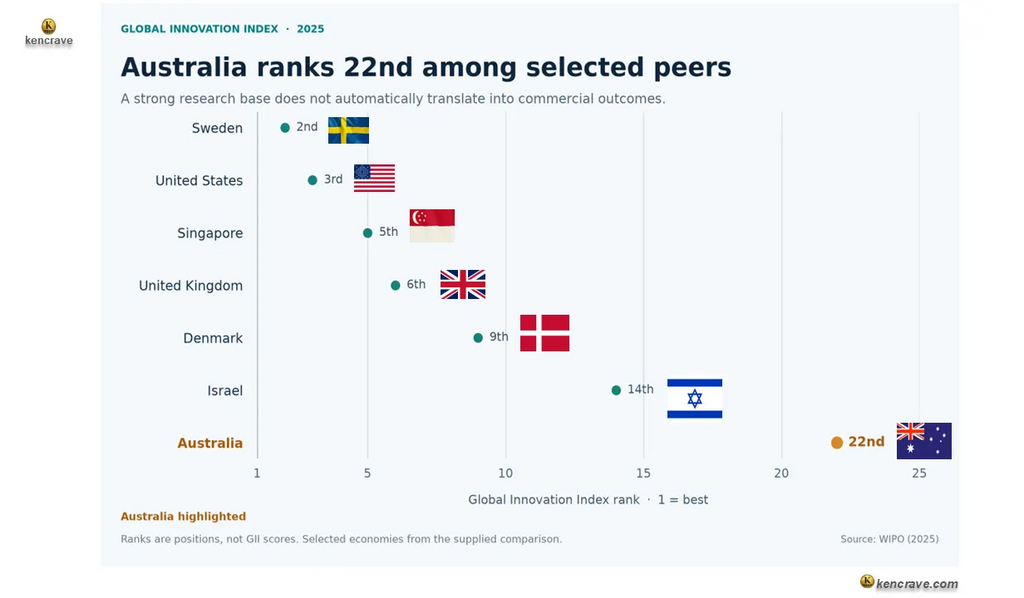
This innovation gap is a clear indication as to why state initiatives like Queensland's $180.6 million Sovereign Industry Development Fund or Western Australia's $348 million Future Health Research and Innovation Fund exist.
State governments are attempting to step in and fund the downstream, high-cost commercial manufacturing infrastructure (like mRNA facilities and isotope plants) to bridge the missing link between world-class laboratory research and scaled local manufacturing.
Australia vs. US and UK: Research Translation and Commercialization
The US and UK make substantial investments in translational medical research capacity.
The UK has built dedicated research translation centres with a stronger workforce development focus than Australia. The UK's "Golden Triangle" (London, Cambridge, Oxford) hosts twice as many biotech startups as Australia (Haystack Science, 2025).
Australia
It produces 3% of the world's research despite having only 0.3% of the global population. Its MedTech market is valued at $8.5 billion, but less than 4-5% of spending goes to locally manufactured products (DHCRC, 2025).
Australia's Venture Capital Gap in Life Sciences
The US captured about 60% of global high-value VC deal volume and nearly 80% of total value in Q1-Q3 2025 (Global Data, 2025). This was largely driven heavily by massive mega-rounds in artificial intelligence such as OpenAI's historic multi-billion-dollar financing and Anthropic's multi-billion rounds.
Singapore and the UK were also among the top 10 markets.
Australia: Lacks comparable scale and depth in venture capital for life sciences.
Australia's Biotech Startup Gap: One Financed Preclinical Startup in 2025
According to a 2025 analysis by Haystack Science, the US continues to lead other countries in financed preclinical biotech startups. It has almost an order of magnitude more than any other nation. Israel and Denmark each hosted two or more startups in this category.
Australia hosted just one.
Implications for Australia's HealthTech Sovereignty
Australia has strong research capability but lags behind these nations in translation and commercialisation. The UK and US have built more mature research translation workforces. The US and UK have stronger venture capital ecosystems for life sciences.
Australia's procurement system remains a key barrier, with little local adoption despite strong innovation output (DHCRC, 2025).
Australia's HealthTech TOWS: Challenges, Opportunities, Threats, and Risks
The Translation Gap: Why Australian Innovations Struggle to Reach Patients
The "valley of death" continues to claim promising Australian innovations. The clinical evidence catch-22 remains a defining barrier. The innovators need clinical evidence to secure funding but need funding to generate that evidence. Funding gaps at the translation stage are so severe that the sector experiences two distinct "valleys of death", one during pre-clinical development and another at the end of clinical development (Research Australia, 2023).
AI Sovereignty and Geopolitical Risks in Australian Healthcare
Australia risks becoming a hostage to geopolitics if AI systems controlled by overseas technology giants become embedded in healthcare foundations. This vulnerability mirrors Australia's lack of sovereign vaccine manufacturing during COVID-19, a constraint that severely limited the nation's ability to secure and deliver vaccines (NRFC, 2025).
Global hyperscaling companies are seeking to become the de-facto front door through which consumers manage their health. If Australia fails to establish sovereign control over AI models underpinning health services, decisions made overseas could disrupt access to those services.
Investment Gaps Threatening Digital Health Growth
Access to capital remains a critical barrier. The vast majority of digital health SMEs cite access to capital as a top challenge, with over half ranking it their single biggest barrier (ANDHealth, 2026). ANDHealth's FY2026 Industry Sentiment Survey notes that despite digital health growing at over 50 percent compound annual growth since 2018, many companies are being forced into defensive strategies, including layoffs and paused expansion plans. Commercialization support programs are in such high demand that only a small fraction of applicants secure places, demonstrating the intensity of the need.
R&D Tax Policy Uncertainty and Its Impact on Medical Innovation
Proposed limits on the refundable R&D tax incentive are particularly concerning, as medical product development routinely takes well beyond ten years, with some estimates averaging around 17 years from discovery to market (Research Australia, 2023). The government has previously acknowledged this reality. However, policy settings continue to reflect shorter timeframes that do not align with the realities of medical innovation.
Funding Fragmentation and the Sustainability Problem
The gap between strategy and implementation has widened, with one commentator describing the environment as a car with no fuel (Xestro, 2026). One-off grants create ghost integrations resulting in features that are technically present but poorly supported or left to age because maintenance brings no commercial return. Once grants end, many software vendors are reluctant to begin new work because they see no path to sustainability beyond the initial build.
Regulatory Bottlenecks and Compliance Pressures
Regulators have struggled to manage emerging technologies like AI scribe products, shifting from education to compliance action after identifying scope creep and weak post-market monitoring. Critical frameworks for leveraging health data remain unresolved, with foundational governance structures still not finalized years after being legislated. This governance vacuum undermines Australia's ability to leverage its most significant health data asset.
The Cost of Inaction: Losing Australian IP to Overseas Markets
The risk of inaction is not neutral. Australia continues to lose its best ideas offshore. Much of Australia's intellectual property moves offshore before early-stage trials, with the nation losing significant value and capability development opportunities. Once IP moves offshore, it is difficult to bring back for domestic production at scale (Research Australia, 2023).
Key Summary: Challenges, Opportunities, Threats and Risks
Challenges:
- Procurement prioritizes cost over value with as little as 5% local content in some health services.
- Two "valleys of death" that is research-to-prototype and evidence-to-procurement.
- Fragmented funding with150+ programs across five federal portfolios.
- Underdeveloped venture capital that is conservative, short-horizon, and less attention to lifesciences.
- Medical research institute funding gap. Victoria 17c vs. NSW 55c vs. Queensland 80c; 10 of 14 Victorian institutes face closure by 2030.
- Regulatory shift. Education-to-compliance shift on AI scribe tools; health data governance unresolved.
- R&D tax misalignment of 10-year limit vs. 17-year development reality.
Opportunities
- $25.4B MRFF endowment can disburse roughly $1.4B annually without eroding principal but currently releases only about $650M.
- $15B National Reconstruction Fund with onshore mandate for medical science.
- Proven accelerator models with AND Health ($19.70:$1), AUScelerate ($47M to $220M), CTCM ($19.75M to $64M).
- Sovereign manufacturing proof point with CSL Seqirus's $1B Melbourne facility.
- Digital health growth: 52% year-on-year since 2019; South Australia up 125% since 2022.
- Global market growth: medicines market to exceed US$2.3T by 2030; medtech to US$0.96T.
- State-level momentum: Queensland's $180.6M Sovereign Industry Development Fund; WA's $348M Future Health Research and Innovation Fund; Sydney Biomedical Accelerator's $143.3M.
Threats
- AI sovereignty loss: Global hyperscalers becoming the de-facto front door to Australian healthcare; decisions made offshore could disrupt domestic access.
- Capital flight: Australian IP moving offshore before early-stage trials; once gone, difficult to repatriate for domestic production.
- Global VC concentration: US captured about 60% of high-value VC deal volume and roughly 80% of value in Q1–Q3 2025.
- Competitor ecosystems: UK's "Golden Triangle" hosts twice as many biotech startups as Australia; Israel and Denmark each hosted 2+ financed preclinical biotech startups vs. Australia's one.
- Loss of sovereign manufacturing capacity. The COVID-19 exposed import dependence; without action, the same vulnerability recurs.
Risks
- Risk of institute closures. 10 of Victoria's 14 independent medical research institutes by 2030 if funding gap persists.
- Risk of continued IP leakage. Each year of delay increases offshore transfer and repatriation becomes harder.
- Risk of AI infrastructure lock-in. Once overseas AI systems embed in clinical workflows, switching costs become prohibitive.
- Risk of accelerator defunding. Time-limited programs end before scaling into permanent infrastructure.
- Risk of policy reversal. The proposed 10-year R&D tax limit could break commercialization momentum mid-cycle.
- Risk of hospital adoption stagnation. Harrison.ai might fail to expand beyond three hospitals, and that limited adoption becomes permanent.
Strategic Recommendations: Building Australia's Sovereign HealthTech Capability
The following recommendations are directed at the specific actors capable of removing the barriers identified in this analysis. Each recommendation is tied to a named barrier, a responsible party, and a concrete first step.
For Federal Government
Reform public hospital procurement to prioritise value over price
Responsible party: Department of Health, Disability and Ageing; Department of Finance.
- Barrier addressed: Risk-averse procurement; 5% local content in some health services (DHCRC, 2025).
- Action: Replace cost-minimisation criteria with value-based procurement that focuses on long-term health outcomes, local industry development, and sovereign capability.
- First step: Embed local content targets in all Commonwealth-funded hospital procurement and require jurisdictions to publish procurement spend disaggregated by local vs. imported content within 12 months.
Develop a national AI in healthcare strategy with genuine sovereign capability
Responsible party: Department of Health, Disability and Ageing; Department of Industry, Science and Resources.
- Barrier addressed: AI sovereignty risk; global hyperscalers becoming the de-facto front door to Australian healthcare.
- Action: Implement the National Policy Roadmap for AI in Healthcare, including investment in privacy-preserving technologies and sovereign compute capacity.
- First step: Define which AI systems constitute critical health infrastructure (e.g., diagnostic algorithms, clinical decision support) and impose data-residency and model-auditability requirements on those systems.
Stabilize R&D tax policy settings to reflect a 10–17-year development timeline
Responsible party: Treasury; Department of Industry, Science and Resources.
- Barrier addressed: Proposed 10-year limit on refundable R&D tax incentive; policy misalignment with medical product development cycles (Research Australia, 2023).
- Action: Abandon the proposed 10-year limit and introduce a separate, longer-horizon R&D incentive stream for medical products.
- First step: Commission an independent review of the R&D Tax Incentive's interaction with the medical product development lifecycle, reporting within 6 months.
Scale and embed successful commercialization programs as permanent infrastructure.
Responsible party: Department of Health, Disability and Ageing; MRFF.
- Barrier addressed: Time-limited, fragmented funding; high demand with low acceptance rates (ANDHealth, 2026).
- Action: Convert proven accelerator models (ANDHealth+, AUScelerate, CTCM) into permanent, recurrently funded programs rather than one-off grant rounds.
- First step: Allocate multi-year funding in the 2027-28 Budget, with a public review of program outcomes every 3 years.
Release MRFF disbursements at a rate consistent with the fund's sustainable capacity.
Responsible party: Department of Health, Disability and Ageing; Future Fund Management Agency.
- Barrier addressed: MRFF balance of $25.4B but annual disbursements of only an estimated $650M, below prior years (Australian Government Department of Finance, 2026).
- Action: Increase annual disbursements toward the PBO-identified sustainable level of est $1.4B without eroding principal.
- First step: Publish a disbursement schedule through 2030-31 showing the path from $650M to $1B annually.
For State and Territory Governments
Coordinate state-level funding and procurement to eliminate fragmentation.
Responsible party: COAG Health Council; state health departments.
- Barrier addressed: 150+ federal funding programs across 5 portfolios plus separate state systems (Universities Australia, 2025).
- Action: Establish a national health innovation coordination framework with agreed state/Commonwealth roles, shared procurement standards, and mutual recognition of clinical evidence.
- First step: Convene a Health Innovation Ministers' Council within 6 months to agree on a single national pathway.
Address the medical research institute funding gap
Responsible party: State treasuries; state health departments.
- Barrier addressed: Victoria's 17c per research dollar vs. NSW 55c and QLD 80c; 10 of 14 Victorian institutes projected to close by 2030 (AAMRI, 2026).
- Action: States should move toward a common per-research-dollar support benchmark, with transitional funding for under-supported jurisdictions.
- First step: Publish a national benchmark for research cost support and a 5-year convergence plan.
For Accelerator Programs and Industry Bodies
Build and publish independent evidence of commercialization ROI.
Responsible party: MTPConnect; ANDHealth; AUScelerate; Research Australia.
- Barrier addressed: Heavy reliance on self-reported and commissioned evaluations; no matched-control studies.
- Action: Commission independent, matched-control evaluations of accelerator programs, and publish failure rates alongside success metrics.
- First step: Establish a common evaluation framework across ANDHealth, AUScelerate, and CTCM, with results published annually.
Maintain coordinated advocacy across peak bodies.
Responsible party: AusBiotech; MTAA; Research Australia.
- Barrier addressed: Fragmented advocacy dilutes policy impact.
- Action: Present a unified industry position on R&D tax settings, procurement reform, and funding mechanisms.
- First step: Establish a joint industry policy council with AusBiotech, MTAA, and Research Australia, meeting quarterly.
For Health Services
Reform procurement teams and embed digital health standards from the outset.
Responsible party: Public hospital networks; state health departments.
- Barrier addressed: Cost-only decision-making; complex procurement requirements that disadvantage local medtech manufacturers (DHCRC, 2025).
- Action: Mandate value-based procurement training for hospital procurement teams and embed interoperability and digital health standards in all tenders.
- First step: Pilot a local SME pitch pathway in at least two public hospital networks within 12 months.
For Technology Providers and SMEs
Prepare for value-based procurement by generating robust clinical and economic evidence.
Responsible party: Individual SMEs; supported by accelerators.
- Barrier addressed: The clinical evidence catch-22 (Research Australia, 2023).
- Action: Engage with commercialisation programs early and design clinical trials to produce both regulatory-grade and health-economic evidence.
- First step: For each product, prepare a health-economic dossier alongside the regulatory submission.
Leverage existing programs and MRFF grant opportunities
Responsible party: SMEs; universities; research institutes.
Responsible party: SMEs; universities; research institutes.
- Barrier addressed: Low awareness of available support; low acceptance rates (ANDHealth, 2026).
- Action: Map all eligible programs at the earliest stage of development and apply to multiple streams where eligible.
- First step: Engage a commercialisation advisor within the first 6 months of development.
For Investors
Develop patient, risk-tolerant capital aligned with the 10-17year development timeline
Responsible party: Treasury; NRFC; superannuation funds.
- Barrier addressed: Underdeveloped VC market; conservative capital; short timeframes misaligned with medical products (Global Data, 2025; Research Australia, 2023).
- Action: Establish long-horizon life-sciences funds with government co-investment, modelled on successful sovereign capability funds in Israel and Singapore.
- First step: Feasibility study for an Australian Sovereign Life Sciences Fund, reporting within 12 months.
Recognize the scale of the opportunity in digital health.
Responsible party: Industry bodies; Austrade.
- Barrier addressed: Capital gap despite 50%+ sector growth (ANDHealth, 2025).
- Action: Increase allocation to digital health within diversified life-sciences portfolios.
- First step: Publish an annual Australian digital health investment outlook to improve visibility for domestic and offshore investors.
Key Takeaways: Australia's HealthTech Translation Gap
- Australia hosts roughly 2,900 life sciences organisations employing one in 60 workers. However, it produces 3% of global research with only 0.3% of the world's population.
- Three accelerator programs have independently demonstrated returns: ANDHealth ($19.70 per $1), AUScelerate ($47M into $220M), and CTCM ($19.75M into $64M).
- Sovereign manufacturing is already proven at scale. CSL Seqirus's $1 billion Melbourne facility, AdvanCell's Thorium-228 plant, and Southern RNA's mRNA facility.
- Victoria contributes 17c per research dollar versus NSW's 55c and Queensland's 80c. 10 of Victoria's 14 independent institutes face closure by 2030.
- Global market opportunity is large. Medicines market is expected to exceed US$2.3 trillion and medtech to reach US$0.96 trillion by 2030 yet the US captured roughly 60% of high-value VC deal volume in Q1–Q3 2025 with Australia hosting just one financed preclinical biotech startup.
FAQs: Australia's Medical Innovation
1. Why does Australia lag in commercializing medical research?
Cost-driven procurement, scarce venture capital, fragmented funding, and R&D tax settings misaligned with a 17-year timeline.
2. What is the MRFF?
Australia's $25.4B medical research endowment, committing $6.5B through 2033-34 and targeting $1B annually by 2030-31.
3. Do Australian healthtech accelerators deliver ROI?
Yes. ANDHealth returns $19.70 per $1; AUScelerate turned $47M into $220M; CTCM turned $19.75M into $64M.
4. Why do local medtech innovations struggle in public hospitals?
Procurement prioritises cost over value; as little as 5% of some health services' spend goes to local products.
5. What is Australia's sovereign HealthTech strategy?
MRFF and NRFC investment, sovereign manufacturing, procurement reform, R&D tax stability, and a national AI in healthcare strategy.
Sources and References
This analysis report relies on a mix of government reports, industry body publications, accelerator evaluations, consultancy analyses, and media releases.
- Association of Australian Medical Research Institutes (AAMRI). "Medical Research Institutes Funding Brief." AAMRI Report, 2026.
- AMRI VIC. "Victorian Support for Victoria's Independent Medical Research Institutes Still Trailing All Other States and Territories." Media Release, May 5, 2026.
- ANDHealth. "State of the Digital Health Industry Report." ANDHealth Report, 2025.
- ANDHealth. "FY2026 Industry Sentiment Survey." ANDHealth Report, 2026.
- AUScelerate National. "$220 Million Unlocked: AUScelerate Initiative Powers New Heart and Diabetes Innovations Toward Patients." July 30, 2026.
- Austrade & AusBiotech. "Life Sciences in Australia: Industry Capability Report." Austrade Report, 2025.
- Australian Government Department of Finance. "Medical Research Future Fund." 2026.
- Australian Government Department of Health and Aged Care. "MRFF 3rd 10-Year Investment Plan 2024-25 to 2033-34." Government Report, 2024.
- Australian Government Department of Health and Aged Care. "High-Tech Vaccine Plant Opens in Melbourne." Media Release, December 2, 2025.
- Australian Government Department of Health and Aged Care. "About the MRFF." 2026.
- Australian Industry Group. "Date Before You Get Married: When It Comes to Industry Research Collaboration." Ai Group Analysis, 2025.
- AusBiotech. "Annual Report Highlights a Defining Year for Australia's Life Sciences Sector." Biotech Dispatch, 2025.
- BioNSW. "Life Sciences Industry Report." BioNSW Report, 2025.
- Biotech Dispatch. "Medtech Pipeline Accelerates as Report Showcases Translation Success of MTPConnect-Backed Innovators." December 4, 2025.
- Breakthrough Victoria. "Navi Medical Technologies Secures FDA Clearance." 2025.
- CB Insights. "ANDHealth— Investments." CB Insights Report, 2024.
- CBRE. "Global Life Sciences Atlas: Melbourne Market Profile." CBRE Analysis, 2025.
- CSL Seqirus. "World-Class $1bn Vaccine and Antivenom Manufacturing Facility Opens in Melbourne." Press Release, December 2, 2025.
- Digital Health CRC. "Smarter Procurement: The Missing Link in Australia's Digital Health Future." DHCRC Report, 2025.
- 4DMedical. "4DMedical's CTVQ Receives FDA 510(k) Clearance: First and Only Non-Contrast VQ Imaging." September 4, 2025.
- FREOPP. "World Index of Healthcare Innovation." FREOPP Analysis, 2024.
- Global Data. "US Dominates High-Value VC Investments H1 2025 Globally." Global Data Analysis, 2025.
- Haystack Science. "The Needle Issue 22." Haystack Science Analysis, 2025.
- Health Services Daily. "AUScelerate Claims $220m Investment Boost from $47m MRFF-Backed Accelerator." August 9, 2026.
- IQVIA Institute. "Global Medicine Use Trends 2026." IQVIA Institute Report, 2026.
- LaunchVic. "Victorian Life Sciences Factsheet." LaunchVic Report, 2025.
- LaunchVic. "Sector Analysis." November 21, 2025.
- L.E.K. Consulting. "Global Consultancy Firm L.E.K. Consulting Backs ANDHealth to Put Real Numbers Behind Australia's Digital Health Impact." Press Release, January 20, 2026.
- Mordor Intelligence. "Global Medical Device Technologies Market." Mordor Intelligence Report, 2026.
- Medical Technology Association of Australia (MTAA). "Clinical Translation and Commercialisation Medtech Program." MTAA Report, 2025.
- MTPConnect. "Driving Australian Medtech Innovation Success." MTPConnect Report, 2025.
- Navi Medical Technologies. "Navi Raises $6.8 Million to Commercialise Breakthrough Paediatric Technology in the US." 2026.
- National Reconstruction Fund Corporation (NRFC). "What Are NRFC's Priority Areas and Why Do They Matter?" NRFC Report, 2025.
- Parliament of Western Australia. "Hansard Daily: Estimates." May 20, 2026.
- Praxis Global Alliance. "Medical Technology Market Outlook." Praxis Global Alliance Report, 2026.
- Queensland Government. "Sovereign Industry Development Fund Announcements." Queensland Government Report, 2025.
- Research Australia. "Pre-Budget Submission 2023-24." Research Australia Report, 2023.
- Sydney Biomedical Accelerator. "NSW Government Funding for Biomedical Research Complex Announced." 2022.
- The Sydney Morning Herald. "Robotics, Medical Science, Renewables: Labor Moves on $15bn Pledge to Revive Manufacturing." November 27, 2022.
- Universities Australia. "150 Programs, 12,000 Scientists: Short Research Reform Critical to Lift National Productivity." Universities Australia Analysis, 2025.
- University of Western Australia. "Funding Boosts Trials of Innovative Breast Cancer Imaging Technology." February 2026.
- Western Australian Government. "Future Health Research and Innovation Fund — State Budget 2026-27." WA Government Report, 2026.
- World Intellectual Property Organization (WIPO). "Global Innovation Index 2025: Australia." WIPO Analysis, 2025.
- Xestro. "Industry Commentary on Digital Health Sustainability." Xestro Analysis, 2026.