
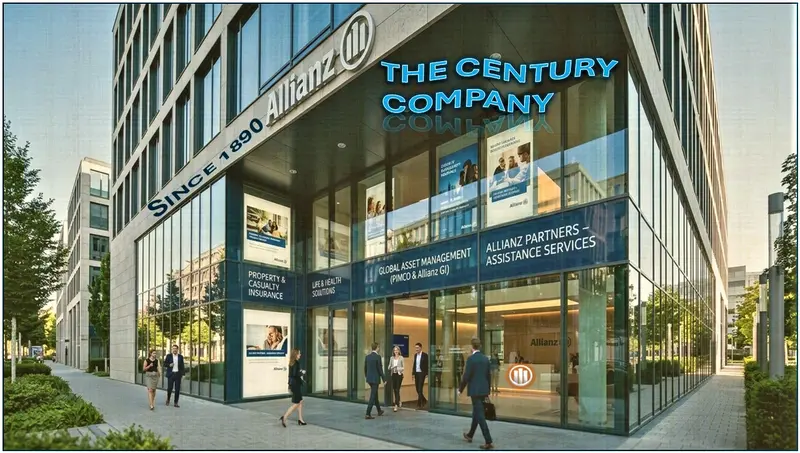
A Modern Allianz headquarters exterior showcasing “Since 1890” heritage and “The Century Company” branding global insurance and asset management leader in a sleek glass building. Image Credits: Kenneth Njoroge via Kencrave
Europe
This analysis offers a different way of looking at Allianz. It steps back to examine strategic choices made over 135 years, and how those choices shape what comes next. Allianz is in the middle of a significant transformation. It has modernized its operations, strengthened its asset management capabilities, and reshaped its global footprint. These moves follow a clear logic with strategic implications for the company.
We look at what Allianz is doing, why now, and what it signals about the future of the entire insurance and asset management industry.
The Leaders Behind the Legacy
The Allianz story cannot be told without understanding the individuals who have shaped its direction. The company was founded in Berlin in 1890 by Carl von Thieme and Wilhelm von Finck, a reinsurance expert and a banker who together built a company that would outlast them both.
From those early days, a remarkable pattern emerged. Over more than a century, one leader followed another, each inheriting a company shaped by those before them and passing on a stronger institution to those who followed.
From those early days, a remarkable pattern emerged. Over more than a century, one leader followed another, each inheriting a company shaped by those before them and passing on a stronger institution to those who followed.
From guiding the company through two world wars and economic depressions, to transforming it into a global powerhouse, to navigating modern digital and sustainability challenges, Allianz's leadership has consistently demonstrated one defining characteristic. The thread of continuity that runs through the company's entire history is perhaps its most distinguishing feature.
What This Report Analysis Reveals
The analysis compares Allianz directly with its major rivals, including AXA, Zurich Insurance Group, Generali, Ping An, and Munich Re. These comparisons help explain why some competitors have pulled ahead while others have struggled to keep pace with Allianz as an insurance titan.
You will learn which business segments quietly fund the rest of the company and which bets could fail.
What Makes This Analysis Different
This analysis takes a longer view with projections based on various scenarios. It also traces Allianz from its founding in Berlin in 1890 through major events such as wars and economic depressions, and regulatory shifts. It asks how the company survived when so many others failed.
What You Will Find Inside
The analysis covers Allianz's core business segments: Property-Casualty insurance, Life and Health insurance, and Asset Management. You will learn which business segments quietly fund the rest of the company. Which bets could fail. And why Allianz walked away from banking after acquiring Dresdner Bank. You will also see specific price levels where the stock becomes a bargain.
As of May 2026, Allianz's share price was €380 - €389
As of May 2026, Allianz's share price was €380 - €389
Allianz’s performance from 2023 to 2025 has significantly exceeded its long-term averages, driven by higher investment income, disciplined underwriting, and operational efficiency. The analysis revelation to the long term investors: the company offers a stable 4.5%–5% dividend yield supported by ongoing multi-billion-euro share buybacks.
Who Should Read This Report
Whether you are an investor, a business leader, a strategist, an actuary, or simply a careful observer of global financial institutions, this analysis will provide fresh perspective.
It does not assume you already know the insurance industry inside out. It explains every bit of Allianz as a global titan in the insurance industry, treating you as a thoughtful business reader, not a trader looking for a hot tip.
This comprehensive strategic analysis will be released on a later scheduled date.